
Seawater RO membranes typically achieve 35–40% recovery, whereas brackish-water RO commonly runs at 10–16 bar [S5][S7].
The comparison covers membrane performance, feed pressure, recovery, energy demand, fouling control, capital cost, and replacement strategy for municipal, industrial, and wastewater-reuse projects [S3][S7].
Select the membrane by feed salinity and recovery target
Feed salinity and required recovery determine the practical membrane class: seawater RO is built for high osmotic pressure, while brackish-water RO uses a different membrane design because the feed contains fewer dissolved salts [S5][S7]. Brackish-water RO is commonly specified at 10–16 bar, or 150–230 psi, using membranes developed for the lower-pressure environment [S7].
Seawater systems face a different scale of concentration and fouling challenge.
Compare rejection, pressure, recovery, and fouling risk
SWRO can be screened using a salt-rejection range of 99.5–99.8% [S4].
BWRO operates at lower feed salinity and can concentrate hardness and silica as recovery increases [S3][S7].
Do not select on purchase price alone

The selected membrane must fit the feedwater and the required permeate quality, not the lowest quoted element price. One SWRO selection study reports that incorrect membrane selection can cause a 30–50% system-performance decline, more frequent cleaning cycles, higher energy use, and premature replacement [S4].
For SWRO, compare at least five items: salt rejection, operating pressure, feedwater fouling risk, cleanability, and total cost of ownership. The same source sets a practical salt-rejection range of 99.5–99.8% and identifies membrane area, energy consumption, and operating pressure as linked capital and operating-cost decisions [S4].
The membrane-bioreactor is a different process class and should not be substituted into an RO comparison, but its upstream solids-removal principles reinforce the need to control suspended material before any desalination train [S3].
Match pretreatment to the dominant failure mode
These are feedwater limits for the cited seawater application, not universal acceptance criteria for every RO installation. The operating objective is to prevent organic fouling, biofouling, and mineral scaling from overriding the membrane’s salt-rejection performance [S4].
Seawater systems should therefore evaluate media filtration or equivalent solids control, antiscalant strategy, biological stability, oxidant control, and cleaning compatibility before membrane selection is frozen.
BWRO pretreatment depends on the source water. Hardness and silica determine scaling risk, while increasing recovery increases the concentration of dissolved species reaching the membrane [S3][S5]. A bag filter can protect downstream equipment from discrete particulate, but it is not a substitute for dissolved-scale control or fine pretreatment in either RO class [S3].
Apply the selection rules to common applications
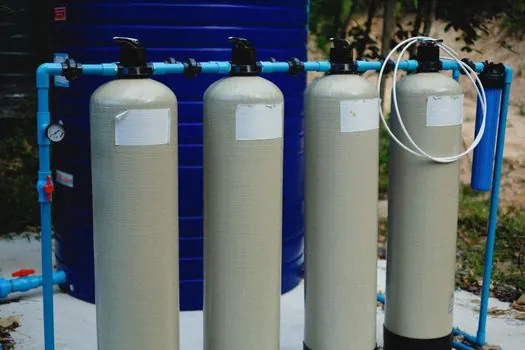
For municipal seawater desalination, screen SWRO elements using the general salt-rejection range of 99.5–99.8%, along with operating-pressure and energy-consumption balance, feed-water quality, fouling risk, membrane lifespan, cleanability, and total cost of ownership [S4]. The feedwater limits of SDI below 3, TOC below 2 mg/L, iron below 0.05 mg/L, and no free chlorine provide the cited design basis [S4].
For brackish groundwater or reuse water, start with a BWRO element at 10–16 bar, then calculate recovery against hardness and silica limits rather than accepting 90% recovery by default [S5][S7].
Industrial process water requires the product specification to lead the membrane choice. The cited targets are below 500 mg/L TDS for drinking water, below 50 mg/L for industrial boiler applications, and below 1,000 mg/L for agriculture, with recommended rejections of at least 99.7%, 99.8%, and 99.5%, respectively [S4].
Size the market view around systems, not membrane revenue alone
The global RO membrane market was valued at USD 5.1 billion in 2025, with a forecast of USD 11.5 billion by 2034 and a 9.40% CAGR for 2026–2034 [S1]. A separate estimate values RO membranes at USD 3.73 billion in 2024 and projects USD 5.11 billion by 2029, a 6.5% CAGR for 2024–2029 [S2]. The differing values reflect different market boundaries, so procurement teams should distinguish membrane revenue from complete desalination-system value.
The broader membrane-based desalination systems market was valued at approximately USD 11.4 billion in 2025 and forecast at USD 25.2 billion by 2034, a 9.2% CAGR [S3]. That scope includes membrane elements, pressure vessels, UF and MF pretreatment, high-pressure pumps, energy-recovery devices, controls, and post-treatment, making it more useful for plant-capital planning than a membrane-only market figure.
Seawater and brackish-water desalination as a combined market was estimated at USD 22.42 billion in 2025 and projected at USD 42.12 billion by 2034 [S8]. These figures include desalination beyond membrane elements, so they should not be added to membrane or system estimates. They are directional market measures, not engineering price quotations.
Verify performance before issuing the purchase specification

Before procurement, require the supplier to state test conditions for salt rejection, normalized permeate flow, pressure, temperature, and recovery. The SWRO selection target of 99.5–99.8% rejection is useful for screening, but membrane data sheets must be compared at equivalent conditions; otherwise, a higher quoted rejection does not establish superior life-cycle performance [S4].
Request a complete mass balance covering feed flow, permeate flow, concentrate flow, recovery, pressure, and calculated kWh/m³. Also obtain cleaning compatibility, storage limits, element dimensions, pressure-vessel certification, and replacement assumptions. Track rejection decline, normalized flux, differential pressure, cleaning frequency, and actual specific energy consumption once commissioning begins, because these operating signals determine whether the selected membrane class remains economically sound.