
American Standard S-shape beams cover S3x5.7 through S24x121 with tapered flanges designed for lighter structural loads, while W-shape wide-flange beams span W4x13 to W44x335 with parallel flanges for high-capacity commercial framing, per the ASTM A6 designation system [S3][S5].
The two shapes share a rolled-steel I-family origin but diverge sharply on flange geometry: S-shapes taper from a thicker root near the web to a thin edge, whereas W-shapes hold constant flange thickness across the full width [S1][S6]. That single geometric difference drives every downstream decision on capacity, connection detailing, and unit cost.
Flange geometry and rolling standard
S-shape beams use a sloped inner flange face with a generous fillet radius at the web junction, producing the classic "American Standard I-beam" silhouette that has been rolled for over a century [S1]. W-shape beams carry parallel inner and outer flange faces with a near-square fillet, which is the geometric feature that gives them higher lateral stiffness for a given depth [S6]. Both families are dimensioned under ASTM A6/A6M, and the S-shape section tables list depth in inches plus weight in pounds per foot, for example S12x50 denoting 12 in depth at 50 lb/ft [S5]. The W-shape designation follows the same convention, so a W6x25 is roughly 6 in deep at 25 lb/ft, with the actual depth listed in the A6 table rather than the nominal number [S4].
Size range and weight per foot
S-shape production cuts off at S24x121, which tops out near 121 lb/ft (about 180 kg/m), while W-shape production now extends to W44x335, with the heaviest standard W-shape weighing roughly 335 lb/ft (about 498 kg/m) [S3]. At the light end, S3x5.7 is one of the smallest hot-rolled sections still produced, useful for lintels and trailer cross-members, whereas the smallest standard W-shape, W4x13, already carries a wider 4 in flange suitable for bolted end-plate connections [S3]. The W-shape family also offers intermediate weights at every depth, such as W12x40, W12x45, W12x50, and W12x58, giving designers a much finer weight gradient to match a calculated moment demand without oversizing [S4]. S-shape tables offer fewer weights per depth, so matching an exact required section modulus often forces the specifier to step up to the next heavier S-shape.
Section properties: stiffness, moment capacity, and weight efficiency
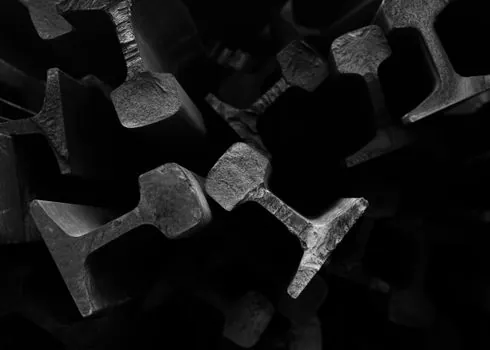
Comparing a representative mid-range section, a W12x40 has a depth of 11.94 in, flange width of 6.56 in, web thickness of 0.295 in, flange thickness of 0.515 in, cross-sectional area of 11.7 in^2, and elastic section modulus Sx of 51.9 in^3 at 40 lb/ft [S4]. For an S-shape in the same depth class, S12x31.8 has a depth of 12.0 in, flange width of 5.00 in, web thickness of 0.350 in, flange thickness of 0.544 in, and Sx of 36.0 in^3 at 31.8 lb/ft, meaning the W-shape delivers roughly 44 percent more bending capacity per pound of steel in this comparison [S5]. That gap widens at larger depths: W24x84 with a 24.1 in depth and 84 lb/ft reaches Sx = 196 in^3, while the heaviest S-shape at S24x121 with the same nominal depth carries Sx in the same order but at 44 percent more self-weight [S4][S5]. The parallel flange of the W-shape also raises the weak-axis moment of inertia Iy by a factor of roughly 2 to 3 over the S-shape at comparable depth, which is what makes W-shapes behave better under lateral-torsional demands on long unbraced spans.
Selection criteria: when S-shape still wins
The S-shape tapered flange has not been rendered obsolete; the geometry concentrates material near the web, which is exactly where bending stress peaks, so for short, heavily loaded flange surfaces such as crane trolley rails, the S-shape's thick root distributes wheel load into the web more gradually [S1]. Steel service centers also stock S-shapes for renovation work where matching the existing tapered flange profile avoids shimming or custom-bolted clip angles [S3]. For gantry crane runways and light industrial mezzanines, an S-shape in the S6x12.5 to S12x50 range is routinely specified, with the designation telling the fabricator depth, weight, and bolt-hole pattern in one line [S3]. Connection detailing is another S-shape advantage in certain configurations: the sloped flange face provides a natural seat angle bearing surface without the need for stiffener plates, an economy that the parallel W-shape flange does not offer [S1][S6].
Selection criteria: when W-shape is the correct call

W-shape beams are the default for multi-story commercial framing, warehouse headers, bridge girders, and any application where span length, deflection limit, or weak-axis bending controls the design [S3]. The parallel flange simplifies welded and bolted end-plate moment connections, which is why seismic moment frames in the US almost universally specify W-shapes rather than S-shapes. For column loads, the heavier W14x90 to W14x730 range and the W12x40 to W12x336 range are commonly used, with the W14 series offering cross-sectional areas up to roughly 215 in^2 in the heaviest sections [S4]. W-shapes also offer the deepest stock sections, up to W44x335 at 44 in nominal depth, which no S-shape can match, and that depth is what allows 60+ ft clearspan roof framing without intermediate columns [S3][S4].
Connection detailing and fabrication differences
Bolted shear connections behave differently on the two shapes. On an S-shape, standard clip angles bear against the sloped flange face, so the bolt group sees a small eccentricity that must be checked in the connection design. On a W-shape with parallel flanges, the clip angle seats flat, and the bolt group acts in single-plane shear, simplifying the AISC Steel Construction Manual checks [S6]. For welded moment connections, the W-shape's constant flange thickness eliminates the need to shim or slope the weld groove to match a tapered surface, reducing fit-up labor on the shop floor. The S-shape's tapered flange, by contrast, requires the welder to either bevel the plate to match the slope or accept a variable-thickness fillet weld, neither of which is preferred on production tonnage.
Cost, availability, and lead-time signals

W-shape beams are produced in far larger tonnage than S-shapes because the parallel-flange rolling process feeds directly into the same mills that supply the structural framing market at scale, so W-shapes are typically available next-day from regional service centers in common sizes such as W8x18, W10x30, W12x40, and W14x53 [S3]. S-shapes are still stocked in popular sizes such as S3x5.7, S4x7.7, S6x12.5, S8x18.4, S10x25.4, S12x31.8, and S12x50, but the mill heat frequency is lower, so non-stock S-sizes often carry a 4 to 8 week mill-rolling lead time and a per-ton premium over equivalent W-shapes. For projects where schedule and connection labor dominate the budget, the W-shape almost always wins on total installed cost; for projects where the tapered flange is a true engineering requirement, the S-shape premium is unavoidable.
Comparison matrix for the specifier
Stacking the two families on the criteria that drive a beam choice: flange geometry, S-shape is tapered with a 2:1 to 2.5:1 thickness ratio from root to tip, while W-shape is parallel with a uniform thickness [S1][S6]. Size range, S-shape runs S3x5.7 to S24x121, W-shape runs W4x13 to W44x335, so W-shape covers roughly 2.5 times the depth span and 3 times the maximum unit weight [S3]. Bending efficiency at 12 in depth, S12x31.8 delivers Sx = 36.0 in^3 at 31.8 lb/ft, W12x40 delivers Sx = 51.9 in^3 at 40 lb/ft, so the W-shape carries about 27 percent more moment per pound of additional steel [S4][S5]. Best-fit use cases, S-shape for crane rails, mezzanines, renovation matching, and short flange-loaded spans; W-shape for long-span commercial framing, moment frames, bridge girders, and column sections [S3]. Connection economy, S-shape favors seated-angle bearing connections, W-shape favors welded and bolted end-plate moment connections [S1][S6].
For a typical 30 ft clear-span roof beam carrying 80 psf total load, an engineer will usually select a W-shape in the W16x36 to W21x50 range; for a 20 ft runway beam supporting a 2-ton overhead crane, an S-shape in the S8x18.4 to S12x31.8 range is the conventional call. Confirming the rolled section against the project's ASTM A6 project specification and the AISC 360 chapter F flexural requirements is the last gate before releasing the order [S4][S5]. Specifiers working on heavy civil or foundation piling should also evaluate the HP (H-pile) family, which runs HP8x36 to HP18x204 and is a separate W-shape derivative with equal-width flanges tuned for axial driving loads [S3].
Spec-level background on the components involved: pressure transmitter, flow meter, and industrial valve.
This topic is covered further in Rebar Bender Rental vs Purchase: A Short-Project Decision Guide.