
High visibility work gloves use fluorescent colors and reflective accents to make hand signals more recognizable in low-light or high-traffic settings [S1][S2].
For traffic control, construction, and material-handling crews, the best glove combines visible hands with the cut, puncture, impact, weather, and grip protection required by the task [S2][S4].
Visibility Must Cover the Signaling Hand
Fluorescent materials commonly use neon yellow, orange, or lime green, while reflective tape or stitching adds conspicuity when directed light reaches the glove [S4]. Dark work gloves can blend into equipment, vehicles, and shadowed work areas, making the position and meaning of a signal harder to read [S2].
For signaling, fluorescent coverage should cover enough of the hand to keep the fingers and arm movements visible in daylight and low-light conditions [S4]. Contrasting or high-visibility palms are particularly useful when the signaler rotates the hand or presents the palm toward approaching traffic [S2].
Reflective material improves recognition under directed light, but it does not replace fluorescent color for daylight conspicuity [S4]. Moisture presents a challenge for high-visibility work gloves, so wet-weather selection requires attention to the reflective material and fabric construction rather than color alone [S4].
Match the Glove to the Signaling Task
Roadway crews, crane operators, spotters, survey teams, and warehouse traffic controllers need gloves that remain visually distinct while preserving controlled hand movement [S2][S6]. A high-visibility glove becomes useful only when the wearer can form, hold, and repeat the required signal without losing grip or tactile control.
The visible exterior is one part of the specification. Fluorescent work gloves may also be combined with cut, vibration, impact, and puncture protection, and some products use contrasting palms or black-and-high-visibility construction [S2][S3]. The Mechanix high-visibility range included 22 products, with listed promotional prices from $6.99 to $43.39 in the reviewed results [S3].
Material handling adds another requirement. The hands must remain visible while carrying planks or controlling tools, but the palm also needs sufficient friction and wear resistance for the material being handled [S7]. Bright color cannot compensate for a glove that slips, tears early, or prevents the signaler from making a precise gesture.
Compare Fluorescent, Reflective, and Contrast Designs
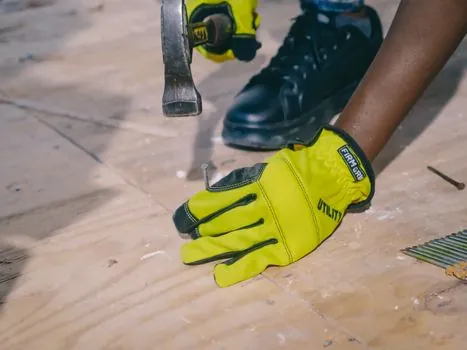
The principal design options are fluorescent-dominant gloves, reflective-accent gloves, and mixed-color gloves with fluorescent or contrasting palms. Each option addresses a different visibility condition, so the strongest choice depends on lighting, traffic exposure, and the physical hazards present. [S1]
High-visibility gloves are for crews whose hands must function as visual signals, particularly around moving traffic, plant, and equipment [S6]. They are not a substitute for vehicle-control procedures, radios, barriers, lighting, or trained traffic-control personnel. They are also not automatically chemical, heat, or electrical protection.
Test Comfort, Dexterity, and Wet-Weather Performance
Breathable back-of-hand materials and quick-drying liners can move moisture away from the skin while preserving the fluorescent exterior, reducing the likelihood that workers remove gloves or work without them [S4].
Waterlogged gloves can become heavy, reduce finger movement, and contribute to hand fatigue [S4].
Fitting checks should include finger closure, palm contact, signal repetition, tool handling, and sustained wear. Testing with the same gestures used on site exposes a poor palm grip or limited wrist motion that a color sample cannot reveal. For broader PPE selection, the safety gloves reference provides a useful framework for matching protection to the task.
Resolve Visibility Against Mechanical Protection

Cut resistance, impact protection, puncture resistance, vibration damping, and chemical exposure must be evaluated separately from visibility. A roadway or construction assessment should identify sharp materials, falling objects, swinging tools, rebar or nails, and chemical contact before selecting a glove [S4].
Full-hand fluorescent coverage offers more visible area, but it can reduce the surface available for a specialized palm coating. Back-of-hand fluorescence combined with a conventional palm may provide enough conspicuity while preserving grip, but that conclusion depends on the work zone and signal distance [S4].
Ironclad organizes its high-visibility gloves within a broader catalog that includes cut-resistant, impact, vibration-damping, waterproof, cold-condition, chemical-resistant, and leather-palm categories [S5]. This range illustrates the practical distinction: visibility is one performance attribute, while mechanical and environmental protection remain separate product choices.
Specify Visibility by the Work Environment
A three-stage specification is practical: evaluate lighting, vehicle speed, weather, and proximity to moving traffic; identify cut, impact, puncture, and chemical hazards; then resolve the visibility-performance trade-off between full-hand fluorescence and a conventional palm [S4].
ANSI/ISEA 107-2020 addresses chromaticity and luminance for high-visibility safety apparel, while fluorescent color and reflective accents address different operating conditions [S4]. Buyers should request the applicable compliance documentation for the complete glove and verify whether it covers the fluorescent material, reflective elements, or the entire product [S4].
Two trackable signals should determine replacement: loss of visible signal definition during a nighttime or wet-weather trial, and deterioration in grip, dexterity, or glove condition after repeated signaling cycles. Those checks connect visibility performance to the actual work rather than package color or model name alone.