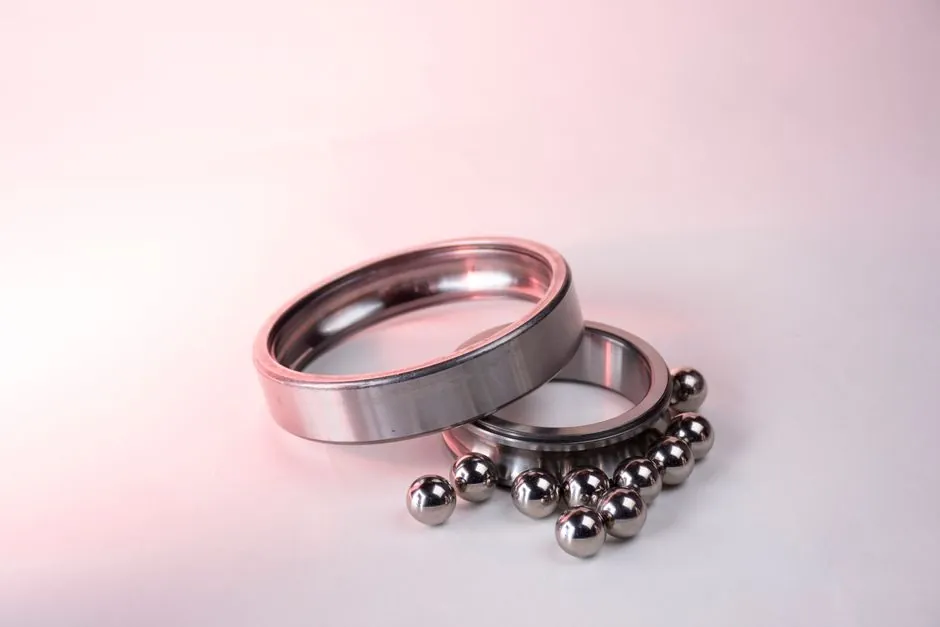
Self-aligning ball bearings (SABBs) accept 3° to 7° of dynamic angular misalignment under normal load conditions, while spherical roller bearings (SRBs) are typically specified for 0.5° under standard service and up to 2° at low load, per NSK, SLF Fraureuth, and Lily Bearing technical data [S1][S2][S5].
The distinction is not academic: the same 50 mm bore envelope carries roughly 20.8 kN dynamic load in a 1210 SABB versus 96 kN in a 22210E SRB, a 4.6× delta that drives the choice between the two [S5]. Engineers specifying self-aligning bearings for shaft-deflection or housing-misalignment duty must read the angle range against load and speed, not as a standalone headline number.
SABB Misalignment: 3° to 7° Dynamic, 0.07 to 0.12 rad Spec Range
NSK publishes the dynamic-misalignment envelope at approximately 0.07 to 0.12 radian, which is 4° to 7° on the angular scale, for SABBs under normal loads, with a caveat that larger angles may not be allowable in every application [S1]. PIBSales and SKF, both citing the same product family, narrow the practical range to 3° to 7° for general industrial use, with SKF's textile-application bearings specifically rated for a maximum of 3° [S4].
The double-row ball geometry with a single concave outer raceway is the mechanism: the inner ring, balls, and cage tilt as a unit against the spherical outer race, allowing the bearing to absorb static skew and dynamic shaft deflection simultaneously [S3][S6]. The contact angle is small, which is why axial load capacity is limited, but the same low contact angle keeps friction down and unlocks the high-speed behaviour that defines the type, reference speeds around 7,500 rpm for a 60 mm bore 1212 SABB [S5].
SRB Misalignment: 0.5° Standard Service, Up to 2° at Low Load
SLF Fraureuth states the operating envelope in two tiers: under normal operating conditions with a circumferential inner ring, SRBs can be swiveled by 0.5° out of central position without limitation, and at low loads and stresses, swiveling angles up to 2° are permissible [S2]. Lily Bearing places the standard-design tolerance at 1.5° to 2°, with some heavy-duty variants reaching 2.5° [S5].
The reason for the lower number is the line contact of the barrel rollers: the longer the contact patch, the more a tilt misloads the roller end and accelerates surface distress. SRB boundary dimensions fall under DIN 635-2 and ISO 15, while tolerances follow DIN 620-2 / ISO 492 and radial internal clearance follows DIN 620-4 / ISO 5753-1 [S2]. The E design (optimised internal geometry, no suffix letter) is now the default for most manufacturers, including SLF, FAG/Schaeffler, and SKF equivalents.
Load and Speed Trade-off: Why the Angle Difference Exists
Two same-bore examples make the trade-off concrete. A 1212 SABB (60 mm bore) carries 25.5 kN dynamic and 10.0 kN static at 0.28 kg; a 22212E SRB (60 mm bore) carries 120 kN dynamic and 105 kN static at 0.90 kg, a 4.7× dynamic-load advantage at roughly 3× the mass and 2–3× the cost [S5]. The SRB also accepts combined radial-plus-axial loads because of the rollers' geometry, while the SABB's small contact angle limits it to mostly radial duty.
Speed goes the other way. The SABB's point contact generates less frictional heat, and the 1212 reference speed of about 7,500 rpm comfortably outpaces the 22212E's roughly 4,300 rpm [S5]. SRBs require oil-bath or forced lubrication to push into higher speed territory; SABBs are happy with grease in sealed-for-life variants, which is why they dominate fans, light conveyor pulleys, and small electric motors where misalignment risk coexists with high rotational speed.
Static vs Dynamic Misalignment: Why the Numbers Are Not Symmetric
Schaeffler's product literature draws an explicit line between static and dynamic angular misalignment, with both compensable within the same bearing envelope [S3]. Static misalignment is the one-time assembly error between shaft axis and housing bore; dynamic misalignment is the running variation caused by shaft deflection under load, thermal growth, or coupling reaction.
For practical installation work, the Lily Bearing field note is the most useful: most SRB installations are designed with misalignment below 1°, because the tolerance is a safety margin, not a design target [S5]. The 0.5° SLF figure for "no limitation" sits in the same zone: it is the long-life design point, not the absolute allowable. For comparison, roller bearing types without self-aligning geometry (cylindrical, tapered roller bearing sets) typically accept only a few minutes of arc, sometimes quoted as low as 2 minutes, which is the gap the self-aligning family was designed to close.
Design and Selection Rules for Specifying the Angle

Three rules of thumb read directly off the data. First, choose the SABB path when speed exceeds 5,000 rpm, axial load is small, and housing alignment is uncertain (textile spindles, fan shafts, small motor shaft ends); the 3° envelope is the working number, with 7° as the absolute ceiling under light load [S4][S5]. Second, choose the SRB path when radial load dominates, combined loading is expected, and the shaft will deflect more than a few tenths of a degree under operating load; the 0.5° design point holds for full rated life, with 2° reserved for lightly loaded service [S2][S5].
Third, regardless of type, the published angle is not a target. SKF and NSK both note that running at the maximum angle shortens life, increases friction, and in the SRB case can drive edge-loading on the rollers [S1][S6]. The bearing should be used to absorb residual misalignment after the best practicable shaft and housing alignment has been achieved, not to compensate for a sloppy mechanical layout.
Standards, Cage, and Lubrication Anchors
The boundary-dimension and tolerance standards are stable across manufacturers. SRBs follow DIN 635-2 and ISO 15 for boundary dimensions, DIN 620-2 / ISO 492 for tolerance classes (standard PN), and DIN 620-4 / ISO 5753-1 for radial internal clearance (standard class CN) [S2]. SABB boundary dimensions fall under the ISO 15 family as well, with series 12, 13, 22, 23 also offered with a 1:12 tapered bore (suffix K) and complete adapter-sleeve mounting kits (series 12..-K + H, 13..-K + H, 22..-K + H, 23..-K + H) [S3].
Cage material is a real variable in misalignment performance. Schaeffler lists solid PA66 polyamide or brass as standard SABB cages; SLF supplies SRBs with brass as the default [S2][S3]. Brass is the conservative pick where misalignment peaks because it tolerates higher temperatures and survives momentary lubrication loss better than PA66, at the cost of slightly higher friction. Sealed-for-life SABBs (2RS variants) and sealed SRBs (suffix W33 for the oil-feature package plus seals) simplify field service but cap speed at the grease-limited thermal threshold.
For broader procurement context on the bearing-versus-adjacent-component trade-off, see this analysis of structural epoxy versus mechanical fastening for 2026 load-bearing joint design, which covers a different joining decision but applies the same static-versus-dynamic and design-margin logic to mechanical assemblies. Trackable signals for the next design cycle: any revision to ISO 15 boundary-dimension tables for the 240 and 241 SRB series, and any manufacturer move to publish a higher-than-2° SRB misalignment rating as a standard (not special) option.