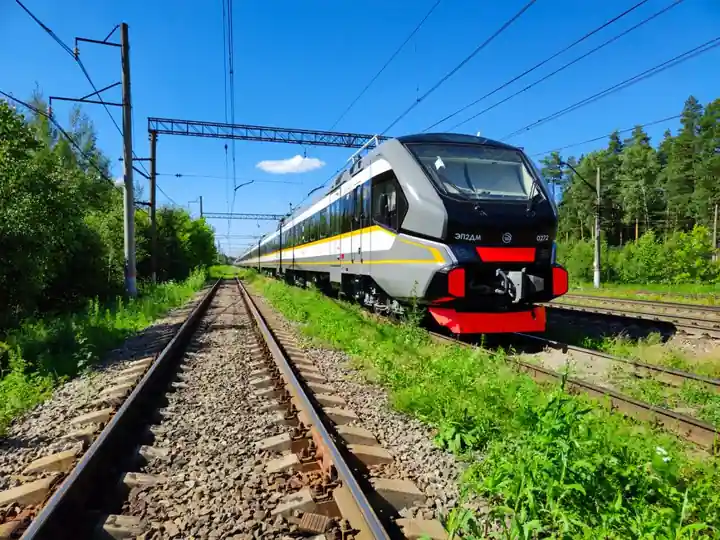
A sealed pre-adjusted railway axle tapered bearing unit is delivered to the wheelset workshop as a ready-to-mount cartridge, with the rolling elements, seals, grease fill and axial clearance already set at the bearing factory [S4][S6].
The format covers three naming conventions used across the industry: the Cartridge Tapered Roller Bearing (CTRB) specified by RDSO for Indian Railways LHB coaches [S6], SKF's Tapered Bearing Unit (TBU) family [S4], and the Compact TBU (CTBU) derivative that relocates the seal between the inner and outer rings [S2].
What the unit actually contains
A standard TBU consists of two inner rings, one common outer ring, two tapered roller and polymer cage assemblies, a central spacer, a defined grease fill and two sealing systems; lateral spacers, backing rings, end caps and locking devices are added on customer request [S4]. NSK's Sealed-Clean Rotating End Cap variant adds a rotating end cap, cap screws, a locking plate and a seal wear ring specifically to keep the garter seal land clean [S1].
The RDSO CTRB definition is even tighter: a self-contained, pre-assembled, pre-adjusted, pre-lubricated, completely sealed unit applied to or removed from the axle without exposing the bearing elements [S6]. Indian Railways parts are machined from nickel-chromium alloy steels to close tolerance, and are designated "No Field Lubrication" (NFL), meaning they run between two successive POH (Periodic Overhaul) cycles without grease replenishment [S5].
Timken's AP and AP-2 assemblies for rail freight and passenger car journals follow the same logic (self-contained, pre-lubricated), while the lighter Pinion-Pac variant targets light-duty axle and gear assemblies with a pre-set, pre-sealed geometry that locks bearing setting at the factory [S3].
Sealing options and why the compact seal is winning
Two seal families dominate the market. Inch-size AAR freight TBUs still use a garter seal running on a dedicated seal wear ring; AAR has standardised both the seal and the wear ring so components from different bearing suppliers remain interchangeable [S4]. The compact design (CTBU) replaces the separate wear ring with an integrated low-torque seal that combines labyrinth, lip and flinger elements between the inner and outer rings [S2].
The published gain is large and traceable: friction torque drops up to 75% versus a garter seal arrangement, and continuous operating temperature falls by approximately 20°C, which directly extends grease life and cuts energy draw at the axle [S2]. Because the seal wears on the ring itself, the CTBU can drop a spacer or wear ring from the stack, which shortens the required journal length and reduces axle bending [S2]. SKF seal-test data on the same design confirmed water and dust exclusion under long-term endurance conditions [S2]. For more on how sealing, friction and contamination interact in industrial rotating equipment, the entry on tapered roller bearings covers the general tribology.
Steel selection by vehicle duty
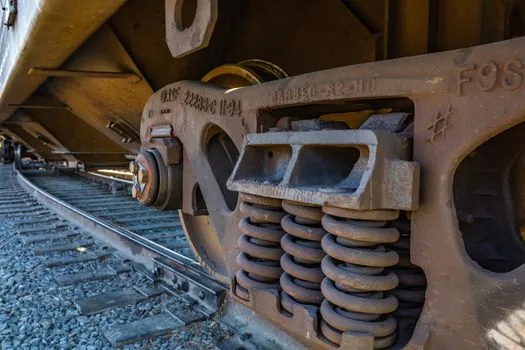
Tapered bearing units were originally developed in the 1950s for North American freight cars to replace plain bearings, and AAR still mandates case-carburised steel for the inner rings, outer rings and rollers of inch-size freight TBUs [S4]. For higher-speed service (locomotives, multiple units, passenger coaches, mass transit, and freight cars with closed axlebox designs), through-hardened steel is widely used, because it is typically cleaner with fewer inclusions and delivers longer endurance under the relevant load spectra [S4].
SKF also offers hybrid TBUs for adapter-style freight applications where the outer ring is exposed: the outer ring is case-carburised, the rollers are through-hardened, and the inner rings are either, depending on the customer spec [S4]. Indian Railways CTRBs use nickel-chromium alloy steels machined to close tolerance, with rollers produced at 14 per row (28 per cartridge) and raceways hardened, ground and honed [S5].
Grease, clearance and why the workshop loses control
The biggest workflow change versus a loose bearing pair is that grease selection, quantity and distribution are decided at the bearing factory, not on the workshop floor [S4]. That matters because under-greasing starves the contact, and over-greasing generates heat that ages the base oil; the original TBU design moves the critical greasing step into a clean room with metered dispense, which is one reason the cartridge format is mandatory for AAR interchangeability [S4].
Pre-adjusted axial clearance is the second big shift. Instead of the workshop setting endplay with shims during wheelset assembly, the cartridge ships with a defined internal clearance, and NSK's end-cap design lets the unit be set and inspected on a fixture rather than inside the axlebox [S1]. Schaeffler's TAROL units are a comparable factory-set, greased and sealed double-row tapered roller bearing package for railway axleboxes [S7]. Bearing inspection and testing procedures for these units are codified in dedicated test documents, including a published method for evaluating the sealing system of a TBU or cartridge taper roller bearing [S8].
Comparison of the three main unit formats
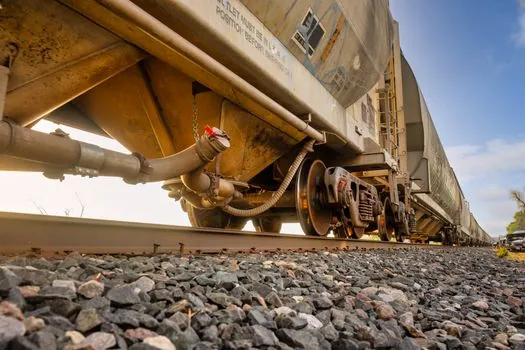
Across the formats, the engineer is really choosing between freight interchangeability, low-friction compact sealing, and high-speed steel cleanliness: [S3]
1) AAR inch-size TBU with garter seal: standardised for North American freight, interchangeable across suppliers, uses case-carburised steel, but carries the highest seal friction and the longest journal of the three [S4].
2) Compact TBU (CTBU) with integrated low-torque seal: friction torque reduced up to 75%, operating temperature around 20°C lower, shorter journal enables stiffer axle design, but no equivalent AAR standardisation [S2].
3) RDSO CTRB (Indian Railways LHB / Casnub bogies): nickel-chromium alloy steel, NFL between POH cycles, removal/installation without exposing rollers, mandatory for the Indian LHB coach fleet [S5][S6].
Timken's AP and AP-2 sit in a similar factory-set, pre-lubricated niche for North American rail freight and passenger journals, with the smaller Pinion-Pac scaled down for light-duty axle and gear packages [S3].
Failure modes and shop-floor handling
The classic cartridge failures are seal-driven, not rolling-contact-driven. Fretting debris from a worn seal land can enter the bearing and accelerate surface fatigue, which is the original problem AAR redesigned away from plain bearings in the 1950s [S2]. Indian Railways service notes make the handling rules explicit: do not unpack until mount, do not drop the unit, remove all transport wedges between the rollers before fitting, and never allow welding current to pass through the bearing (always attach the ground cable at the axle) [S5].
Spherical roller variants on ICF coaches must never be interchanged component-by-component because the radial clearance is set at the factory [S5]. For railway-grade coolant distribution unit or hydraulic power unit skids that share a wheelset or bogie, the same "no field lubrication, no disassembly" rule is applied wherever sealed cartridge bearings are used. A second look at the wider pre-lubricated bearing envelope is also useful when comparing railway CTBUs to other sand reclamation unit rotating machinery, where cartridge philosophy is migrating from rail into foundry equipment.
Standards, sourcing and traceability

For any AAR-spec freight axle, every cartridge component (inner ring, outer ring, rollers, garter seal, seal wear ring) must trace to the AAR standard, and SKF has been AAR-approved for this design since 1977 [S2][S4]. Indian Railways procurement is governed by the RDSO specification that defines the CTRB as a self-contained, pre-adjusted, pre-lubricated, fully sealed unit applied or removed from the axle without exposing the bearing elements [S6].
Sealing-system performance is independently verifiable using the documented test procedure for the seal on a TBU or cartridge taper roller bearing, which covers water exclusion, dust exclusion and torque rise under accelerated contamination [S8]. For related engineering guidance on adjacencies such as zero-leakage process pumps, the mag-drive vs canned motor pump cutover article covers similar cartridge-style integration thinking. On the metallurgical side, the comparison of scalloped, straight-sided and link-type disc packs is a useful reference for engineers who also have to specify case-hardened versus through-hardened parts in gearbox stacks. Process engineers auditing grease and contamination control will find the principles mirrored in the no-bake sand reclamation recovery rates write-up.
The next decision node is the journal length: any rebuild that can accept a 15-25 mm shorter axle end gains stiffness from the CTBU geometry [S2], so a track signal is any tender document published by a major wheelset operator that drops the legacy AAR journal length on closed-axlebox passenger stock. A second signal is the next revision of RDSO's CTRB specification, which historically moves in step with Indian Railways' LHB and Vande Bharat maintenance intervals.