
A self-priming pump is a centrifugal design that can evacuate air from the suction line and establish a liquid seal without a flooded inlet or external priming pump, typically reaching a re-prime height of 4-7 m in the small-frame ZX/BZ class and up to 8-9 m in engineered drainage sets [S2][S7].
The category covers household 0.5 HP units rated 35 L/min at 35 m head, agricultural 4-inch diesel-driven sets in the US$4,700-5,000 range, and SPDW auto-prime dewatering pumps for construction and flood duty, all sharing the same re-prime logic but diverging sharply on materials, solids handling, and driver type [S1][S2][S5].
Working Principle and Where Self-Priming Fits
Self-priming centrifugal pumps use an integrated water reservoir above the impeller; on start-up, mixed air and liquid are re-circulated through a back-flow port until the volute is flooded, at which point the pump behaves as a standard end-suction centrifugal machine [S2]. This makes them the default choice where the suction source sits above the pump (suction lift), where the line must be drained between runs, or where an operator cannot be relied on to prime a pump manually — irrigation, site dewatering, household booster duty, and chemical transfer into atmospheric tanks are the canonical fits.
Inside the broader pump family, a self-priming pump sits between a true centrifugal pump (which loses prime on air ingress) and a positive-displacement pump (which is self-priming by construction but trades flow rate for pressure pulsation). The duty decision is therefore not "self-priming vs. non-priming" alone but "self-priming centrifugal vs. peristaltic vs. diaphragm" for a given solids and viscosity profile.
Variant Comparison: Centrifugal, Jet, Peripheral, and Drainage
Four variants dominate the 2026 catalogue, and the selection logic differs by duty: (1) Standard self-priming centrifugal (ZX/BZ series, e.g. 40ZX15-60) for clean water at moderate head with re-prime capability and stainless/corrosion-resistant mechanical seal options [S7]; (2) Self-priming jet pumps (QB60/QB70/QB80, 0.5-1 HP, 1/2"-1" ports) for shallow-well domestic suction up to ~9 m with a venturi ejector boosting effective lift [S3]; (3) Peripheral (vane) self-priming pumps for high-pressure low-flow niches such as small-scale booster and misting; (4) Auto-prime solids-handling drainage pumps in the SPDW family for construction, mining, and flood duty where the medium carries 10-30 mm solids [S5][S6].
On the criteria that matter for a spec engineer — re-prime time, max solids size, head band, and driver — the four variants line up as follows. Centrifugal (ZX): ~60-120 s re-prime from dry, 5-8 m suction lift, head to 60 m, electric motor [S7]. Jet (QB): 30-90 s re-prime, suction lift to 8-9 m via ejector, head to 40-55 m, electric, sensitive to foot-valve leakage [S3]. Peripheral: fast re-prime, head to 70-80 m at very low flow (1-3 m³/h), limited to clean water [S6]. Drainage (SPDW): re-prime via vacuum priming tank, solids to 20-30 mm, head to 25-30 m, available in diesel-engine driven mobile skid form [S5].
Key Spec Bands and Where to Read the Datasheet
Four numbers decide almost every spec: maximum head (Hmax, m), maximum flow (Qmax, L/min or m³/h), rated suction lift, and solid-handling diameter (mm). The household 220 V/370 W/0.5 HP unit at 1-inch ports hits 35 L/min and 35 m head — a useful benchmark for the small-frame end of the catalogue [S1]. Mid-frame agricultural units (1-3 HP) cluster at 50-80 L/min and 40-55 m, while diesel-driven 4-inch sets move into the 300-800 L/min band at 30-50 m [S2]. Drainage pumps trade head for flow and solids passage; an SPDW-150 class dewatering set typically delivers 150-400 m³/h at 20-35 m with 76-100 mm porting [S5].
Beyond the four headline numbers, verify: (a) seal and construction — the ZX series self-priming pump uses corrosion resistant mechanical seals and stainless steel material [S7]; (b) voltage/frequency — 220 V/50 Hz is specified for the household self-priming pump [S1]. wash-down duty; (d) re-prime time at rated lift, which is the single most common field complaint and the easiest number to fake on a data sheet.
Application Match: Irrigation, Household, Drainage, Chemical
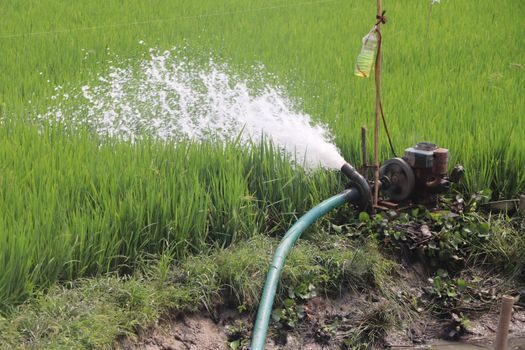
Agricultural irrigation with suction lift from a canal or shallow well is the textbook ZX/QB application: continuous duty, clean water, low-to-moderate solids, electric supply available [S2][S3]. Household booster and roof-tank refill — 0.5-1 HP, 1-inch, 220 V single-phase — is dominated by the 35 L/min × 35 m class, where the failure mode is usually foot-valve loss of prime, not pump capacity [S1].
Dewatering on construction sites, in quarries, or during flood response is the SPDW/auto-prime space, with diesel drive for sites without grid power and trailer-mount for mobility; solids-handling to 20-30 mm is the differentiator [S5]. Chemical and light-industrial transfer (the chemical-water-slurry trio in the Yonjou ZX listing) requires the corrosion-resistant mechanical seal and stainless wetted options on the ZX family; do not use a QB jet pump with chemical service unless the seal elastomer and wetted metal are confirmed for the specific fluid [S2][S7].
Selection Criteria, Failure Modes, and What to Reject

Pick a self-priming pump by working through five gates in order. (1) Fluid: clean water, wastewater with solids size S, or chemical with named compatibility — this kills 60% of candidates immediately because the seal and elastomer are wrong. (2) Suction lift: anything over 7-8 m at sea level wants a jet pump with ejector, not a plain centrifugal self-primer. (3) Solids: zero solids → peripheral or QB; 5-10 mm → standard centrifugal; 20-30 mm → drainage/SPDW with vortex or chopper impeller. (4) Head × flow: cross-check against the pump curve at the duty point, not the Hmax/Qmax pair the catalogue headlines. (5) Drive: electric single-phase for household, three-phase for fixed industrial, diesel for mobile or grid-less sites [S1][S3][S5].
Common failure modes the spec sheet hides: loss of prime after a few minutes of air ingestion (foot valve or shaft seal leak, not the pump itself), cavitation at high suction lift, overheating on dead-head against a closed discharge, and seal failure from running dry. The 2026 catalogue from Taizhou and Ningbo suppliers lists CE, ISO 9001, and on the larger sets EAC and UKCA marks for export; absence of any of these on a 380 V three-phase industrial unit is grounds to reject the quotation [S2][S4].
Sourcing Signals, Standards, and Price Bands
Price spread in 2026 is wide and tracks frame size more than brand: small household 0.5 HP self-primers sit in the US$20-60 band per piece with 100-500 piece MOQs, QB jet pumps in the US$8-30 band at 500-piece MOQs, mid-frame agricultural units at US$30-70, and diesel-driven 4-inch/10-inch mobile sets at US$4,700-5,000 per piece with 1-piece MOQ [S2][S3]. MOQ is therefore a useful proxy for which market tier a supplier actually serves — 500-piece MOQ on a QB jet pump is a high-volume irrigation exporter, while 1-piece MOQ at four-figure pricing is an engineered-set or project bidder [S2][S3].
Standards to require on the datasheet: ISO 9906 (rotodynamic pump acceptance tests) for hydraulic performance, CE Machinery Directive for EU sale, and ISO 9001 for the manufacturer; for chemical service also confirm wetted-material certificates against the named fluid. Payment terms across the major Chinese export channels cluster on LC, T/T, and D/P, with PayPal and Western Union offered for the small-MOQ traders and 1-piece sample orders [S2][S3]. For a buyer evaluating slurry pump price and cost guide: 2026 bands, drivers and TCO the same TCO logic applies — drive 70% of the lifetime cost through seal and energy, not the headline unit price. Track the next sourcing window around the September 2026 Canton Fair phase and watch for ZX-class units with published re-prime curves rather than the bare Hmax/Qmax pair.
Spec-level background on the components involved: linear guide.