A centrifugal pump is a rotodynamic machine that moves liquid by converting the kinetic energy of a spinning impeller into pressure. Liquid enters at the eye of the impeller, is flung outward by the vanes, and is then decelerated in a volute or diffuser, where velocity becomes static head. Centrifugal pumps are the most widely used pump type in industry, covering everything from municipal water supply and building services to oil refining, chemical processing, and power generation.
Unlike a positive-displacement pump, a centrifugal pump produces head that varies with flow along a continuous performance curve. This makes it efficient and self-regulating for clean, low-viscosity liquids, but it also means correct hydraulic selection, suction conditions, and operating range matter more than for any other pump family. This guide explains the types, hydraulics, materials, and specifications an engineer needs to specify one correctly.
Photo: S.J. de Waard, CC BY 2.5, via Wikimedia Commons
This guide is written for industrial purchasing engineers and design engineers. It covers 6 chapters from what a centrifugal pump is, through pump and impeller types, hydraulics and the affinity laws, materials and shaft sealing, spec-sheet decoding, to a structured selection sequence, with 7 selection FAQs. All parameters reference the public construction and dimensional standards ASME B73.1, API 610 / ISO 13709, ISO 5199, ISO 2858, and API 682, along with Hydraulic Institute practice.
Chapter 1 / 06
What is a Centrifugal Pump
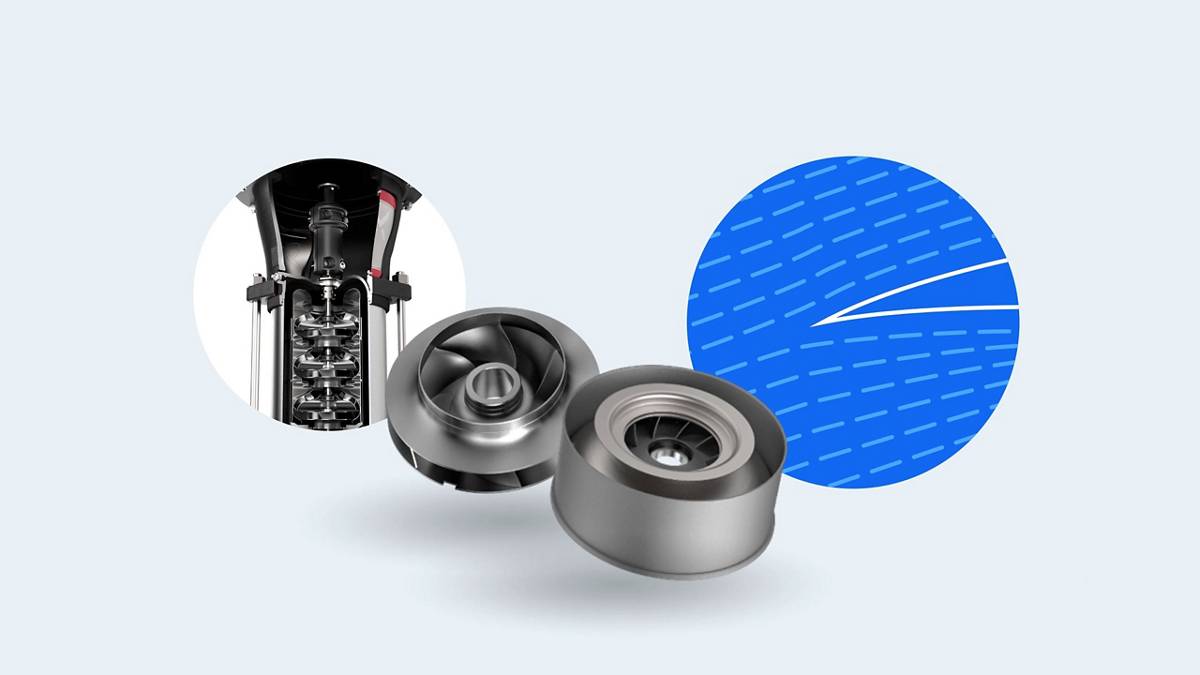
A centrifugal pump is a rotodynamic machine that adds energy to a liquid continuously, by means of a rotating impeller, rather than by trapping and squeezing discrete volumes the way a positive-displacement pump does. The shaft drives the impeller at constant speed; liquid enters axially at the impeller eye, the curved vanes accelerate it radially outward, and the surrounding volute casing or a ring of diffuser vanes slows that high-velocity stream so that the dynamic head converts into static pressure at the discharge nozzle. Everything the pump does follows from this single energy conversion: velocity into pressure.
Because the energy transfer is hydraulic rather than mechanical displacement, a centrifugal pump produces a head that falls as flow rises, tracing a smooth head-versus-flow curve from a maximum at zero flow (shutoff head) down to a maximum flow at zero head. The system it serves imposes its own resistance curve, and the pump runs where the two curves intersect. This self-balancing behavior is the reason centrifugal pumps dominate industry: they tolerate throttling, parallel and series operation, and variable demand without relief valves, provided the operating point stays within the safe band around the best efficiency point.
The physics dates to 1689, when Denis Papin described a straight-vane centrifugal machine, but the practical pump arrived with the curved-vane impeller and the volute casing in the 19th century, and with electric motor drive at the turn of the 20th. Modern hydraulic design adds the diffuser, the double-suction impeller for high flow, and multistage construction for high head. Today centrifugal pumps account for the large majority of all pumps installed worldwide, and the U.S. Department of Energy estimates that pumping systems consume on the order of a fifth of global electric motor energy, which is why hydraulic efficiency and right-sizing carry real cost weight.
Four engineering quantities anchor every centrifugal pump: flow rate (capacity), total head, net positive suction head required (NPSHr), and efficiency at the duty point. A pump that delivers the right flow and head but is starved of suction pressure will cavitate and erode; one selected far from its best efficiency point will vibrate and wear its seals and bearings prematurely. The discipline of selection, covered in Chapter 6, is the discipline of matching all four to the actual system, not just to the nameplate flow and head.
It is worth fixing the boundary against the other major pump family. A centrifugal pump is the right choice for clean, relatively low-viscosity liquids at moderate to high flow, where the head requirement is stable. A positive-displacement pump (gear, screw, diaphragm, peristaltic, metering) is preferred for high viscosity, precise dosing, very high pressure at low flow, or shear-sensitive media. Viscosity above roughly 200 to 500 cSt sharply degrades centrifugal performance and is the classic boundary where engineers cross over to displacement machines.
Chapter 2 / 06
Pump Types and Configurations
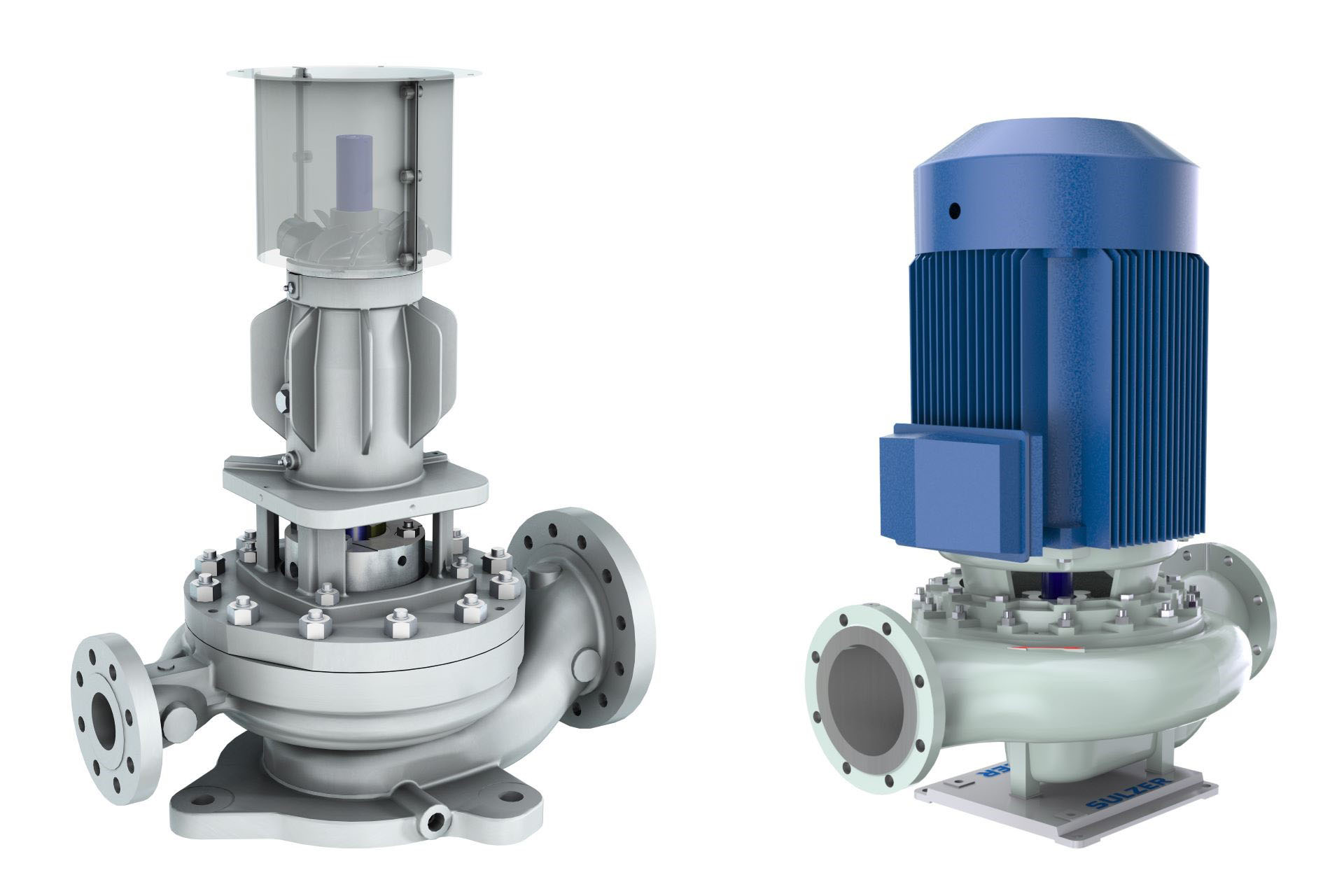
Centrifugal pumps are classified by casing arrangement, number of stages, and shaft orientation. The same hydraulic principle appears in many mechanical forms, each optimized for a different combination of flow, head, footprint, and serviceability. The table below summarizes the principal configurations and their typical duty envelopes; the API 610 type codes (OH, BB, VS) provide the most rigorous vocabulary and are used across the oil, gas, and chemical industries.
Configuration
API 610 type
Typical head
Typical service
End-suction, single-stage
OH1 / OH2
10 to 220 m
General process, water, chemical (ASME B73.1)
Vertical inline
OH3 / OH5
10 to 200 m
Tight footprint, pipe-mounted, HVAC
Axially split, between bearings
BB1 / BB3
50 to 600 m
High flow water transport, pipelines
Radially split barrel, multistage
BB5
200 to 3,000 m
Boiler feed, high-pressure injection
Vertical turbine / can
VS1 / VS6
10 to 300 m
Deep wells, sumps, condensate, fire
Submersible
not in API 610
5 to 200 m
Borehole, dewatering, sewage
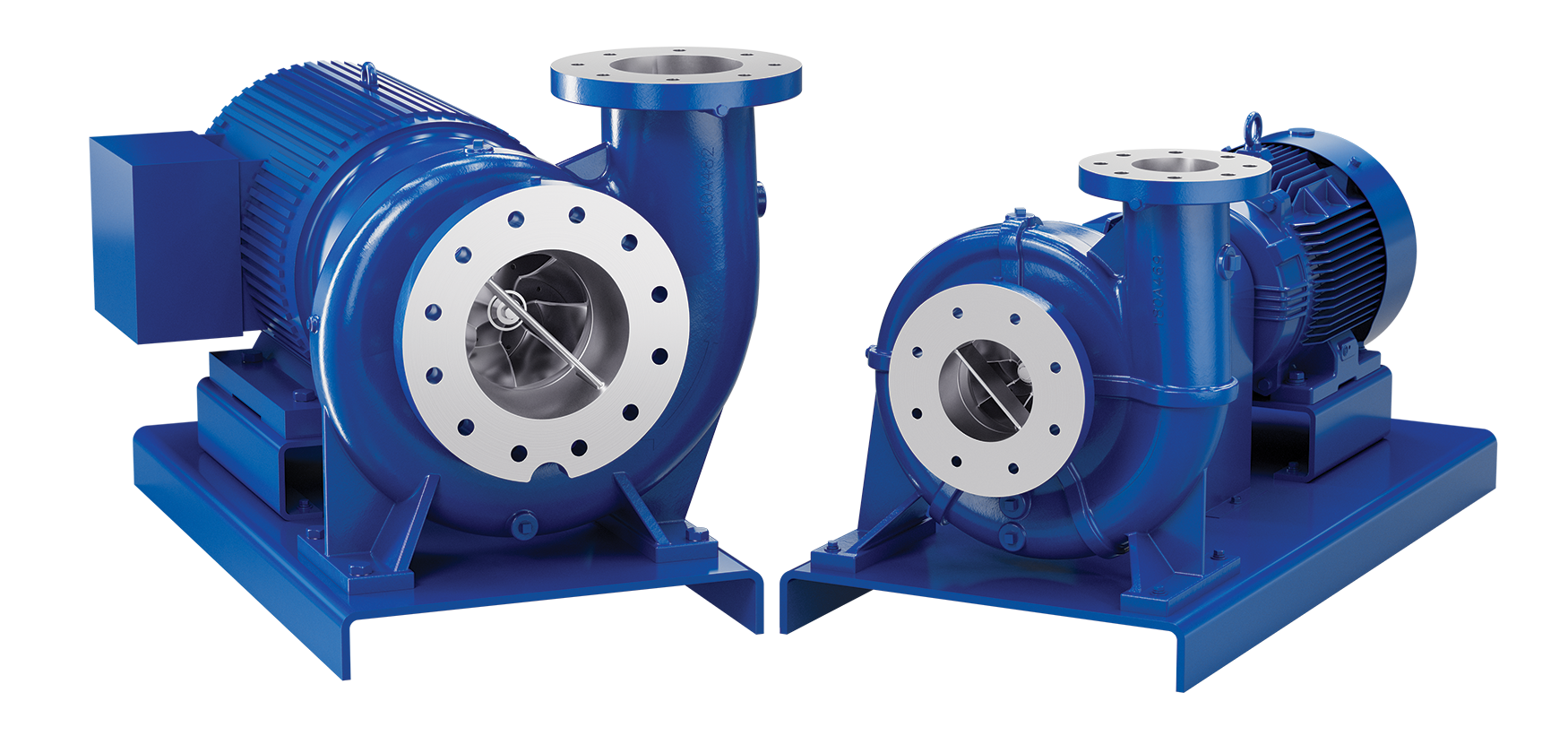
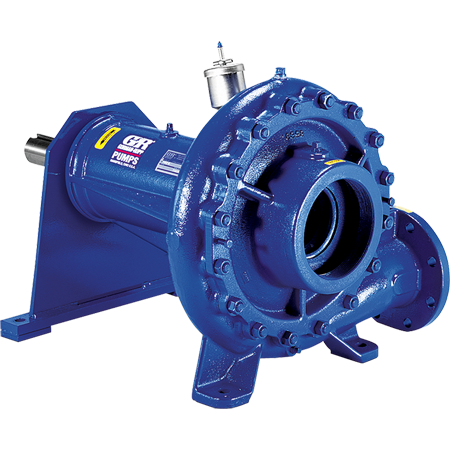
End-suction single-stage is the most common industrial form: the suction nozzle is on the casing axis, the discharge points up, and the impeller overhangs a single bearing housing (an overhung, or OH, design). ASME B73.1 standardizes the dimensions of horizontal end-suction process pumps so that any maker's pump of a given size is footprint-interchangeable. API 610 calls the foot-mounted version OH1 and the centerline-mounted version OH2; centerline mounting keeps the casing concentric to the shaft as it grows hot, which is why OH2 dominates refinery service.
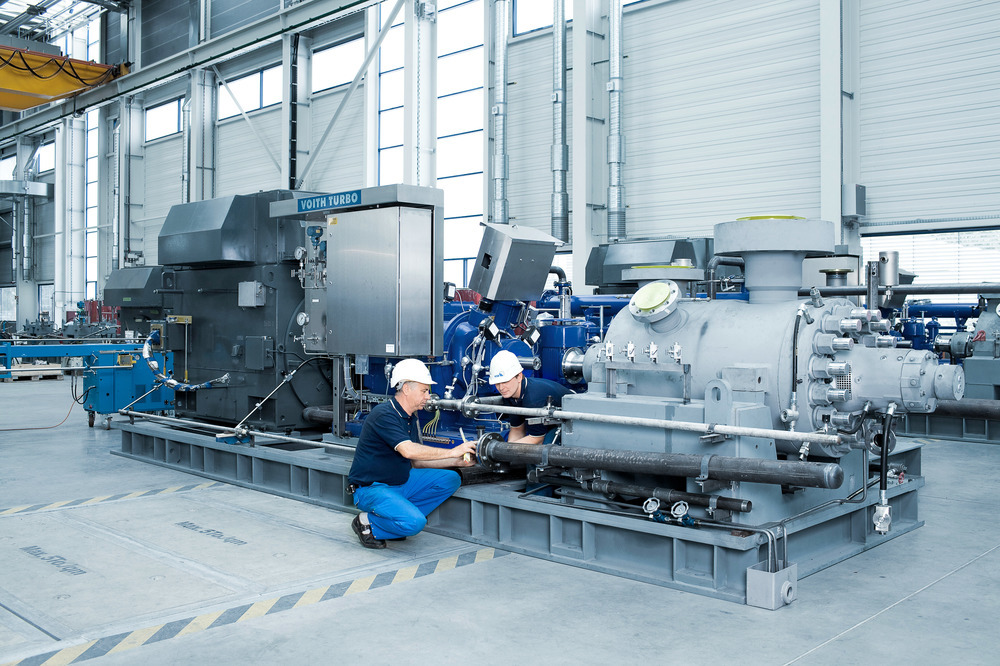
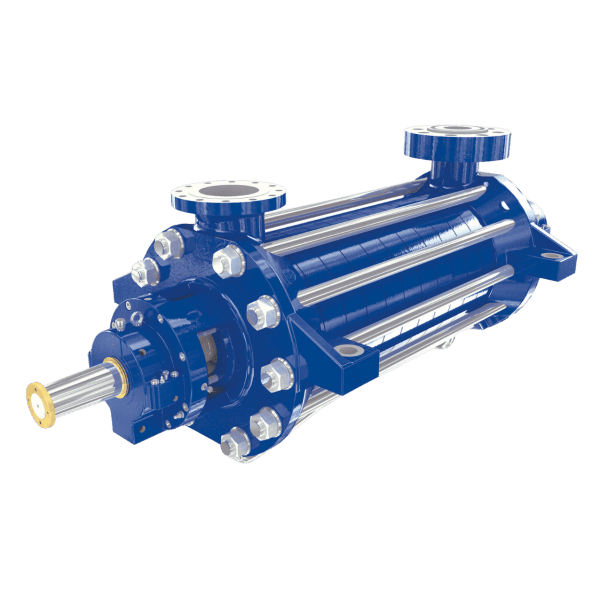
Between-bearings (BB) pumps support the impeller on a bearing at each end of the shaft, which removes the cantilever deflection of an overhung rotor and allows higher pressure and larger impellers. Axially split casings (BB1 single or two-stage, BB3 multistage) split along the shaft centerline so the top half lifts off for maintenance, ideal for large water-transport and pipeline duty. Radially split barrel pumps (BB5) enclose the multistage cartridge in a forged outer barrel and are the standard for boiler feed and high-pressure injection where the discharge pressure can reach hundreds of bar.
Vertically suspended (VS) pumps hang the bowl assembly below grade on a column, drawing from a wet pit, sump, or deep well, with the motor above the liquid surface. VS1 wet-pit diffuser pumps serve cooling-water intakes and large sumps; VS6 double-casing can pumps handle condensate and light hydrocarbons that need a low NPSH, since submerging the first-stage impeller provides natural suction head. Submersible pumps integrate a sealed motor with the pump and sit fully in the liquid, dominating borehole water supply, mine and construction dewatering, and sewage transfer where no above-ground space exists.
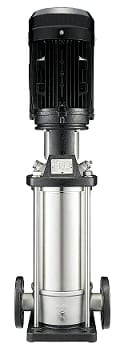
Stage count is the other axis. A single-stage pump develops head from one impeller and suits the bulk of duties below roughly 150 to 220 m. When the head requirement exceeds what one impeller can produce at reasonable efficiency, a multistage pump stacks impellers in series on one shaft, each adding its share of head, as in vertical multistage pumps for pressure boosting and reverse osmosis feed, or horizontal multistage pumps for boiler feedwater. A double-suction impeller, fed from both sides, doubles the flow capacity and balances axial thrust, which is why large between-bearings water pumps almost always use it.
Chapter 3 / 06
Impellers, Specific Speed and the Affinity Laws
The impeller is where energy enters the liquid, and its geometry decides almost everything about the pump's character. Two independent choices define an impeller: its mechanical form (open, semi-open, or closed) and its hydraulic family (radial, mixed-flow, or axial), the latter set by specific speed. The table below compares the three mechanical forms, which trade efficiency against tolerance of solids.
Impeller form
Shrouds
Relative efficiency
Best suited to
Closed
Both sides
Highest
Clean, non-abrasive liquids (water, chemicals)
Semi-open
One side (back)
Medium
Liquids with light solids, moderate fiber
Open
None
Lower
Slurry, sewage, stringy or solid-laden media
A closed impeller carries shrouds (cover plates) on both faces of the vanes, fully enclosing the flow passages. It is the most efficient form because almost no liquid leaks across the vane tips, and it is the default for clean water and chemical service. Wear rings between the impeller and casing maintain that efficiency over time and are a routine spare part. A semi-open impeller has only the back shroud, so its vanes run with a controlled clearance against the casing; it sacrifices a few points of efficiency for the ability to pass small solids and to be re-set as it wears. An open impeller has bare vanes and the greatest tolerance for stringy or solid-laden liquids such as sewage and slurry, at the cost of efficiency.
The hydraulic family is set by specific speed (Ns), an index that combines rotational speed, flow, and head at the best efficiency point into a single number that captures the shape of the impeller independent of its physical size. Low specific speed (in US units, roughly 500 to 4,000) produces a true radial impeller with narrow, high-curvature passages that make high head at low flow. Medium specific speed (about 4,000 to 8,000) produces a mixed-flow impeller, where the liquid leaves at an angle between radial and axial, balancing head and flow. High specific speed (above roughly 8,000 to 15,000) produces an axial-flow propeller that moves very large volumes against low head, as in flood-control and cooling-water pumps. Specific speed also predicts the achievable peak efficiency and the slope of the power curve, so it is the first number a hydraulic engineer reaches for.
Once an impeller is built, its behavior under a change of speed or diameter follows the affinity laws, the most practical tool in the chapter. For a change in impeller speed (N) or trimmed diameter (D), flow scales linearly (Q proportional to N or D), head scales with the square (H proportional to N squared or D squared), and shaft power scales with the cube (P proportional to N cubed or D cubed). The table below shows the consequence of a 10 percent and a 20 percent speed reduction, the basis of variable-frequency-drive energy savings.
Speed change
Flow change
Head change
Power change
-10% (to 90% speed)
-10%
-19%
-27%
-20% (to 80% speed)
-20%
-36%
-49%
+10% (to 110% speed)
+10%
+21%
+33%
The cube relationship between power and speed is the entire economic case for variable-speed pumping: trimming flow with a drive rather than a throttle valve cuts power dramatically, because a valve burns the surplus head as friction while a drive simply produces less. The same square-and-cube relations govern impeller trimming, which the maker uses to fit one casing to many duty points; trims beyond roughly 10 to 15 percent of full diameter, however, begin to erode efficiency and should be checked against the published curve rather than assumed. The affinity laws hold under geometric similarity and ignore second-order changes in efficiency and NPSHr, so they give a close estimate, not a contractual guarantee.
Chapter 4 / 06
Materials, Seals and Standards
Two construction questions dominate centrifugal pump procurement after the hydraulics are fixed: what the wetted parts are made of, and how the rotating shaft is sealed where it leaves the casing. Both are governed by the liquid, and both are codified in international standards that let a buyer specify and second-source with confidence.
Wetted materials must match the liquid's corrosivity, abrasiveness, and temperature. Grey cast iron and ductile iron casings, usually with bronze or stainless trim, are the economical default for clean water and non-corrosive duty at moderate temperature; they cover building services, irrigation, and general water transport. CF8M (the cast equivalent of 316 stainless, 16 to 18% Cr, 10 to 14% Ni, 2 to 3% Mo) is the workhorse for mild chemical, food, and pharmaceutical service. For seawater, brine, and chloride-bearing liquids, duplex (cast grade CD3MN, ASTM A890) and super-duplex resist the chloride stress-corrosion cracking that pits ordinary 316. Abrasive slurry calls for CD4MCu or high-chrome white iron, and strong acids push the selection to nickel alloys such as Alloy 20 and Hastelloy C. API 610 packages these into named material classes, summarized below.
Shaft sealing is the most common maintenance point on any centrifugal pump. Traditional soft packing (gland packing) is cheap and forgiving of grit but leaks by design and needs periodic gland adjustment, so it survives only on non-hazardous water and slurry. A single mechanical seal, two flat lapped faces (one rotating, one stationary) held together by a spring and the process pressure, is the modern default; it leaks only in vapor quantities and runs for years on clean liquid. For hazardous, toxic, flammable, or volatile liquids, API 682 defines dual seal arrangements, a pressurized barrier fluid (Arrangement 3) or an unpressurized buffer fluid (Arrangement 2) with a seal support system, to keep emissions inside the pump and to meet fugitive-emission limits.
Where any leakage is unacceptable, the seal is removed entirely. A magnetic-drive pump transmits torque across a sealed containment shell through a magnetic coupling, and a canned-motor pump encloses the motor rotor inside the process liquid; both are sealless and eliminate the seal failure mode outright. The trade is that the process liquid lubricates the internal product-lubricated bearings, so sealless pumps demand clean liquid and rigorous protection against dry running, which destroys those bearings in seconds.
The governing standards form a coherent map. ASME B73.1 fixes the dimensions of horizontal end-suction chemical process pumps. ISO 2858 does the equivalent dimensional job in metric Europe (end-suction pumps rated to 16 bar), and ISO 5199 adds the Class II construction and test requirements on top of those dimensions. API 610 (published identically as ISO 13709) is the heavy-duty construction standard for petroleum, petrochemical, and natural gas service, prescribing shaft stiffness, a minimum 25,000-hour bearing life, allowable nozzle loads, and a 20-year design life. API 682 governs the seals, and the Hydraulic Institute (ANSI/HI) standards govern testing tolerances and NPSH margin practice.
Chapter 5 / 06
Key Specification Parameters
A pump data sheet may list dozens of fields, but a manageable set of parameters drives the selection and protects against the field failures that recur on real plants. Each is explained below; together they define the duty point, the suction safety margin, the energy cost, and the mechanical envelope.
Flow rate (capacity, Q) is the volume delivered per unit time, in m3/h (or L/s, or US GPM). It is set by the process, but it must be quoted as the actual required flow, not a padded number, because oversizing pushes the operating point left of best efficiency and shortens life. Industrial single-stage process pumps commonly cover roughly 1 to 1,600 m3/h; large between-bearings water pumps reach many thousands of m3/h.
Total head (H) is the energy added per unit weight of liquid, expressed in metres (or feet) of liquid column, and it is independent of liquid density, which is why pumps are rated in head rather than pressure. The system head is the sum of static lift, friction loss, and any pressure difference between source and destination. A general-purpose ASME B73.1 process pump such as the ITT Goulds 3196 reaches heads to 223 m (730 ft) and flows to 1,590 m3/h (7,000 GPM); multistage pumps reach far higher heads by stacking stages.
NPSH required (NPSHr) is the suction-side margin the pump itself needs to avoid cavitation, measured on a test rig as the suction head at which total head falls by 3 percent. The system must supply NPSH available (NPSHa) greater than NPSHr at every operating point, with margin: industry keeps at least 0.5 to 1 m, and the Hydraulic Institute recommends a margin ratio of roughly 1.1 to 2.0 times NPSHr for hot or volatile liquids. NPSHr is highest at high flow, so it must be checked at the right end of the curve, not only at the duty point. Cavitation, the formation and violent collapse of vapor bubbles, erodes the impeller, raises noise and vibration, and can destroy a pump in days.
Efficiency is the ratio of hydraulic power delivered to shaft power absorbed, peaking at the best efficiency point (BEP). Well-designed single-stage process pumps reach roughly 70 to 85 percent at BEP, with large high-specific-speed machines exceeding 88 percent and small or low-specific-speed pumps falling well below. Because power scales with the cube of speed, efficiency at the real operating point, not the catalogue peak, sets the lifetime energy bill, which usually dwarfs the purchase price.
The remaining parameters complete the mechanical and electrical envelope:
Best efficiency point (BEP) and operating range: the preferred operating region runs roughly 70 to 120 percent of BEP flow; size so the normal duty sits near 80 to 110 percent and add a minimum-flow bypass for low-demand protection.
Maximum working pressure and temperature: the casing pressure-temperature rating, for example to 26 bar (375 PSIG) and 371°C (700°F) on a heavy-duty process pump, with flange class (PN16/PN40, ANSI 150/300) matched to the system.
Rotational speed: typically 1,450/1,750 rpm or 2,900/3,500 rpm on 50/60 Hz two- and four-pole motors; higher speed raises head and NPSHr together.
Shaft power and motor rating: sized for the worst-case point on the power curve (often the high-flow end), with margin per IEC/NEMA practice.
Seal and bearing arrangement: single or API 682 dual seal, sealless option, and grease- or oil-lubricated bearings with the target L10 life.
Chapter 6 / 06
Selection Decision Factors
Applying the previous five chapters to a specific model follows a fixed sequence. Most selection mistakes come not from a single wrong number but from deciding the wrong thing first, fixing a casing material before the hydraulics, for example. The eight steps below double as an RFQ template.
Define the duty point: establish the required flow (m3/h) and total head (m) from the process and a verified system-head calculation. Quote the actual flow, not a padded figure, and identify the full operating range from minimum to maximum demand.
Check suction conditions (NPSH): compute NPSHa from the suction tank level, line losses, and liquid vapor pressure, then require NPSHr below it with margin (at least 0.5 to 1 m, more for hot or volatile liquids). If NPSHa is tight, consider a lower-speed pump, a double-suction impeller, or a vertical can configuration.
Choose configuration and stages: end-suction single-stage for general duty, between-bearings or multistage for high head, vertical or submersible for wet pits and wells. Map the head requirement to the configurations in Chapter 2.
Set impeller type and hydraulics: closed impeller for clean liquids, semi-open or open for solids and fiber; let specific speed at the duty point confirm radial, mixed-flow, or axial geometry. Confirm the selected point sits near BEP.
Select materials: match casing and wetted parts to the liquid using Chapter 4 and the API 610 material classes, then verify against the maker's corrosion chart at the actual concentration, temperature, and velocity. Add abrasion allowance for slurry.
Specify the seal and sealing system: single mechanical seal as default; API 682 dual seal with a support system for hazardous or volatile liquids; magnetic-drive or canned-motor sealless pump where zero leakage is mandatory and the liquid is clean.
Confirm the standard and certifications: ASME B73.1 or ISO 2858/5199 for general process; API 610 / ISO 13709 for oil, gas, and severe service; plus pressure directive (PED 2014/68/EU), explosion protection (ATEX/IECEx) for the driver, and any sanitary (EHEDG/3-A) or fire (NFPA 20/UL/FM) requirement.
Evaluate energy and total cost of ownership: compare efficiency at the real operating point, not the catalogue peak, and weigh a variable-frequency drive against throttling. Over a typical service life, energy and maintenance dominate the purchase price.
One dimension that buyers routinely underweight is serviceability. A back-pull-out design lets the rotating assembly be removed without disturbing the casing or piping, slashing repair time; standardized dimensions (ASME B73.1) make spares and second sources easy; and local stock of wear rings, seals, and bearings determines how long a line stays down after a failure. Established makers, ITT Goulds (3196), Grundfos (CR multistage), KSB (Etanorm), Sulzer, Flowserve, and Xylem among them, maintain service networks and spare-part inventories that matter far more after ten years of operation than the few percent of purchase price they add up front.
FAQ
What is the difference between NPSHr and NPSHa, and how much margin should I keep?
NPSHa (available) is a property of the system: the absolute pressure at the pump suction minus the liquid vapor pressure, expressed as head of liquid. NPSHr (required) is a property of the pump, measured on a test rig as the suction head at which total head drops by 3 percent at a given flow. To avoid cavitation you need NPSHa greater than NPSHr at every operating point, not just at the duty point. Industry practice keeps a margin of at least 0.5 to 1 m, and the Hydraulic Institute recommends a margin ratio of roughly 1.1 to 2.0 times NPSHr for difficult services such as hot or volatile liquids. The largest NPSHr always occurs at high flow, so check the right end of the curve, not the rated point.
What is specific speed and why does it dictate impeller shape?
Specific speed (Ns) is a dimensionless-style index computed from rotational speed, flow, and head at the best efficiency point, and it groups pumps by hydraulic family rather than by size. Low specific speed (US units roughly 500 to 4,000) gives a true radial impeller: high head, low flow, narrow passages. Medium values (about 4,000 to 8,000) give a mixed-flow impeller where the liquid leaves at an angle between radial and axial. High values (above roughly 8,000 to 15,000) give an axial-flow propeller: very high flow, low head. Specific speed also predicts the shape of the power curve and the achievable efficiency, so two pumps with the same duty but different speeds are not interchangeable on hydraulics alone.
How do the affinity laws let me trim an impeller or change motor speed?
The affinity laws relate performance to impeller speed (N) or diameter (D): flow scales with N or D to the first power, head scales with the square, and shaft power scales with the cube. So a 10 percent speed reduction via a variable frequency drive cuts flow about 10 percent, head about 19 percent, and power about 27 percent, which is why VFD throttling saves far more energy than a control valve. Trimming the impeller diameter follows the same square and cube relations within roughly a 10 to 15 percent trim before efficiency falls off noticeably. The laws assume geometric similarity and ignore changes in efficiency and NPSHr, so treat the result as a close estimate, not a guarantee.
What is the difference between an ANSI/ASME B73.1 pump and an API 610 pump?
ASME B73.1 specifies horizontal, end-suction, single-stage, centerline-discharge process pumps and is primarily a dimensional interchangeability standard: any maker's B73.1 pump of a given size shares footprint and connection dimensions, so end users can second-source freely. It targets general chemical process duty. API 610 (also published as ISO 13709) is a construction and reliability standard for petroleum, petrochemical, and natural gas service. It is far more prescriptive on shaft stiffness, bearing life (25,000 hours minimum), nozzle loads, materials, and a 20-year design life, and it classifies pumps as overhung (OH), between-bearings (BB), and vertically suspended (VS). API pumps cost more and are specified where temperature, pressure, and emissions are severe.
How do I choose the casing and impeller material for my liquid?
Match the wetted metallurgy to the corrosivity, abrasiveness, and temperature of the liquid. Cast iron or ductile iron casings with bronze or stainless trim suit clean water and non-corrosive duty at moderate temperature and cost. CF8M (cast 316 stainless) is the workhorse for mild chemical and food service. For seawater, brine, and chloride-bearing liquids, duplex (CD3MN) and super duplex resist chloride stress-corrosion cracking that defeats 316. CD4MCu and high-chrome irons handle abrasive slurry. Nickel alloys such as Alloy 20 and Hastelloy cover strong acids. API 610 codifies these as material classes (S-6, S-8, C-6, D-1 and so on). Always confirm against the maker corrosion chart at the actual concentration, temperature, and velocity before ordering.
Why does running a pump far from its best efficiency point shorten its life?
Every centrifugal pump has a best efficiency point (BEP) where flow enters and leaves the impeller smoothly. Far to the left of BEP (low flow), the liquid recirculates inside the impeller, raising radial thrust, vibration, temperature rise, and seal and bearing load, and at very low flow the liquid can flash. Far to the right (high flow), NPSHr climbs and cavitation begins. The preferred operating region is roughly 70 to 120 percent of BEP flow, with an allowable region of about 40 to 110 percent depending on the pump. Reliability programs target sizing so the normal duty sits near 80 to 110 percent of BEP, and they add a minimum-flow bypass to protect the pump at low demand.
What sealing options exist and when do I need a mechanical seal versus a sealless pump?
Soft packing (gland packing) is cheapest and tolerant of dirty water but leaks by design and needs frequent adjustment, so it is limited to non-hazardous duty. A single mechanical seal is the default for most process pumps; for hazardous, toxic, or volatile liquids API 682 defines dual seals (pressurized or unpressurized) with a barrier or buffer fluid and a support system to control emissions. Where zero leakage is mandatory, choose a sealless pump: a magnetic-drive pump uses a non-contacting magnetic coupling, and a canned-motor pump encloses the rotor in the process liquid. Sealless types eliminate the seal failure mode but demand clean liquid and careful protection against dry running, since the process liquid also lubricates the internal bearings.
Centrifugal Pump Manufacturers
Source-backed product routes. Open a company dossier for procurement scope and cited evidence.