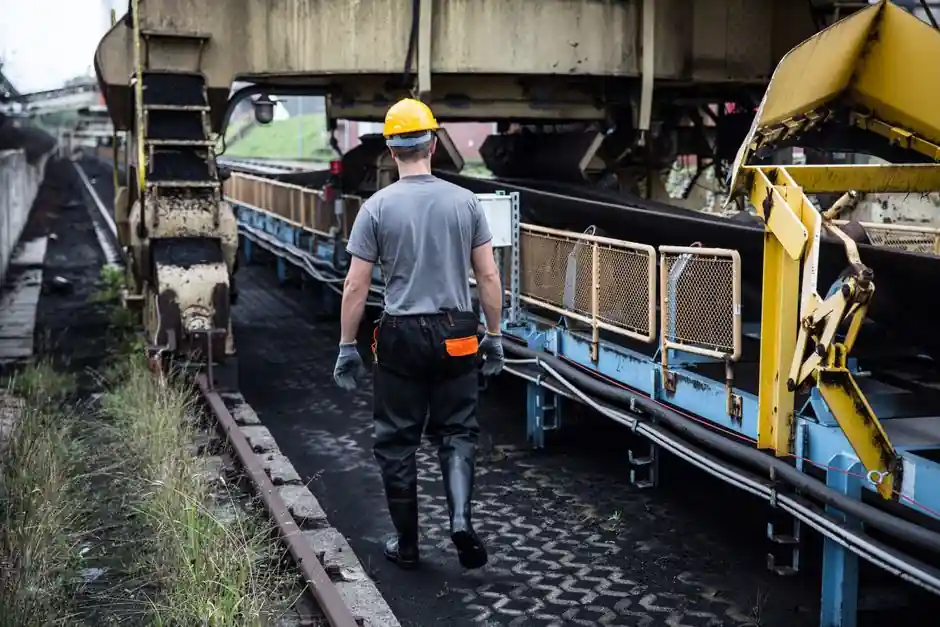
En-masse drag conveyors use a moving scraper chain to convey powder, granules, and small granular materials in a closed casing [S5].
What Flight Spacing Controls in an Ash System
Flight spacing determines whether the conveyor merely pushes material ahead of each flight or moves it en masse as a continuous column. In en-masse service, the flights can use about 70–90% of the available space within the conveyor for material movement [S1].
The spacing is not a free-standing dimension. Trough cross-section, chain type, flight geometry, material bulk density, particle size, moisture, feed rate, and required capacity all affect the calculation. Neo Conveyors offers custom enclosed drag chain conveyors for applications including fly ash, with capacities up to 200 TPH and sections up to 60 m [S2].
Fly ash requires special attention because it is fine, dusty, and potentially abrasive. MHE designs industrial drag conveyor systems for demanding bulk-material handling involving abrasive materials, elevated temperatures, and challenging operating conditions [S3]. The selected spacing should therefore be tested with the actual ash bulk density and flowability, not copied from a coal or grain duty.
Compare En-Masse and Conventional Drag Arrangements
En-masse flight spacing supports continuous-column movement, while full-height scraper or paddle flights push material in discrete plugs. En-masse systems are low-speed, high-torque machines, and their lower chain speed reduces frictional and chain wear; full tall flights increase chain weight, power demand, and trough wear [S4].
For a new fly-ash line, en-masse service is the stronger starting point when the ash is free-flowing and the required rate justifies the larger system. A conventional paddle arrangement remains relevant for shorter runs, controlled feeds, applications requiring cleanout, or inventories with changing bulk properties [S1][S4].
Set Chain Speed Against Trough and Capacity
Speed cannot be treated as a throughput multiplier. When the ash bed becomes too deep, friction against the side walls slows the upper material relative to the chain. That velocity difference produces slippage, premature wear, and reduced volumetric efficiency [S4]. A square housing cross-section is identified as the most efficient arrangement for en-masse conveying [S4].
That difference matters because material weight, conveyor type, and layout influence the suitable operating speed [S1]. Fly-ash specification should start with the lowest speed that meets the validated duty, then increase it only if the capacity calculation and test run confirm stable en-masse movement.
Match Inclination and Flight Form to the Material
Flat-bar flights are used mainly for horizontal conveyors and inclines up to 15°, depending on the bulk solids. U-flight, O-flight, and OO-flight forms are used for very fluid materials and greater inclines, with filler plates available for cleanout [S4].
Neo Conveyors offers drag chain conveyors for horizontal service and inclinations of 0°–45° [S2]. These published envelopes are equipment limits, not automatic selections for fly ash.
For an inclined ash line, flight form, fill depth, friction angle, material cohesion, and moisture must be considered together. The chain conveyor must pull the lower part of the ash bed while preserving enough movement between the flights to prevent a stationary upper layer. Excessive fill depth increases wall friction and creates the slippage condition associated with capacity loss and wear [S4].
Account for Abrasion, Heat, and Dust Containment
Fly-ash handling can combine abrasive particles with elevated temperature, while enclosed systems are required to prevent dust release. The relevant mechanical risks are chain wear, flight wear, liner wear, sprocket wear, and chain tension loss rather than only rated motor power [S2][S3].
Neo Conveyors lists forged and roller chain among its drag chain conveyor features [S2].
A fully enclosed rectangular trough with sealed inlet and outlet connections limits dust leakage along the conveying path. The same system can also provide weatherproofing for outdoor service [S2].
Size the Chain, Flights, and Drive as One System
Motor power cannot be selected independently from flight spacing. More material per flight increases chain pull, while a larger en-masse bed can improve volumetric efficiency if the chain remains engaged and the material does not slip [S4].
Large-pitch roller conveyor chain literature identifies fly ash as an application for short center distances and slow chain speed, while warning that chain mass on the return side can affect the arrangement [S8]. This makes center distance and return strand geometry part of the flight-spacing decision, not details to settle after the general arrangement is frozen.
The conveyor chain specification should include the material duty, temperature, duty cycle, center distance, trough width, flight spacing, speed, and chain tension method. Commercial guidance identifies chain type and flight spacing alongside trough cross-section and motor power as linked design outputs [S2]. A chain selected only by nominal pull strength would omit the operating conditions that control wear and service life.
Commission From the Bulk-Solids Data
A defensible fly-ash selection starts with measured bulk density, particle-size distribution, moisture, flowability, abrasivity, temperature, required tonnes per hour, inlet geometry, conveyor length, and inclination. These inputs feed trough area, flight spacing, chain speed, drive power, and wear-material selection; commercial specifications list the same core calculation set [S2].
The operating checks should then track chain speed against actual ash velocity, flight loading, trough fill, motor current, chain tension, and liner or flight wear.
For procurement, request the flight pitch, chain pitch, flight material, liner material, chain speed, rated capacity, chain pull, motor power, take-up travel, and maximum material temperature on the equipment data sheet. Also compare the temperature limit of the roller chain option with the chain and flight material actually proposed, because the available fly-ash literature does not establish one universal pitch for every plant [S1][S8].
The next trackable signal is an operating baseline that compares commanded chain speed with measured ash-bed velocity, because divergence is the direct indicator of slippage, capacity loss, and accelerating wear described in en-masse guidance [S4].