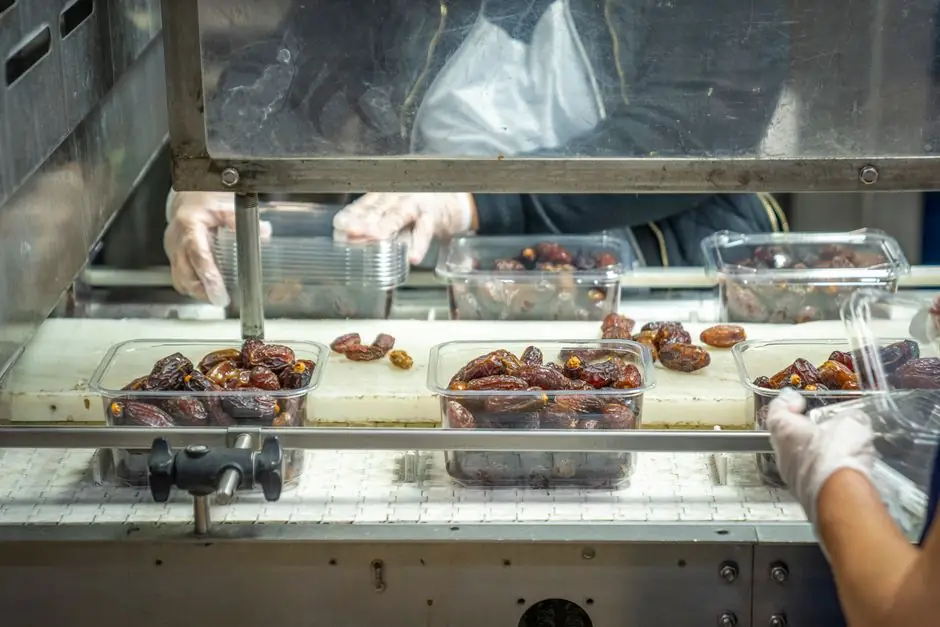
A Belgian pork plant lubricates 45 overhead conveyor systems across freezing, scalding, washing, and transport zones, using application-specific products rather than one lubricant for the entire line [S1].
NSF H1 classification is the starting point for incidental food contact; temperature, moisture, cleaning chemicals, viscosity, penetration, drip risk, and lubrication interval determine whether the lubricant is suitable [S1][S4].
Why Food-Grade Conveyor Chains Need Lubrication
Lubrication is required to reduce friction and heat at the pin-and-bush joint, bush-and-roller interface, link plates, and other components specified by the chain manufacturer [S4][S5].
Without controlled lubrication, those interfaces experience accelerated wear, higher energy consumption, contamination retention, and increased failure risk [S5]. In food processing, lubricant can also drip or transfer onto product, so excess application creates both a hygiene exposure and a housekeeping problem [S3][S4].
The requirement is not simply to coat the outside of the chain. Lubricant must penetrate the pin-and-bush clearances, form a protective film, and remain controlled at the chain's actual speed, load, orientation, and temperature [S4].
NSF H1 Is Necessary but Not Sufficient
NSF H1 lubricants are intended for machinery where there is a reasonable possibility of incidental contact with food; H2 lubricants are used where no contact with food is expected, while H3 products are rust removers for equipment such as hooks and trolleys [S2].
H1 registration does not by itself establish compatibility with a chain installation. The lubricant must still be assessed against operating temperature, water and steam exposure, cleaning chemicals, contamination, penetration, viscosity, corrosion risk, and residue formation [S1][S4].
Compatibility also extends beyond the chain. Lubricant selection should account for the chain material, guide and seal materials, sprockets, rollers, and cleaning chemicals [S4]. The plant's technical data sheet, food-grade registration, and the chain manufacturer's lubrication instructions remain the controlling references before a lubricant is changed, mixed, or used over a longer interval [S4].
Compare Lubricant Chemistries and Delivery Methods

For food-grade service, synthetic PAO fluids can suit H1 duties and perform well when low-temperature flow is required, but viscosity still controls delivery behavior [S6].
Match Lubrication to the Operating Zone
At the Belgian plant, cooling areas are documented at 0°C and 100% humidity. At the Belgian plant, some conveyors operate with water at 60–65°C and steam exposure.
Other sections encounter water mist, chlorinated washdown, heavy contamination, or intensive cleaning [S1]. These duties require different properties: low-temperature flow in refrigerated zones, controlled penetration and wash-off resistance in wet zones, and oxidation and residue control near heated equipment [S1][S4].
Automatic application is not automatically the best choice. At the Belgian plant, Food Lube G150 is used across multiple chain systems, while Food Lube AL is applied in selected automatic and temperature-exposed conveyor applications. The product choice follows the duty rather than reversing that logic.
Apply Lubricant at the Working Interfaces
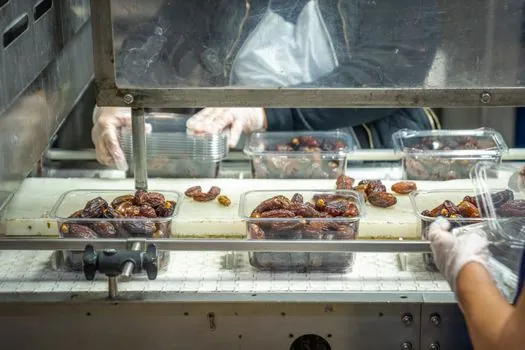
Application should target the pin-and-bush joint, bush-and-roller interface, specified side-plate points, and any sprocket or guide contact called out by the chain manufacturer [S4]. Capillary action then carries a controlled amount into the internal clearances; spraying only the visible exterior leaves the primary wear surfaces untreated [S4].
Begin with the equipment manufacturer’s lubrication specification, confirm the exact product against its current technical data sheet, food-grade registration and compatibility information, apply a controlled amount at manufacturer-identified points so it can penetrate the internal articulating surfaces, and check for unacceptable drip, fling and residue.
Constraints for Clean and Automated Systems
Food-grade conveyor design must prevent lubricant leakage, spillage, and uncontrolled transfer to product. Application systems should deliver only the required quantity, while inspections cover seals, piping, nozzles, drip points, and the chain's working surfaces [S3][S4].
Cleaning and lubrication cannot be separated. Food areas require regular chain cleaning and sanitisation, including hard-to-reach components, and the cleaning method must be compatible with both the chain and the lubricant [S3][S4]. After wet cleaning, the chain should be allowed to drain and dry as required, inspected for corrosion, and relubricated at the validated time [S4].
These requirements are stricter for installations using an overhead conveyor, where lubrication points may be numerous and manual access can be inconsistent. The chain conveyor configuration should be reviewed as a system of chain, lubricant, delivery equipment, washdown, and inspection access rather than as a stand-alone mechanical asset.
Build a Validated Lubrication Routine
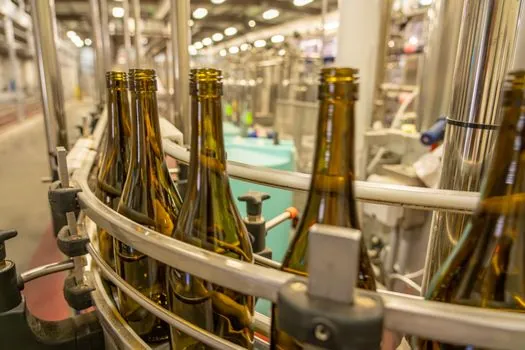
A food-grade maintenance program should begin with the chain manufacturer's specification, then record chain type, speed, load, temperature, moisture, cleaning regime, lubricant registration, viscosity, delivery method, and interval for each section [S4].
Inspection criteria should include chain wear, corrosion, lubricant penetration, residue, drip, fling, blocked nozzles, and evidence of product contact [S4]. Maintenance records provide the trackable signal for adjusting frequency or quantity, especially where one line contains refrigerated, heated, and washed zones with different demands [S1].
The related decision between chain and belt equipment in high-temperature transfer is covered in Chain vs Belt Conveyor for High-Temperature Transfer, but the lubrication conclusion remains straightforward: food-grade chain conveyors require controlled lubrication, and the lubricant, application method, and interval must be validated for each operating zone.