
On a packaging line, a shaft collar failure rarely announces itself; the conveyor index drifts, the registration mark lags, and reject rates climb before anyone walks over with a wrench, and the choice between set-screw, single-split, and double-split designs is what determines whether the collar is the silent workhorse or the recurring fault [S4].
Quick-clamping shaft collars are built specifically for that environment, requiring no tools for installation, adjustment, or removal, which makes them a common fit for packaging equipment where format changeovers dominate the daily schedule [S2]. Material selection is the next gate: 316 stainless paired with 18-8 stainless hardware, or anodized 2024 aluminum where mass matters, covers most washdown and high-speed indexing frames [S1][S5][S6].
Set-Screw vs Single-Split vs Double-Split: The Holding-Power Hierarchy
Properly installed clamp-style collars can deliver up to twice the axial holding strength of comparable set-screw designs, because compressive contact distributes load around the shaft circumference instead of concentrating it at a single screw tip [S4]. Solid set-screw collars give the lowest holding power of the three, since a single screw drives directly into the shaft and creates localized deformation; a single-split design adds a second clamp body that draws tight against the shaft, and a double-split collar distributes that holding power uniformly around the full circumference, which is the configuration specified for high axial load stations such as film-feed dancer or cap-sorter star wheels [S5]. Holding power overall scales with collar bulk, bore size, and screw size, with surface friction between the collar and the shaft as a fourth variable, so a zinc-plated finish (smooth, corrosion-resistant, lower friction) is the wrong choice when the priority is anti-slip, and a black-oxide or oven-blackened finish (rougher, higher friction) is the right one [S3][S5].
Material Choices for Washdown, Corrosion, and Lightweight Indexing
Three materials dominate packaging-line shaft collars: aluminum, carbon steel, and stainless steel, with the selection driven by corrosion exposure, mass, and cost [S5]. Aluminum collars, often supplied as 2024-T4 in thin-line profiles, are light, durable, and corrosion-resistant with strong holding power for their mass, and are popular on high-speed rotating shafts where inertia matters [S5][S6]. Carbon steel collars are the economical default for bearing retention and spacing, but they are vulnerable to rust in wet environments unless protected; zinc plating adds the most corrosion resistance, while black oxide preserves more holding power, so a typical packaging specification reads "carbon steel, black-oxide finish" for dry sections and "carbon steel, zinc-plated" only when slip is acceptable [S5]. Stainless collars, 303 or 316 grade, are specified for direct food contact zones, salt-air washdown, and acid or caustic cleaning cycles, and the holding power of a stainless collar is only as good as its cap screws; mismatched hardware (for example, a 316 body with low-grade screws) is the most common premature-failure pattern in stainless clamp collars, and the fix is to use the same grade of hardware as the collar body [S1][S5].
Changeover Frequency, Torque, and the Tool-Free Argument
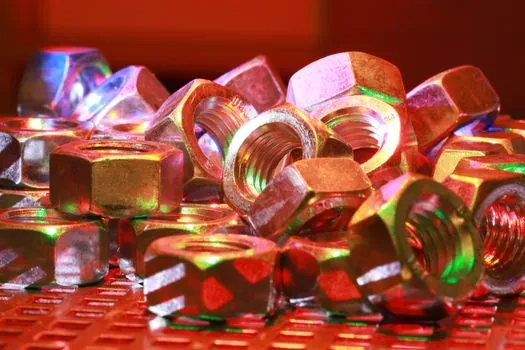
Packaging lines change format far more often than they overhaul mechanically, and quick-clamping collars address that by removing the tool step entirely: install, adjust, and remove with a hand lever rather than a hex key or torque wrench [S2]. That gain is real but conditional, because clamp-style designs still depend on proper torque to deliver their rated holding power, and a calibrated torque wrench remains required in precision indexing and registration stations to prevent under-torque slippage or over-torque distortion of the collar body [S4]. For stations where format change happens several times per shift (label heads, mandrels, conveyor guide rails), the quick-clamping design pays back in minutes saved per changeover; for sealed, never-touched bearing retention points, a set-screw collar remains the lower-cost correct answer [S2][S4]. Face-to-bore perpendicularity is the third precision variable, and a precision-ground face with a locating groove ensures the load-bearing side sits flat against the gear, sprocket, hub, or pulley so pressure distributes evenly and the collar does not "walk" off the shaft over time [S3][S5].
Decision Matrix: Matching Collar Type to Packaging Station
A practical selection reads along four axes: holding mechanism (set-screw / single-split / double-split), material (aluminum / carbon steel / stainless), finish (black oxide / zinc / none), and tool-free changeover (yes / no) [S1][S3][S5]. For form-fill-seal film feeds and registration servos, a double-split 303 or 316 stainless collar with stainless-matched hardware and a precision face is the conservative specification; for label-applicator mandrels and ink-coder shafts that change format every shift, a quick-clamping single-split aluminum or stainless collar is the typical call [S2][S6]. For dry, low-changeover spacer and stop applications (conveyor idlers, guard rails), a carbon-steel set-screw collar with black-oxide finish is the cost-effective baseline, while washdown zones under daily caustic cleaning should step up to 316 stainless regardless of holding-power need [S3][S5]. Bore sizing closes the loop: an oversize bore will not clamp adequately and may release under load, while an undersize bore will not seat, so verifying the nominal shaft diameter and tolerance class before ordering is the last gate before a packaging-line collar goes on the BOM [S5].
Limits, Failure Modes, and Standards Reality

There is no formal industry standard governing shaft-collar dimensions; most manufacturers share a roughly uniform dimensional envelope, so interchangeability is conventional rather than certified [S8]. The real failure modes on packaging lines are well documented even without a standard behind them: set-screw collars slip when the screw is harder than the shaft, the screw tip galling or deforming the shaft surface rather than biting it; clamp collars distort and lose contact area when over-torqued; zinc-plated collars slip in high-shock indexing because the smooth finish sacrifices friction for corrosion resistance; and stainless collars fail at the screws, not the body, when hardware grade is mismatched [S3][S4][S5]. A useful procurement rule is to match hardware grade to collar body grade (for example, 18-8 or 316 fasteners with a 316 collar) and to specify a locating groove on the load-bearing face wherever the collar supports axial load against a gear, bearing, or sprocket [S1][S3][S5].
Field Signals to Track on the Next Specification Review
Two signals are worth pulling at the next line audit: changeover time per format change, since a 2-5 minute saving per changeover compounds quickly across a multi-shift packaging operation, and reject-rate drift on indexing and registration stations, since a slipping collar often shows up as rising registration faults long before it shows up as a mechanical stop [S2][S4]. For deeper context on how locating components are graded against shaft and key hardware, the shaft key material selection for high torque guide covers a related but distinct set of grade-match rules. On the next packaging-line collar purchase order, the three specs that consistently prevent repeat failures are: holding mechanism matched to changeover frequency, material grade matched to washdown chemistry, and fastener grade matched to collar body grade.