
Two-piece clamp-style shaft collars in zinc-plated carbon steel or 303/316 stainless steel, rated heavy-duty, are the baseline specification for conveyor, drivetrain, and stop applications on material handling equipment, with bore size held to the same tolerance class as the shaft and face-to-bore perpendicularity checked on load-bearing faces [S2][S3].
The shaft collar is the simplest part on the bill of materials and the one most likely to bring a line down, because it carries axial locating duty on bearings, sprockets, and gear hubs, and acts as the mechanical stop that keeps a drivetrain from walking under load [S3][S5].
Set Screw vs. Two-Piece Clamp: Holding Power on Conveyor Shafts
Set-screw collars transfer torque through localized point contact: the screw tip bites into the shaft, and a softer-than-shaft screw on a through-hardened or case-hardened shaft simply cannot develop rated holding force, so set-screw collars are the wrong pick for variable-load or reversing conveyor drives [S3][S4].
Two-piece clamp collars distribute compressive force 360° around the bore, and properly torqued clamp collars routinely deliver roughly twice the axial holding strength of comparable set-screw designs, which is why heavy-duty clamp collars are the default in mining, aggregate, lumber, and overland conveyor specifications [S2][S3].
For shafts above about 50 mm (2 in.) diameter, or anywhere axial shock loads appear (bucket elevators, incline conveyors, pallet stop rails), step up to heavy-duty or ultra-heavy-duty clamp collars rather than upsizing a light-duty clamp, because bulk and screw size scale together and a heavy-duty collar at the same bore carries close to twice the axial load of a low-profile unit of equal bore [S2].
Bore Tolerance, Face-to-Bore Perpendicularity, and Shaft Prep
Bore size on a precision shaft collar is typically held to a few hundredths of a millimetre (a few thousandths of an inch), and matching that tolerance to the shaft finish is non-negotiable: an under-tolerance bore will not slide on, while an over-tolerance bore slips under load regardless of how tightly the screws are torqued [S2][S5].
Face-to-bore perpendicularity, the angle between the collar face and the bore axis, governs how evenly load is transferred when the collar is used as a hard stop or bearing face; on load-bearing positions this should be verified by the supplier, since a non-perpendicular face tilts the contact patch, raises Hertzian stress, and accelerates wear on the mating component [S2].
Shaft prep matters as much as the collar spec: burrs, peen marks, and surface roughness above about 1.6 µm Ra (64 µin Ra) cut effective holding power, and on conveyor lines subject to washdown or chemical exposure, surface finish also decides whether the joint survives corrosion [S5][S8].
Material Selection: Steel, Stainless, and Aluminum Trade-Offs
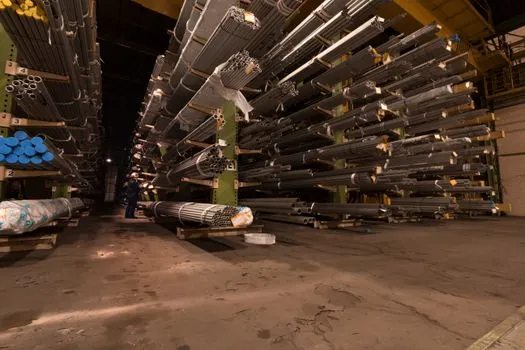
For dry, indoor conveyors, zinc-plated carbon steel gives the best combination of holding power and cost, with the plating adding corrosion resistance at the cost of some surface friction, a real trade-off because the smooth zinc layer reduces the slip-load threshold of a set-screw joint [S2].
For washdown, food-adjacent, or outdoor applications, 303 stainless is the workhorse for general corrosion resistance and machinability, while 316 stainless is specified where chlorides, acids, or salt exposure are present; both are non-magnetic in the austenitic condition and carry lower holding force than mild steel of the same geometry because the surface is smoother and the screws have to be torqued more carefully to avoid stripping [S2][S3].
Aluminum collars cut mass for high-speed or moving frames, but the holding power drops further, so aluminum is reserved for instrument, indexing, and light-duty applications rather than for primary drivetrain stops on a material handling line [S2][S8].
Surface Finish: Black-Oxide vs. Zinc Plating vs. Stainless
Black-oxide (oven-blackened) finish on steel collars raises surface friction and therefore holding power, which is the right pick on dry, indoor conveyor shafts where corrosion is not a concern and the goal is to maximize slip torque [S2].
Zinc plating trades some of that friction for corrosion resistance, so it is the right choice in humid or mildly corrosive plants; in heavy chemical, marine, or washdown environments, drop the zinc and move up to 303 or 316 stainless rather than rely on a plating layer that will eventually fail [S2][S3].
For comparison, on equivalent bore sizes: black-oxide steel holds best, zinc-plated steel holds slightly less but resists rust, 303 stainless holds less again but is corrosion-tolerant, 316 stainless is the most corrosion-tolerant with similar holding to 303, and aluminum is the lightest with the lowest holding power, useful as a quick screening matrix when a buyer is choosing between stocked options [S2][S8].
Standards, Sizing Practice, and What Is Not Formal
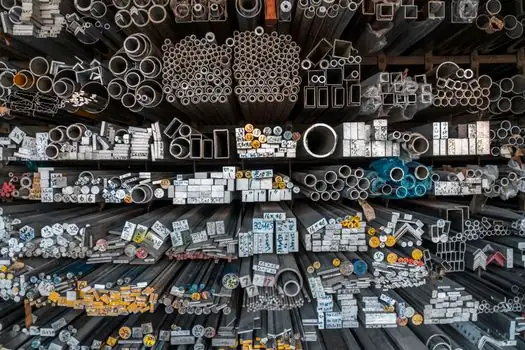
There is no single formal industry standard that governs shaft collar dimensions, bore tolerances, or load ratings across all manufacturers, although bore and OD proportions are broadly uniform across major brands, so cross-vendor substitution on the same nominal bore is usually safe for general-purpose applications but must be re-verified for load-bearing or safety-rated positions [S7].
Material specifications do follow recognized standards (stainless grades per AISI/ISO, zinc plating per ASTM B633 for example), and dimensional practice on common inch and metric bores (1/2 in., 1 in., 25 mm, 50 mm and up) is close enough between brands that a maintenance shop can usually swap suppliers without re-machining the shaft [S7].
Keyed shaft collars, with a transverse keyway machined in the bore, are the right pick where positive torque transfer is required, on a gearbox output shaft for example, because the key prevents relative rotation even if the clamping force is lost; standard key profiles follow ISO 773 / DIN 6885 patterns for metric shafts, and matching the keyway to the standard is what keeps the assembly serviceable [S3].
Failure Modes and Limits in Material Handling Service
The most common failure on a material handling line is not a broken collar body, it is a slipped collar: a set-screw that loosened under vibration, a clamp that was never torqued to spec, or a bore worn into a non-circular shape from micro-motion on an undersized shaft [S3][S8].
Under sustained vibration, metal collars (steel and stainless) hold their position better than aluminum or plastic, but even steel collars need periodic re-torque checks on high-vibration equipment such as vibratory conveyors, crushers, and screen feeders, because no mechanical joint on a vibrating frame is maintenance-free for the life of the asset [S8].
A second failure mode is corrosion-induced seizure, especially on zinc-plated collars in washdown areas where the plating is breached and the underlying carbon steel rusts, swelling the bore and locking the collar to the shaft so that removal requires cutting; the preventive spec is to use stainless from the start in those zones rather than rely on the plating [S2][S3].
For applications that need both locating and torque transfer, a shaft collar can be paired with a shaft key or used adjacent to a shaft coupling, with the collar taking axial locating duty and the key or coupling handling torque, which is a common split on conveyor drive shafts that carry both thrust and reversing load [S3].
On related conveyor and drivetrain hardware, sprocket selection for material handling is governed by similar bore-tolerance and material-trade rules, and reading it alongside this shaft collar spec keeps the whole drivetrain on the same tolerance logic.