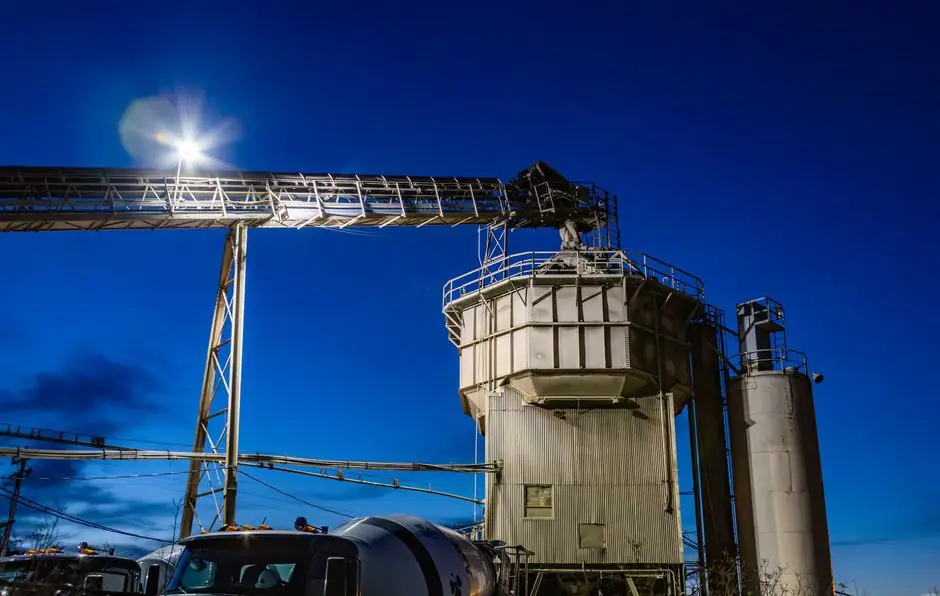
Inverted-tooth silent chain drives deliver up to 99% mechanical efficiency and, in heavy configurations, roughly twice the horsepower capacity of conventional silent chain designs at the same envelope, making them a credible alternative to heavy roller chain drives in cement plant service [S2][S6].
Cement plants expose chain drives to abrasive dust, clinker fines, ambient temperatures often above 150 °F (66 °C) near kilns and coolers, and shock loads from crusher and mill start-stops; silent chain geometry tolerates these conditions better than open roller chain, provided pitch, flank angle, and sprocket are matched to the application [S3][S5][S8].
Why Inverted-Tooth Geometry Fits Cement Service
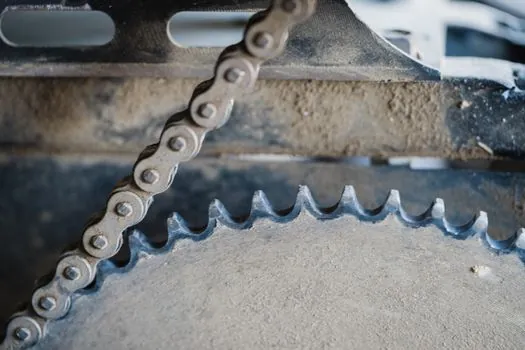
Silent chain, also called inverted-tooth chain, engages the sprocket with a row of toothed link plates rather than free-spinning rollers, spreading contact across many teeth at once and producing a quieter, lower-vibration drive than a roller chain of equivalent pitch [S3]. The 60° tooth flank angle is essentially standardized across manufacturers, which keeps sprocket sourcing and replacement predictable for plant maintenance teams [S3].
Multi-strand silent chain, where two or more single chains are pinned side-by-side, scales load capacity without changing sprocket geometry, and is the configuration most often quoted for cement mill and kiln drive retrofits where a single-strand unit would be undersized [S3][S6]. For conveyor-side service, however, the cement-industry supply base still centers on bucket elevator chains, drag chains, reclaimer chains, and pan conveyor chains, and silent chain is typically reserved for high-speed power transmission rather than for material handling itself [S5].
Core Selection Parameters: Pitch, Flank Angle, Width
Three measurements drive every silent chain specification: pitch (center-to-center link spacing), link flank angle (almost always 60° to the centerline), and overall chain width, which is the lever for capacity rather than a change in pitch [S3][S9]. Pitch must be chosen first, because the sprocket must be re-cut to match and a mis-match silently chews the drive until teeth hook or the chain climbs the sprocket.
Width is then selected to carry the design horsepower at the operating rpm, and the rule of thumb from heavy-duty suppliers is that each added strand roughly doubles the catalog horsepower rating, consistent with Ramsey's published claim that its Rampower line delivers about twice the horsepower of conventional silent chain at the same pitch and width [S6]. For cement kiln and cooler fans, where 100–300 HP at 1,000–1,800 rpm is common, a single-strand heavy series is usually adequate, while crushers and large raw mills more often justify multi-strand [S6][S8].
Operating Envelope: Speed, Temperature, Dust
Standard silent chain drives are routinely rated for speeds above 7,000 FPM (feet per minute) and mechanical efficiency up to 99% in well-aligned, properly lubricated service, a benchmark established in published manufacturer data and still cited in current selection literature [S2]. Cement plant ambient conditions around kilns, preheater towers, and clinker coolers regularly sit at 60–80 °C with localized hot spots, and dust load is the bigger threat than temperature: cement fines infiltrate pin-bushing clearances, accelerate wear, and shorten chain life far more than heat alone [S3][S5][S8].
Selection should therefore favor sealed-pin or sealed-link constructions, hardened pin and bushing materials, and continuous-film lubrication with oil reservoirs sized for the higher operating temperature, rather than grease, which solidifies in dusty, hot enclosures and starves the pin-bushing joint [S3][S5]. For outdoor or preheater-tower drives, a fully enclosed chain case with positive ventilation is the practical defense against the airborne fines that otherwise destroy bushing surfaces inside a single shift.
Silent Chain vs Roller Chain vs Conveyor Chain in Cement Duty
Silent chain, heavy-series roller chain, and dedicated conveyor chain are the three real options, and they are not interchangeable. The table below lines them up against the four criteria that drive cement-plant decisions. [S3]
Silent chain wins on speed capability, noise, and vibration, holding 99% efficiency at high rpm and tolerating multi-strand width scaling; it loses on field splicing and on parts commonality with the broader plant roller-chain inventory [S2][S3][S6]. Heavy-series roller chain wins on field repairability, spare-parts commonality across the plant, and tolerance of misalignment, and is the default where sprockets are already in stock and crews know how to set the drive [S8]. Conveyor-specific chains (bucket elevator, drag, reclaimer, pan) win on material-handling duty, with cast or fabricated attachments engineered for the product being moved, and have no business in a high-speed power-transmission role at all [S5][S7].
For coal-mill and cement-mill main drives running above 600 rpm, silent chain or synchronous belt is the typical choice for the gearbox input; for raw-material conveyors, clinker coolers, and kiln-feed chains, the heavy-duty conveyor chain families dominate and silent chain is not specified [S5][S7][S8].
Where Silent Chain Succeeds and Where It Fails in a Plant
Silent chain is the right call for kiln and cooler fans, coal-mill pulverizer drives, and any high-speed gearbox input shaft where noise and vibration would otherwise reach operators, with published ratings up to 3,000 HP and 7,000+ FPM well above what the plant actually needs [S2]. It is also a strong fit for retrofitting a noisy roller chain drive on a horizontal mill where the operator station is within 3 m of the drive, because the noise reduction is immediate and the efficiency is preserved [S2][S3][S6].
It is the wrong call for any chain that has to articulate around a small sprocket under high shock (bucket elevators, reclaimer booms, apron feeders), where the multi-plate silent chain stacks cannot shed contamination and will gall under the cyclic bending that the application imposes; a heavy-duty conveyor chain or apron-chain design is engineered for exactly that flex-and-shock duty [S5][S7]. It is also wrong for slow, highly contaminated scraper service inside a drag conveyor, where case-hardened roller chain or dedicated forged drag chain outperforms an inverted-tooth stack on contamination tolerance and on field link replacement. For additional reading on sizing heavy-series roller chain in the same dust-and-shock environment, see Roller chain selection for cement plants: pitch, service factor, and heavy-series rules.
Sourcing, Standards, and Maintenance Discipline
Measure, do not guess: pitch, link flank angle, chain width, and number of strands must be read off the existing chain or off the OEM drawing, because silent chain pitch is not interchangeable with roller chain pitch even when the center distance looks similar [S9]. The standard measurement protocol is to count links over a known length, divide for pitch, confirm the 60° flank with a protractor against a worn link, and then match the width to the catalog horsepower at the actual operating rpm [S3][S9].
Because no single ISO or AGMA standard governs every silent-chain geometry variant, the practical safeguard is to keep sprockets, chain, and master links from the same manufacturer and series; mixing a John King, Ramsey, or Tsubaki silent chain with a third-party sprocket of the same pitch can still produce premature wear if the flank geometry, tooth width, or hardness spec diverges [S5][S6][S9]. Maintenance intervals for cement-plant silent chain should be scheduled on the same rotation as gearbox oil changes, with a visual check of pin-bushing wear, a tension check against the manufacturer's slack limit (typically 1–2% of center distance), and a lubricant sample pulled for particulate, since cement fines in the oil are the leading indicator of impending pin-bushing failure [S3][S5][S8].