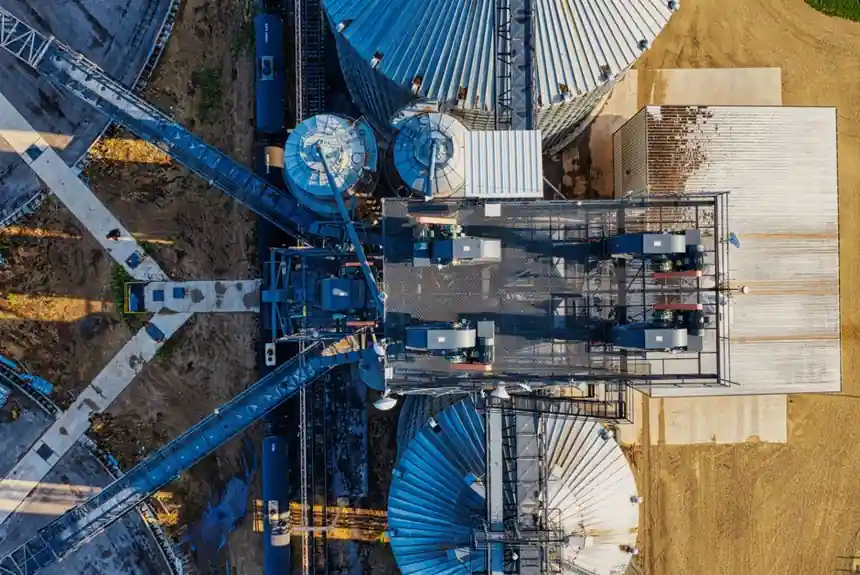
Cement mills, quarries, and clinker coolers run roller chain in some of the harshest mechanical service found in bulk solids handling: abrasive dust above 200 °C near the kiln shell, heavy shock on apron conveyors, and continuous 24/7 duty on bucket elevators, where downtime is measured in lost tonnes per hour.
Cement industry equipment typically requires comparatively large pitch chain (over 1.5"/38.1 mm pitch), and excessive wear, elongation, and stiffness in those large drives are harder to compensate for because of the physical size and weight of the chain plus bucket attachments [S4]. Selection is therefore driven less by catalog horsepower and more by environment, service factor, and chain architecture than for general industrial drives [S5].
What "roller chain" means in a cement context
Roller chain is a series of short-pitch cylindrical rollers articulated on pins and bushings, transmitting power through sprocket meshing, with steel transmission roller chain made to close tolerances for smooth joint articulation and efficient power flow [S7]. Within a cement plant the same ISO 606 basic geometry shows up in three roles: power transmission (kiln drives, crushers, fans), material handling (apron, pan, and case conveyors), and vertical lift (bucket elevators, both centrifugal and continuous discharge) [S2][S4].
Cement conveyor chain in particular runs apron conveyors, case conveyors, and bucket elevators at the cement mill and on cement carrier vessels, where loads are highly abrasive and pins, bushings, and rollers receive special surface hardening to extend wear life beyond standard conveyor chain [S2]. A 2006 sector review still cited as the baseline reference describes the cement chain environment as a combination of water ingress, coarse particulate residue, and difficult lubrication that accelerates wear in any chain not built for the duty [S4 (2006-09)].
Selection flow: power-based vs load-based, with service factor first
The standard power-based flow starts with five inputs, namely input power type, driven equipment, horsepower, full-load speed of the fast shaft, and desired slow-shaft speed, then adds shaft diameters, center distance, and any drive geometry constraints before the first chain pitch is touched [S3]. The same data-collection checklist is repeated in current 2026 selection guides: motor kW/HP, driver RPM, output RPM, center distance, load nature, duty cycle, environment, and envelope [S5].
Two paths then branch from that dataset. For drives, the design horsepower is HP × service factor, with Ks ≈ 1.0 for uniform load on electric motors, 1.2 for moderate shock, and 1.4 for heavy shock; on internal combustion engines with mechanical drive the same load classes step up to 1.2 / 1.4 / 1.7 [S3]. For slow conveyors and bucket elevators, a load-based path using payload, lift height, and speed is preferred, because the design horsepower on a 24/7 vertical elevator is often far below the chain's catalog rating and wear, not fatigue, governs life [S5].
Once design HP is known, the chain pitch is read off a quick-selector chart at the intersection of design HP and small-sprocket RPM, choosing the fewest number of strands for the most economical selection, and only escalating to duplex or triplex when a single-strand rating is exceeded [S3]. Multiple-strand chains multiply power capacity but demand precise parallel alignment, and misalignment is the fastest way to convert a duplex chain into a single-strand wear machine [S5].
Cement-specific chain types: heavy series, attachment chains, BF/RF elevator chain

Standard transmission chain is not the right baseline for cement service: cement and aggregate chain is sold as an engineered class explicitly designed to handle heavy shock loads, abrasive environments, and continuous operation in cement plants, quarries, and bulk terminals [S6]. Within that engineered class the main families are heavy-series transmission chain (larger plates, larger pins, often through-hardened), large-pitch attachment conveyor chain (with K1, K2, G1, G4 buckets or scraper bars welded or bolted to extended pins), and bucket-elevator chain in dedicated BF (centrifugal discharge) and RF (continuous discharge) variants [S4].
A practical comparison for spec work: standard series chain (40B, 50B, 60B, 80B, 100B, 120B) is the low-cost baseline with the widest availability, heavy series (80H, 100H, 120H, 140H, 160H, 200H) trades cost for thicker plates, larger pin diameters, and typically 15–30% higher fatigue ratings for the same pitch [S3][S5]. Attachment conveyor chain adds standardized attachments (A, K, D, SA, SK, etc.) on extended pins, used on apron conveyors carrying clinker and limestone [S2][S8]. Bucket-elevator chain (BF/RF) adds shot-peened link plates, induction-hardened pins, and case-hardened bushings in clean alloy/carbon steel, with five standard attachment styles and a heavier BT version for the toughest elevators [S4].
The performance delta is real and quantified: in field trials at working cement mills, BF-series chain delivered an averaged 1.5× greater wear life than conventional chain, and several times the life of cheaper lower-quality chain, which is why major operators including Lafarge, CEMEX, National Cement (USA), and Blue Circle run BF series at various global sites [S4].
Service factors and design HP for typical cement drives
For an electric-motor-driven rotary kiln shell drive or clinker cooler drive (uniform to moderate shock), Ks = 1.0–1.3 is acceptable, but for apron conveyors, pan feeders, and primary crushers, heavy shock is the realistic class and Ks = 1.4–1.5 with electric motors, jumping to 1.7 on a mechanical ICE drive [S3]. Bucket elevators are the borderline case: continuous discharge units can be treated as moderate shock (Ks ≈ 1.2–1.3), while centrifugal discharge elevators with intermittent loading and starting under load should be classed as heavy shock (Ks ≈ 1.4–1.5) [S3][S4].
Drives with more than two sprockets, idlers, or unusual conditions such as severely abrasive or corrosive environments, high temperatures, widely fluctuating loads, and frequent starts/stops require special attention and are flagged for engineering review rather than catalog selection [S3]. In cement practice that list is almost always true: dust, heat, and shock load are not edge cases but the baseline.
Pitch, sprocket teeth, and the small-sprocket rule
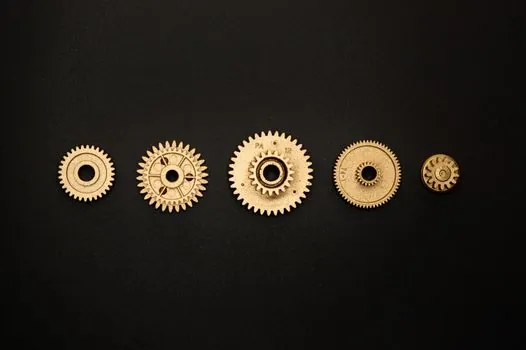
Pitch is the most critical dimension for matching chain to sprocket, and the minimum number of teeth on the small sprocket is a hard constraint set by the chain's horsepower tables rather than a free choice [S3][S5]. Running below the minimum tooth count raises the polygon-ing effect, increases impact velocity on the sprocket teeth, and shortens both chain and sprocket life. A 17-tooth small sprocket on a 2.0" (50B) chain, or 21 teeth on a 3.0" (80B) chain, is a typical cement-plant starting point, and going lower than 17 teeth at 50B pitch is a red flag during spec review.
Sprocket alignment within 0.050"/ft and a slack of roughly 1/120 of the center distance are installation-level guardrails that directly protect any chain selection: a correctly chosen chain on misaligned sprockets still wears as if it were undersized [S5]. Reference engineering chain detail for related sizing work is catalogued in the roller chain encyclopedia entry, and for the bucket-elevator drive side, the same selection flow feeds into the tapered roller bearing supports on the head and boot shafts.
Environment: dust, heat, corrosion, and the lubrication problem
Water ingress, coarse particulate residue, and elevated temperature combine to make effective lubrication the single biggest wear driver in cement chains, and lower-quality products suffer heavy wear in that environment despite adequate catalog ratings [S4]. The 2025 industry survey of heavy-duty cement chain repeats the same point: standard chains fail in the extreme environment of a cement plant, and the right heavy-duty, heat, and abrasion-resistant chain is the difference between smooth production and stoppages [S8 (2025-08)].
Material and surface responses to that environment are well-defined. Induction-hardened pins raise surface hardness to roughly 55–60 HRC while keeping a tough core, case-hardened bushings provide a similar hard wear face, shot-peened link plates push fatigue strength up by introducing compressive surface stress, and specialty coatings or zinc-aluminum flaking add corrosion resistance in wet or chemically aggressive zones [S4][S8]. For very high temperature zones near the kiln or clinker cooler, alloy-steel chain with controlled carbon content and stabilized pin-bushing clearances is specified over standard carbon-steel chain to prevent hot hardness loss [S8].
For apron conveyors, the design decision often lines up as standard conveyor chain with hardened wear parts (lowest cost, shortest life in severe abrasion) versus engineered cement chain with through-hardened pins and bushings (mid cost, 1.5–2× wear life) versus engineered chain plus sealed-for-life or automatic lubrication (highest first cost, longest intervals, and best fit for hard-to-access conveyors) [S4][S6][S8].
Wear limits, replacement triggers, and signs to watch
Replace a power-transmission roller chain when wear elongation reaches about 1.5% and a conveyor chain when elongation reaches about 2–3%, measured across a fixed span of pitches with a caliper or chain wear gauge [S5]. In cement service, measurable elongation is preceded by visible slack, rising noise, and sprocket-tooth hooking, and because large-pitch chain is so physically heavy, allowing elongation to climb much past the 1.5% mark on power drives quickly leads to dangerous head-shaft whipping and bucket collisions on elevators [S4][S5].
Breakage is rare because the wear symptoms are loud and visible long before fracture, but if it does occur the consequences are severe: a snapped BF or RF elevator chain can drop a full bucket line onto the boot casing, take out the head shaft, and cost the plant several days of lost clinker output [S4]. For selection in adjacent bulk-solids service, the same power-based flow with elevated Ks values is covered in the roller chain selection for mining drives reference, and impact-load shock data for the conveyor structures that carry these chains is in the shock absorber sizing for pulp and paper article.
Standards, sourcing, and what to demand from a supplier
For dimensional interchangeability across vendors, ISO 606 short-pitch transmission chain and ISO 606 attachment chain are the baseline, with ANSI B29.1 the US mirror standard covering 40 through 240 sizes and their heavy-series counterparts [S3][S7]. For engineered cement classes, suppliers publish their own internal standards for surface hardening depth, minimum pin shear strength, and shot-peening coverage, and the specifier should demand documented values rather than generic "heavy duty" claims [S4][S6][S8].
Vendor catalog numbers worth knowing for cement spec sheets: TSUBAKI BF (centrifugal bucket elevator), RF (continuous discharge), and BT (reinforced heavy) series, plus general heavy series (80H/100H/120H/140H/160H/200H) for kiln and crusher drives [S4]; iwis engineered cement and aggregate chain for apron and pan conveyors [S6]; and ZEXUS cement conveyor chain with special hardening on pin, bushing, and roller for abrasive service [S2]. For related material-handling conveyor design, the roller conveyor and road roller encyclopedia entries cover adjacent equipment classes.
Spec sheets for cement chain should always list, at minimum: ISO/ANSI size, strand count, pitch in mm, minimum ultimate tensile strength (kN), pin and bushing surface hardness (HRC), attachment style and hole pattern, recommended service factor for the named duty, and maximum allowable wear elongation percentage, and any supplier that returns only a size and a price is a red flag for cement service [S3][S4][S5][S8].
The next spec milestones to track are the 2026 supplier catalog updates for engineered cement chain, which have continued to push hardened-pin minimum depths upward and to publish standardized wear-life test methods, and the gradual adoption of sealed-pin chain in retrofit cement plants, where water-ingress failures have driven operators away from re-lubricatable chain on hard-to-access elevators [S6][S8].