
Pressureless sintered silicon carbide (SSiC) holds flexural strength of 320–400 MPa at 20°C and 360–410 MPa at 1300°C, with open porosity at 0 vol% and Vickers hardness HV1 of 2350 kg/mm², making it the first-choice material for mold and die cavities that see continuous service above 1000°C [S1].
The two commercially relevant SiC families for tooling are pressureless sintered SiC (≥98 vol% SiC, density >3.10 g/cm³) and reaction-bonded SiC (≈12% residual Si infiltrant); a third route, recrystallized SiC, is used for refractory furniture but rarely for loaded die surfaces [S1][S8][S9].
Grade Comparison: SSiC vs RBSiC vs RSiC for Tooling
The SSiC grade delivers compressive strength of 2600 MPa, flexural strength of 400 MPa, and a maximum continuous service temperature near 1600°C in air (≈2000°C under inert gas or vacuum) [S1][S6]. Reaction-bonded SiC reaches the same 2600 MPa compressive class but drops to roughly 250 MPa flexural strength and loses 1300°C strength because of the residual silicon phase, so it is reserved for less loaded jigs and fixtures rather than primary die cavities [S9].
Selection should be driven by three numbers, all sourced: peak service temperature, mechanical load on the die face, and required dimensional tolerance after sintering. Where the part must hold <50 µm tolerance across a 200 mm face and run above 1400°C in oxidizing atmosphere, SSiC is the only defensible choice; where the part is a setter plate, crucible, or support jig under low load, RBSiC delivers 80–90% of the wear life at roughly half the machining cost [S1][S8][S9].
Thermal Cycling and Thermal Shock Behaviour
SSiC combines thermal conductivity of 116 W/(m·K) at 20°C with a coefficient of thermal expansion of 4×10⁻⁶ K⁻¹, which is why it survives rapid heating and cooling in glass forming and metal casting without cracking [S1][S4]. Independent mold-maker data quotes 100 W/(m·K) conductivity against the same 4×10⁻⁶ K⁻¹ expansion, giving a thermal-shock figure of merit that exceeds alumina by roughly a factor of five [S3][S4].
The single most common failure mode in SiC tooling is not bulk fracture but chipping at sharp internal corners under thermal gradient, so draft angles above 1° and corner radii above 0.5 mm are mandatory when ordering custom molds from suppliers such as Fudong, Haikun, or Hard Ceramics [S3][S4][S7]. For deeper coverage of how these SiC families compare with nitride and oxide options, see the silicon carbide properties reference and the silicon nitride properties reference, which line up the modulus and toughness trade-offs side by side.
Corrosion Resistance in Casting and Glass Contact
Immersion corrosion data shows SSiC losing less than 0.2 mg/cm²·yr in 98% H₂SO₄ at 100°C, in 53% HF at 25°C, in 70% HNO₃ at 100°C, and in 85% H₃PO₄ at 100°C, all of which fall in the "recommended for long-term service" band of the supplier's own corrosion guide [S1]. RBSiC in the same 98% H₂SO₄ test loses 55 mg/cm²·yr, roughly 30× worse, because the silicon phase is attacked; the same RBSiC grade in 50% NaOH at 100°C is destroyed, exceeding the 1000 mg/cm²·yr failure threshold [S1].
The practical reading: for non-ferrous die casting of aluminum and zinc, for glass gob forming, and for any acid-side chemical reaction jig, specify SSiC; for alkaline-side contact or for parts where the molten alloy is iron-based and dilution of the free-silicon phase is acceptable, RBSiC remains cost-justified [S1][S3][S4].
Mechanical Loads and Wear Life on Die Faces
Indentation hardness on SSiC reaches 93 R45N, placing it second only to diamond and cubic boron nitride among engineering materials, which is why SiC insert faces outlast tool-steel inserts by a factor of 5–10 in pump and slurry service [S1]. Die-face compressive strength of 2600 MPa is roughly four times that of hardened H13 tool steel at room temperature, but SiC's fracture toughness is lower, so impact loading at part extraction must be controlled through stripper design rather than absorbed by the die material [S1][S6].
Where die action involves high cycle counts of metal-to-ceramic sliding, carbon-impregnated SSiC (C-SiC) is the standard workaround, because the free-carbon phase reduces friction and improves self-lubrication at the part/die interface without sacrificing the >3.10 g/cm³ density [S1]. For tooling that interfaces directly with a casting mold steel frame, SiC's low coefficient of friction against graphite-equivalent thermal conductivity also reduces the cooling-channel count required for stable die temperature.
Forming Routes and Achievable Geometry
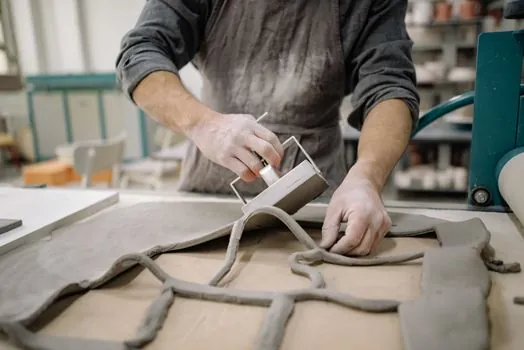
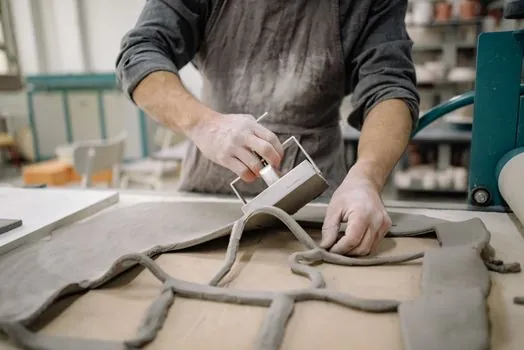
The four forming routes for SiC mold bodies are dry pressing plus sintering, isostatic pressing plus sintering, reaction bonding (silicon melt infiltration of a SiC/C preform), and ceramic injection molding (CIM); injection-molded SiC routinely holds porosity below 0.1% and SiC content above 99%, with the same 2600 MPa compressive and 400 MPa flexural benchmarks as pressed SSiC [S6][S10].
Reaction bonding is preferred for complex internal channels, threads, or thin-wall features because the part shrinks only 1–2% during infiltration, against 15–20% for pressureless sintering, so net-shape tolerance is held without secondary grinding; the trade-off is the residual 8–12% free silicon that caps hot strength and forbids alkaline contact [S1][S9][S10]. For mold bases that need both tight flatness and the wear life of SSiC on the cavity, the typical hybrid is an SSiC cavity insert shrink-fit into a mold base of pre-hardened tool steel, which keeps machining cost contained while putting SiC only where it pays back.
Supplier Capability and Sourcing Signals
Chinese mold-grade SiC suppliers including Haikun, Hard Ceramics, Fudong, Inbot, and Att Elements now publish the same core property block: 2600 MPa compressive, 400 MPa flexural, 1600°C service ceiling, 100–116 W/(m·K) conductivity, 4×10⁻⁶ K⁻¹ expansion, and HV1 in the 2100–2350 range, with custom lead times quoted in the 3–10 day sample window [S1][S3][S4][S6][S7].
Trackable signals to watch on the next sourcing cycle are, first, whether the supplier's certificate of analysis reports per-batch density above 3.10 g/cm³ and per-batch open porosity at 0 vol% (the two numbers that catch under-sintered lots), and second, whether corrosion data is reported on the actual SSiC grade rather than the generic "SiC" column, because the free-silicon content of RBSiC changes the chemistry of acid attack by an order of magnitude [S1]. For a structured decision map covering SSiC versus RBSiC in construction-service versus route-service roles, the SiC ceramic selection for construction: route vs service gate map provides a side-by-side comparator.