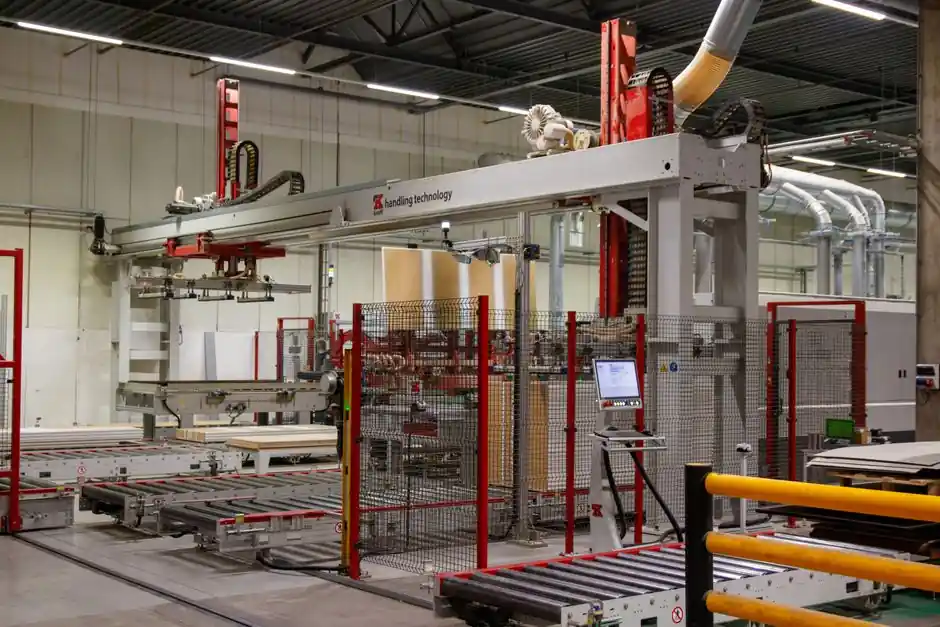
Single-deep and double-deep stacker crane configurations answer the same engineering question with opposite priorities: a single-deep aisle gives the crane direct access to one pallet per storage location, while a double-deep aisle holds two pallets in depth and reaches the rear pallet with a telescopic fork, lifting storage density by roughly 1.5–2× depending on SKU turnover and slotting [S3].
The decision governs rack height limits, crane model selection, and WMS/WCS logic. Interlake Mecalux publishes a five-model single/twin-mast range (MT-1 through MT-5) where the maximum height drops when the same crane is reconfigured for double-deep, for example 108 ft single-deep collapses to 89 ft double-deep on the MT-3, and 118 ft collapses to 108 ft on the MT-4 [S1]. The trade is not free, and it is rarely reversible without new hardware.
What Each Configuration Actually Is
A single-deep automated warehouse places one pallet position per storage slot, with the aisle on one side of the rack; the stacker crane services that one pallet without moving any other load, which is the textbook fully direct-access layout [S4]. A double-deep configuration stores two pallets in the same depth slot, one directly behind the other, so reaching the rear pallet requires a telescopic-fork crane that extends past the front pallet [S3][S4].
Stacker cranes themselves are categorised first by mast count (single-mast for lighter loads, twin-mast for heavier loads and greater heights) and then by reach depth; the same crane can usually be ordered in single-, double-, or triple-deep fork variants [S1][S2]. Operating envelope is wide: Interlake Mecalux specifies an operating range from -22 °F to 104 °F, so the same architecture covers cold storage and ambient warehouses without derating [S1].
Decision Criteria, Side by Side
The dominant variables are selectivity, density, cycle time, payload, and capital. The table below summarises how single-deep and double-deep compare on the four criteria that actually drive a spec committee vote. [S3]
Selectivity and inventory logic: single-deep gives 100% direct access to every pallet, so the WMS can run pure FIFO on any SKU; double-deep forces LIFO on the rear pallet unless the system is willing to shuffle the front pallet out and back in, which is exactly the dependency DELIECN flags in its AS/RS comparison [S3][S2].
Density and footprint: AR Racking states that double-deep cuts the number of work aisles versus single-deep by stacking two pallet units in depth from each aisle; ECS Eco and Geelyracks extend the same logic, with ECS claiming the double-deep layout can eliminate up to about 50% of aisles versus a standard selective rack [S4][S5][S6]. Mecalux's combined-cycle reference work assumes a 50/50 mix of single- and double-deep cycles when modelling throughput, which is the conventional way to bound the average [S8].
Payload and crane sizing: the same MT-3 crane rated 1.65 t in single-deep drops to 1.1 t in double-deep, and the MT-4 and MT-5 are derated from 1.1 t single-deep to 1.1 t double-deep across the line, so going double-deep usually forces a step down in payload class [S1]. Travel and lift performance are unchanged at 722 ft/min travel, 2 ft/s² acceleration, 217 ft/min lift, and 2 ft/s² lift acceleration on the published MT models [S1].
Cycle time and cost per pallet: single-deep cycles are short because there is no telescopic-fork extension and no sequencing logic; double-deep cycles are longer on the rear-pallet retrieval, but the lower cost per pallet position often wins in space-constrained or land-expensive sites, as DELIECN's cost analysis frames it [S3]. Geelyracks and ECS frame the same economics from the racking side: double-deep doubles storage lanes per aisle footprint, narrow-aisle single-deep keeps direct access but compresses aisle width, and the right pick depends on SKU profile, FIFO vs LIFO, and MHE strategy [S5][S6].
Who Single-Deep Is For, and Who It Is Not
Single-deep is the right spec when the operation runs high SKU variety, fast-moving goods, FIFO-sensitive inventory, or time-critical logistics, because the WMS can address any pallet without choreography [S3]. Inform International places e-commerce fulfilment, retail, consumer goods, and food and beverage distribution in the single-deep column for that reason [S2].
Single-deep is the wrong spec when the building footprint is fixed, land cost is high, and the SKU mix is dominated by medium-turnover items where the rear pallet does not need daily access. In that profile, a 1.5–2× density gain pays for the longer rear-pallet cycle in months, not years [S3]. Cold-storage and temperature-controlled facilities are also commonly specified double-deep for the same reason, according to Inform International's application matrix [S2].
Who Double-Deep Is For, and the Failure Modes to Watch
Double-deep is built for medium-turnover goods, bulk storage, and facilities under land or warehouse cost pressure; the rear-pallet dependency is acceptable in those profiles and the density win is the dominant financial driver [S3].
The two failure modes are access sequence drift and crane derating. Access sequence drift happens when SKU velocity changes after the rack is installed, and the rear pallet becomes a fast-mover that the WMS cannot reach without shuffling the front pallet; that is the operational tax on going double-deep. Crane derating is the other trap: the same model crane loses 30–40% of its maximum height when switched from single-deep to double-deep (108 ft to 89 ft on the MT-3, 118 ft to 108 ft on the MT-4), and payload drops from 1.65 t to 1.1 t on the smaller MT-1/MT-2/MT-3 frames, so the warehouse height and pallet weight envelope must be re-checked before committing [S1]. DELIECN also notes that double-deep requires more complex control logic and higher structural rack load ratings, which adds to the capital line [S3].
For very deep lanes, AR Racking's multideep-shuttle architecture extends the same idea past two-deep by feeding shuttles from the main aisle via stacker cranes or transfer cars; it is the natural next step when double-deep still does not cube the building out [S4]. A related storage-density decision is covered in double-deep vs narrow-aisle racking trade-offs for readers cross-checking rack systems, and a complementary high-bay angle on single-girder crane selection sits alongside for facilities that run mixed crane fleets. For pallet-movement throughput context, the pallet stacker category covers the lower-rise end of the same handling family.
Operating Window and Integration Notes
Both configurations run on the same WMS/WCS and can be integrated with conveyors, pallet lifts, RGVs, and shuttle-based subsystems, with the stacker crane as the vertical handling unit and shuttles handling intra-zone horizontal moves [S3]. Mecalux's double-deep video brief explicitly states that access aisles can be eliminated in the facility, which is what cuts installation cost per pallet position [S9].
Two operating parameters are worth pinning in the spec. First, declare the operating temperature range up front: Interlake Mecalux publishes -22 °F to 104 °F as standard, and a cold-store spec below that needs a vendor-confirmed extension, not an assumption [S1]. Second, decide the cycle-mix assumption used for throughput modelling; Mecalux's combined-cycle model uses a 50/50 single-deep and double-deep split as a baseline, and the actual mix should be matched to the SKU velocity profile rather than copied as a default [S8].
Selection Checklist for the Spec Sheet
Use this as a one-page filter when the rack and crane vendors arrive in the same meeting. If three or more of the first four items are true, default to single-deep; if three or more of the last four are true, default to double-deep. [S4]
Single-deep bias: SKU count > 5,000; > 30% of SKUs are A-class fast movers; FIFO is contractually required (pharma, food, batch-tracked chemicals); order cut-off time is tight enough that any shuffle cycle is unacceptable [S2][S3].
Double-deep bias: warehouse footprint is constrained and land cost is high; > 60% of SKUs are B/C class with predictable velocity; LIFO is acceptable; rack height is below the derated crane limit, for example ≤ 89 ft on an MT-3 frame if the original single-deep spec was 108 ft [S1][S3][S6]. If neither side dominates, narrow-aisle single-deep is the conservative compromise: it keeps direct access but compresses aisle width, which Geelyracks documents as the standard escape valve between selectivity and density [S5].