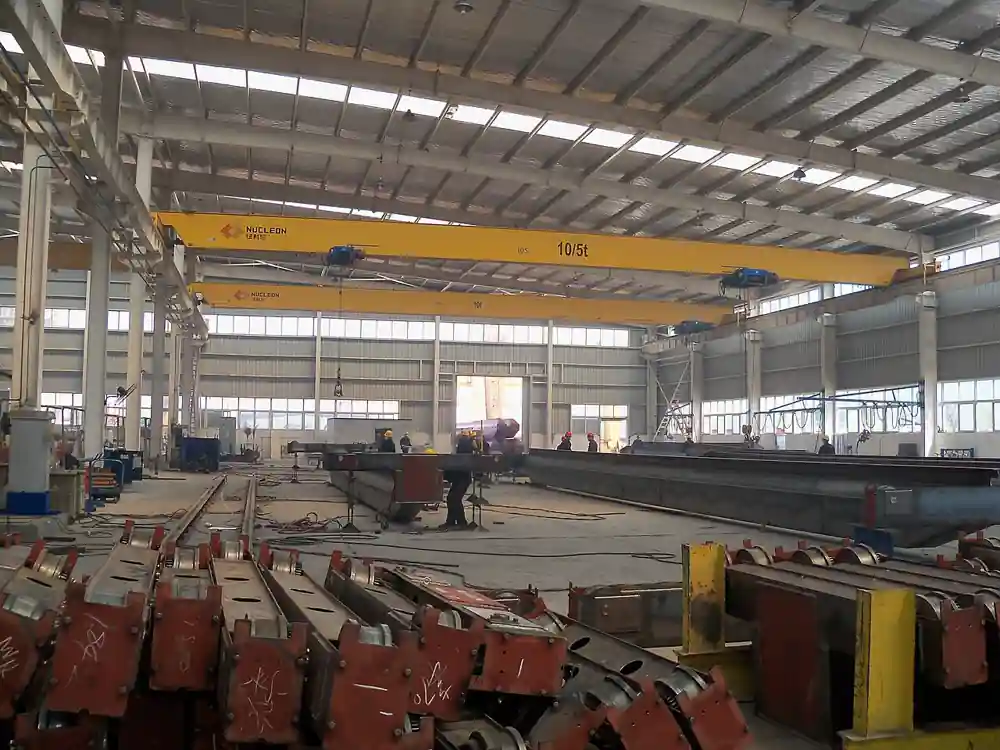
A single girder crane is an overhead travelling crane that carries its hoist on one bridge beam rather than two. It is the workhorse of light and moderate lifting: economical, light on the building structure, and tidy in low-headroom bays. Across workshops, warehouses, and machine shops, the single girder crane handles the bulk of duties from roughly 1 to 20 tons, with spans up to about 30 m.
This guide treats the single girder crane as a complete machine, the bridge girder, end trucks, hoist trolley, and travel drives, designed and classified under CMAA Specification 74 in North America and FEM 9.511 plus ISO 4301 in Europe and internationally. It explains where single girder ends and double girder begins, how duty class drives the structure, and how to read a single girder crane specification before issuing an RFQ.
This guide is aimed at industrial purchasing engineers and design engineers. It covers 6 chapters from definition and history, configurations, duty classification, girder structure and materials, key specification parameters, to selection decisions, with 7 selection FAQs and manufacturer references, helping you build a complete single girder crane knowledge framework in 30 minutes. All parameters reference CMAA Specification 74 and 70, FEM 9.511, ISO 4301-1, ASME B30.2 and B30.17, and EN 13001 public standards.
Chapter 1 / 06
What is a Single Girder Crane
A single girder crane, also called a single girder overhead crane, single girder EOT (electric overhead travelling) crane, or single girder bridge crane, is a lifting machine in which one horizontal bridge girder spans the working bay and carries a hoist trolley. The bridge moves along elevated runway beams (long travel), the trolley moves across the bridge (cross travel), and the hoist raises and lowers the load. Together these three motions cover a rectangular working envelope below the crane. What distinguishes single girder from double girder is the single load-bearing beam: one girder instead of two parallel girders.
The defining structural feature is the hoist mounting. On a single girder crane the hoist trolley is normally underhung, meaning it rides on the bottom flange of the bridge girder rather than on top of it. This places the hoist alongside and below the girder, which keeps the crane light and the dead height low. The trade-off is that the load line sits to one side of the girder web rather than centred between two girders, so the girder must resist both bending and a torsional twist, a fact that shapes the section design discussed in Chapter 4.
Mechanically a single girder crane has four assemblies: (1) the bridge girder, a rolled I-beam or fabricated box section that spans the bay; (2) two end trucks (end carriages) at the ends of the girder, each carrying wheels that ride the runway and the long-travel motor; (3) the hoist trolley, an electric chain hoist or wire rope hoist with its own cross-travel drive; and (4) the electrification and controls, festoon cable or conductor bar feeding power, plus a pendant or radio control. When all of this is integrated and sold as a finished travelling crane, the industry calls it a single girder EOT crane.
Overhead travelling cranes trace to the industrial revolution, when manually operated bridge cranes lifted castings in foundries and rolling mills. Electrification in the early twentieth century brought the electric overhead travelling crane, and the rolled I-beam single girder crane became the economical standard for light and medium duty as steel mills produced consistent beam sections. The Crane Manufacturers Association of America codified the discipline: CMAA Specification 70 for multiple (double) girder cranes and CMAA Specification 74 specifically for top-running and under-running single girder electric overhead cranes. CMAA 74 has been revised repeatedly, with recent editions clarifying allowable stress, deflection, torsion, and wheel-load distribution.
In application scale, single girder cranes occupy the high-volume middle of the lifting market. They rarely exceed about 20 tons, and underhung versions are usually limited to 10 tons or less, yet they account for the majority of overhead cranes installed in general manufacturing because most factory lifts are well within that range. The engineering goal is not maximum capacity but the lightest, cheapest structure that meets capacity, span, duty class, and deflection limits over a 20 to 30 year service life.
Chapter 2 / 06
Configurations and Types
Single girder cranes are classified first by how the end trucks engage the runway, and second by where the runway itself is supported. The two primary configurations are top-running and under-running. Choosing the wrong configuration is the most consequential early decision, because it determines whether the crane load flows into the building columns or hangs from the roof, and it sets the practical capacity ceiling. The table below contrasts the two configurations on the parameters that drive selection.
Configuration
Wheel runs on
Typical capacity
Load path
Best for
Top-running
Top of runway rail
Up to 20 t
Into building columns
Higher capacity, longer span, easy rail service
Under-running (underhung)
Bottom flange of runway
Up to 10 t
Suspended from roof
Low headroom, bay-to-bay transfer, wall approach
Single-leg semi-gantry
One runway, one floor rail
Up to 10 t
Split: column and floor
Mixed structures, partial column support
Wall-travelling (wall crane)
Wall-mounted runway
Up to 10 t
Into wall corbels
Servicing under a larger crane, low-level coverage
Top-running single girder cranes carry their end-truck wheels on rails laid on top of the runway beams. The crane load passes down through the wheels and rails into the runway beams and then into the building columns. This is the higher-duty configuration: it supports more capacity, longer spans, and higher travel speeds, and the rail sits in the open where it is easy to inspect and replace. The cost is greater building headroom, because the bridge girder and hoist hang below the runway rail elevation.
Under-running single girder cranes, also called underhung cranes, have end-truck wheels that ride on the bottom flange of the runway beams, so the entire crane hangs beneath the runway. This frees the floor entirely and lets the runway be suspended from the roof trusses. Underhung runways can be interlocked between adjacent bays, allowing a load to transfer from one crane to another through a switch, which top-running cranes cannot do. The penalties are a lower capacity ceiling, usually 10 tons or less, and the need to monitor wear of the runway lower flange, which carries the wheel load directly. CMAA Specification 74 covers both top-running and under-running single girder cranes in one document.
Semi-gantry and wall-travelling variants extend the single girder concept where a full overhead runway is impractical. A single-leg semi-gantry runs one end on an elevated runway and the other on a floor-level rail carried by a leg, useful where only one wall can carry crane load. A wall-travelling crane mounts its runway on wall corbels and is often installed beneath a larger top-running crane to give low-level coverage along one side of a bay. Both remain single girder machines with one bridge beam and an underhung hoist.
A separate distinction is the hoist type carried by the trolley, which is covered in Chapter 5. In short, lighter single girder cranes use an electric chain hoist, while heavier and higher-duty single girder cranes use a wire rope hoist. The configuration choice (top-running versus under-running) and the hoist choice (chain versus wire rope) are independent decisions that together define the machine.
Chapter 3 / 06
Duty Classification: CMAA, FEM, ISO
Duty class is the single most misunderstood specification on a crane RFQ, and getting it wrong is expensive in both directions: an under-classified crane wears out and cracks early, while an over-classified crane wastes capital on structure the duty never demands. Three classification systems dominate. CMAA Specification 74 (and 70) rates the whole single girder crane by lifetime load cycles and load spectrum. FEM 9.511 and ISO 4301-1 rate the mechanism, principally the hoist, by load spectrum and average daily running hours. The table below summarises the CMAA service classes that apply to single girder cranes.
CMAA service classes A to F are set by the number of lifetime load cycles and how close working loads run to rated capacity. Most single girder cranes fall in Class A to C, occasionally Class D, because the heaviest continuous duties (Class E and F) usually demand a double girder structure. A higher class drives a heavier girder, larger travel and hoist motors, and longer-life mechanisms, so the class chosen at purchase compounds through the entire bill of materials. The class must reflect realistic operation: an honest count of lifts per hour and the typical load as a fraction of capacity, not a guessed safety margin.
FEM 9.511 and ISO 4301-1 rate the mechanism rather than the whole crane. They combine a load spectrum (light, medium, heavy, very heavy) with average daily running time to assign a duty group. FEM uses groups such as 1Bm, 1Am, 2m, 3m, while ISO 4301 uses M3, M4, M5, M6. The two systems align closely: FEM 1Am corresponds to ISO M4, and FEM 2m corresponds to ISO M5 for a hoist that lifts roughly 70 percent of working load about two hours per day. A typical workshop single girder crane hoist is specified around FEM 1Am to 2m, equivalently ISO M4 to M5.
The cross-walk between CMAA whole-crane classes and FEM or ISO mechanism groups is approximate, not one to one, because CMAA rates the whole crane while FEM and ISO rate the mechanism separately. As a working guide, a CMAA Class C machine-shop single girder crane usually pairs with an FEM 1Am to 2m hoist, and a CMAA Class D crane needs FEM 2m to 3m or higher. The table below gives the practical mapping engineers use for first-pass single girder selection, to be confirmed with the manufacturer.
CMAA class (crane)
FEM group (hoist)
ISO 4301 group (hoist)
Indicative daily run time
A / B
1Bm
M3
~0.5 h/day
B / C
1Am
M4
~1 h/day
C
2m
M5
~2 h/day
D
3m
M6
~4 h/day
Chapter 4 / 06
Girder Structure and Materials
The bridge girder is the heart of a single girder crane, and its section choice trades cost against span, capacity, and deflection. Two constructions dominate: a rolled standard I-beam (or wide-flange section), and a fabricated welded box girder. The rolled I-beam is the economical default for short spans and light capacity, while the box girder takes over as span and capacity grow and torsion from the offset underhung load becomes significant.
Rolled I-beam girder. A single standard steel I-beam or wide-flange section, used straight from the mill, is the cheapest single girder. The hoist trolley wheels ride directly on the bottom flange. Rolled sections are economical for spans up to roughly 18 to 20 m (about 65 ft) and capacities up to a handful of tons. The limitations are torsional softness, because an open I-section twists easily under the offset hoist load, and the fixed set of available rolled sizes, which forces the designer to jump to the next heavier beam rather than fine-tune the section.
Welded box girder. A fabricated box, formed from steel plate welded into a closed rectangular section, is far stiffer in torsion than an open I-beam and can be dimensioned to the exact load. Box girders extend single girder cranes to longer spans and higher capacities, including the normal-headroom 40 ton single girder configurations offered by major makers. The closed section resists the twist from the underhung hoist, carries a built-in camber so the girder sits level under dead load, and provides a clean surface for the trolley track. The cost is more fabrication and welding, and welds in load-carrying members must meet the fatigue requirements of the duty class.
The wheel-to-rail and wheel-to-flange interface is the other structural focus. On a top-running crane the end-truck wheels run on a rail, and wheel material and diameter are sized to the maximum wheel load and the duty class to control contact stress and wear. On an under-running crane the wheels run on the runway lower flange, so the flange itself is a wear surface that must be specified and monitored. Camber, deflection, and wheel load are interdependent: at longer spans, the deflection limit (see Chapter 5) usually governs the girder section before bending stress does.
The table below summarises the structural materials and where each construction fits. Steel grade selection follows the governing design code, typically structural steel to EN 13001 in Europe or the equivalent AISC-based allowable-stress approach embedded in CMAA, with the calculated static stress at rated capacity held to a conservative fraction of the material's published ultimate strength.
Girder type
Material
Span suitability
Torsional stiffness
Relative cost
Rolled I-beam
Standard hot-rolled structural steel
Up to ~18-20 m
Low (open section)
Low
Welded box girder
Welded structural steel plate
Up to ~30 m
High (closed section)
Medium
Compact / patented box
Optimised welded plate, OEM design
Up to ~30 m
High
Medium-high
Runway beam (top-running)
Rolled or built-up with crane rail
Per support spacing
N/A
Project-specific
Chapter 5 / 06
Key Specification Parameters
Reading a single girder crane specification is a core skill for purchasing engineers. Spec sheets list many lines, but a manageable set of parameters actually drives the design and the price: rated capacity, span, lift height, duty class, the three travel and hoist speeds, hoist type and reeving, deflection limit, wheel load, and the controls and electrification. Each is explained below.
Rated capacity (SWL). The safe working load, the maximum load the crane is designed to lift, stated in tonnes. Single girder cranes are most common from about 0.5 t to 20 t, with under-running versions usually held to 10 t or less. Capacity sets the hoist size, girder section, wheel load, and motor power, so it is the first number on every RFQ.
Span. The horizontal distance between the centres of the two runway rails, that is, the length of the bridge girder, stated in metres. Single girder spans reach about 30 m. Span and capacity together drive girder weight, because doubling the span more than doubles the bending moment, which is why long-span cranes migrate from rolled I-beam to box girder, and eventually to double girder.
Lift height (hook path). The vertical travel of the hook, set by the hoist drum or chain capacity and the building height, commonly up to about 10 m on standard single girder cranes. Lift height interacts with headroom: the underhung hoist of a single girder crane already minimises lost height, which is one of its advantages in low buildings.
Three speeds. A travelling crane has three motions, each with its own speed:
Hoisting speed: typically 3 to 8 m/min for heavier main hooks and 10 to 40 m/min for lighter wire rope hoists, with creep or micro-speed near 0.5 m/min for precise spotting.
Cross-travel (trolley) speed: commonly 10 to 30 m/min across the girder.
Long-travel (bridge) speed: commonly 20 to 60 m/min along the runway, higher for longer runways and heavier duty.
Hoist type and duty group. Electric chain hoist for lighter duty (up to about 5 t), wire rope hoist for heavier capacity, longer lift, and higher duty. The hoist carries its own FEM or ISO duty group (for example FEM 1Am / ISO M4), which must match the crane service class. Variable frequency drives are now standard on hoist, trolley, and bridge for stepless control and anti-sway.
Deflection limit. The girder's vertical sag under rated load plus trolley, without impact, is limited by CMAA Specification 74 to L/888 of the span for a cambered girder. The supporting runway is held to L/600 for top-running and L/450 for under-running, where L is the relevant span. At longer spans the deflection limit, not the bending stress, usually decides the girder section, and excessive deflection causes the trolley to roll toward midspan and accelerates wheel and rail wear.
Wheel load and electrification. The maximum wheel load, the force each end-truck wheel transfers to the runway, sizes the runway beams and the building columns, and is the number the building structural engineer needs. Electrification (festoon cable or conductor bar), control method (pendant or radio), and ingress protection (IP54 to IP65 housings) round out the specification. For outdoor or washdown duty, specify the appropriate protection and corrosion finish.
Chapter 6 / 06
Selection Decision Factors
To turn the knowledge of the preceding five chapters into a specific single girder crane, follow the decision sequence below. Most selection mistakes come not from a single wrong number but from deciding the wrong thing first, for example fixing on a hoist before confirming capacity, span, and duty class. These eight steps can serve as a fixed RFQ template.
Capacity and load profile: Fix the safe working load from the heaviest realistic lift plus lifting attachments, then confirm single girder is appropriate (at or below roughly 15 to 20 tons). Above that, move to double girder.
Span and lift height: Set the span from the bay width between runway centres and the lift height from the floor-to-hook requirement. Long spans push the girder from rolled I-beam toward box girder.
Configuration: Choose top-running for higher capacity, longer span, and easy rail service, or under-running for low headroom, bay-to-bay transfer, and close wall approach (capacity then usually 10 tons or less).
Duty class: Set the CMAA service class (A to F) from honest lifts-per-hour and load-as-fraction-of-capacity, and the matching FEM or ISO hoist duty group. Most workshop cranes are CMAA A to C, FEM 1Am to 2m.
Hoist type and speeds: Electric chain hoist for light duty up to about 5 tons, wire rope hoist above that. Specify hoisting, cross-travel, and long-travel speeds, and whether VFD micro-speed is required for precise spotting.
Building interface: Confirm maximum wheel load against the runway and column capacity, the deflection limits (L/888 girder, L/600 or L/450 runway), and available headroom. Involve the building structural engineer before finalising span and class.
Certifications and jurisdiction: CMAA 74 plus ASME B30.2 / B30.17 and OSHA in North America; CE under Machinery Directive 2006/42/EC with EN 13001 and FEM 9.511 in Europe; GB/T 3811 with TSG type inspection in China. Match the standard to the destination, not the maker's home country.
Total cost of ownership (TCO): Purchase price plus installation, runway and electrification, periodic inspection, and the cost of downtime. An under-classified crane that wears out early, or an over-classified crane that wastes structure, both raise lifetime cost beyond the purchase difference.
One last commonly overlooked dimension is manufacturer serviceability: local spare-part inventory (wheels, brakes, hoist components), field service and inspection availability, and the supply of the standardised hoist and end-truck modules years after installation. These seem secondary at purchasing but determine repair response time after a decade of production. Major suppliers of single girder cranes and their hoists, including Konecranes (CXT series), Demag (with DC chain and wire rope hoists), ABUS, Columbus McKinnon (Shaw-Box), and R&M, maintain spare-part and service networks across major industrial regions, which makes them reliable choices for plants that cannot tolerate long crane downtime.
FAQ
What is a single girder crane and when should I choose one over a double girder?
A single girder crane is an overhead travelling crane that carries the hoist on one bridge beam instead of two. The hoist trolley is normally underhung, running on the bottom flange of the girder rather than on rails on top of two girders. Single girder cranes dominate the light to moderate duty range, roughly 1 to 20 tons capacity and spans up to about 30 m, and are the standard choice for workshops, warehouses, assembly bays, and machine shops. Choose single girder when capacity is at or below about 15 to 20 tons, the duty is CMAA Class A to C, headroom is tight, and budget matters, because for equal capacity a single girder crane is lighter, imposes lower wheel loads on the building, and typically costs 40 to 50 percent less than an equivalent double girder. Step up to double girder when you need higher hook lift, a walkway or cab on the bridge, an auxiliary hoist, or capacity above roughly 20 tons.
What is the difference between a top-running and an under-running single girder crane?
Both layouts use one bridge girder, the difference is how the end trucks ride the runway. A top-running single girder crane has end-truck wheels that sit on top of rails laid on the runway beams, so the crane load passes through the rails into the building columns. A top-running crane gives more capacity, longer spans, and easier wheel and rail maintenance. An under-running (underhung) single girder crane has end-truck wheels that ride on the bottom flange of the runway beams, so the crane hangs below the runway. Under-running cranes allow the runway to be supported from the roof structure, free the floor, permit interlocking and transfer between bays, and reach closer to the building walls, but they are limited to lighter capacities, usually 10 tons or less, and the runway flange wear must be watched. CMAA Specification 74 covers both top-running and under-running single girder cranes in one document.
What capacity and span range do single girder cranes cover?
Single girder cranes are most common from about 0.5 ton to 20 tons capacity, with spans up to roughly 30 m. Underhung versions are typically held to 10 tons or less because the load hangs from a beam flange. Standardised commercial ranges illustrate this: the Konecranes CXT single girder reaches 12.5 tons in its standard build and up to about 40 tons in a normal-headroom box-girder configuration, with standard spans up to 30 m and lifting heights up to about 10 m. As a rule of thumb, single girder is the economical solution below 15 to 20 tons and spans under about 25 to 30 m. Beyond that, deflection, wheel load, and girder weight push the design toward a double girder, where capacity and span have essentially no practical ceiling and several-hundred-ton mill cranes are built.
What do the CMAA service classes A through F mean for a single girder crane?
CMAA defines six service classes by lifetime load cycles and how close working loads run to rated capacity, and they apply to single girder cranes under Specification 74 just as they do to double girder cranes under Specification 70. Class A is standby or infrequent service such as a powerhouse maintenance crane. Class B is light service such as a repair shop or light assembly, two to five lifts per hour. Class C is moderate service such as a general machine shop, averaging about 50 percent of capacity up to ten lifts per hour. Class D is heavy service such as a foundry or fabricating plant, 10 to 20 lifts per hour with 50 percent of capacity handled constantly. Class E is severe service such as a scrapyard magnet or container crane, 20 or more lifts per hour near rated capacity. Class F is continuous severe service. Most single girder cranes fall in Class A to C, occasionally Class D. A higher class drives heavier structure, larger motors, and longer-life mechanisms.
How do CMAA classes relate to FEM and ISO hoist duty groups?
CMAA Specification 74 (North America), FEM 9.511 (Europe), and ISO 4301-1 describe the same physics with different labels. CMAA rates the whole crane A to F by load cycles and load spectrum. FEM and ISO instead rate the mechanism, mainly the hoist, by a duty group set from the load spectrum (light, medium, heavy, very heavy) and the average daily running time. FEM groups run 1Bm, 1Am, 2m, 3m and up, while ISO 4301 uses M3, M4, M5, M6 and up. As a rough map, FEM 1Am equals ISO M4, and FEM 2m equals ISO M5 for a hoist that lifts about 70 percent of working load roughly two hours per day. A typical workshop single girder crane is specified around FEM 1Am to 2m, or ISO M4 to M5. Always confirm the exact group with the manufacturer, because the cross-conversion between whole-crane CMAA classes and mechanism FEM or ISO groups is approximate, not one to one.
What deflection limit applies to a single girder crane?
CMAA Specification 74 limits the vertical deflection of the bridge girder under rated load plus trolley weight, without impact, to L/888 of the span for a cambered girder, where L is the crane span. The supporting runway is held to tighter limits than the crane girder itself: CMAA commonly applies L/600 for top-running runways and L/450 for under-running runways, where L is the runway span between supports. Lateral runway deflection is generally held to about L/400 under part of the maximum wheel load. Camber is usually built into the girder so it sits level under dead load and droops only under live load. Excessive deflection makes the trolley roll toward midspan, accelerates wheel and rail wear, and can trip the travel drive, so it is a hard design constraint that often governs the girder section long before stress does, especially at longer spans.
Chain hoist or wire rope hoist on a single girder crane?
The hoist is the part of a single girder crane the operator interacts with most, and the choice follows capacity, lift height, and duty. Electric chain hoists are economical and compact and suit lighter duties, typically up to about 5 tons, with modest lift heights and lower lifting speeds. Wire rope hoists handle the heavier capacities, longer lifts, and higher duty groups, and offer smoother high-speed hoisting, lower headroom monorail trolleys, and longer rope life under frequent use. As capacity and cycle count rise, wire rope becomes the practical choice. Modern hoists add variable frequency drives for stepless hoisting, micro-speed spotting, and anti-sway. Match the hoist FEM or ISO duty group to the crane service class: a Class C machine-shop crane usually pairs with an FEM 1Am to 2m hoist, while a Class D foundry crane needs 2m to 3m or higher.