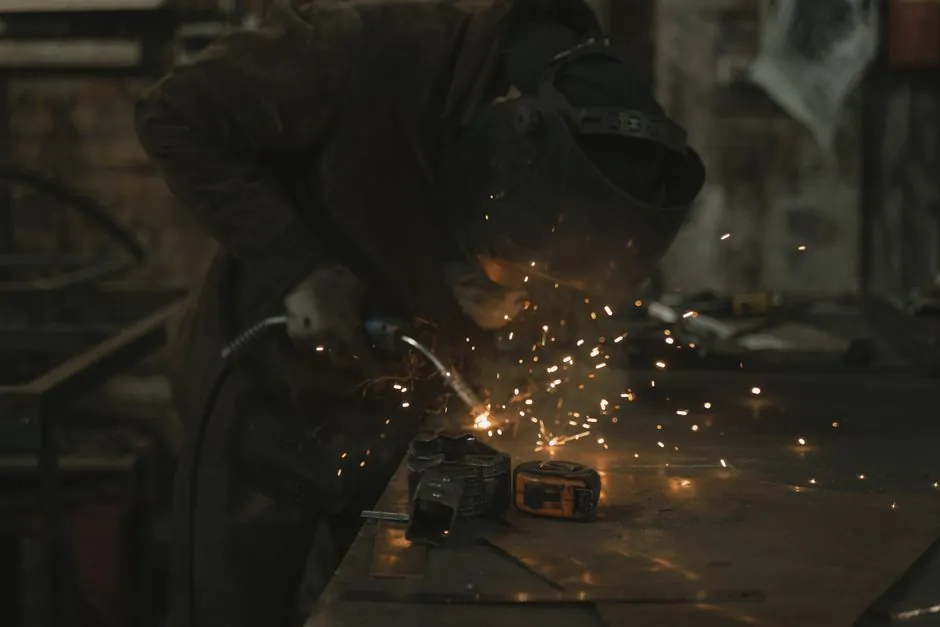
Welding areas defeat conventional spot smoke detectors on three independent counts: arc UV, weld spatter, and stratified fume layers under high-bay decks, and the 2026 reference design is a 135°F fixed-temperature heat detector paired with AI video image smoke/flame detection on existing security cameras [S3][S4].
Where ceiling height exceeds roughly 25 ft, smoke transport time alone can exceed the 3:40 flashover window measured in the UL FSRI modern-room burn, so any ceiling-only spot detector is a documented liability, not a precaution [S4].
Why Spot Smoke Detectors Fail in Welding Cells
Ionization and photoelectric spot detectors both require smoke particles to reach the chamber, and welding fume (mostly sub-micron metal oxide from MIG/GMAW) either stratifies below the detector or coats the chamber and forces a sensitivity drift outside the listed operating window [S1][S5].
Photoelectric units scatter light off smoke particles; welding arc flash produces broadband optical noise that triggers the same scatter logic, and the resulting nuisance-alarm rate is the single most cited reason production teams disable or ignore ceiling detectors on fabrication floors [S1][S5].
NFPA 72's ultraviolet detector category explicitly flags welding arcs as a known false-alarm source, because UV sensors pick up the short-wavelength emission at ignition and cannot discriminate a 200 A GMAW arc from a real flame event [S2].
Heat Detector Sizing and Setpoint Rules
For mechanical rooms, weld bays, and grinding stations the standard prescription is fixed-temperature heat detectors at 135°F (57°C), with rate-of-rise (15°F/min) units reserved for occupied spaces where a 135°F fixed unit would nuisance on a summer afternoon [S3].
Heat detectors do not see the flame, so they will not catch a torch fire until the thermal column reaches the ceiling, but in a weld bay the arc and base metal are already the ignition source, and the goal shifts to confirming fire spread rather than detecting ignition [S1].
AI Video Image Smoke and Flame Detection (VISD/VIFD)
NFPA 72 and FM 3232 both recognize video image smoke detection (VISD) and video image flame detection (VIFD) as listed categories, and the 2026 deep-learning generation runs on standard security cameras rather than purpose-built detection hardware, which collapses the per-channel cost into the existing VMS budget [S4].
The 2026 model class is trained to distinguish a welding flare from a spreading flame: temporal flicker analysis, plume-rise vectors, and color-spectrum gating let the classifier reject the steady, high-luminance arc signature while still alarming on a propagating fuel fire within seconds of ignition [S4].
Camera coverage in a weld bay follows the same cone-of-detection logic as intrusion analytics: a 2 MP fixed camera covers roughly a 30 ft × 20 ft zone at 25 ft mounting height with effective smoke/f flame discrimination, and that footprint is what replaces the spot-detector grid [S4].
Detector-Type Comparison for Welding Areas
Across the four detector families used in fabrication environments, the 2026 spec window sorts as follows on welding compatibility: fixed-temperature 135°F heat detectors rate highest for reliability, rate-of-rise heat second, AI video image detection third but best for speed/coverage in high-bay cells, and ionization/photoelectric spot smoke detectors last because of chronic false alarms and sensitivity drift [S1][S2][S3][S4][S5].
On false-alarm rejection against arc UV, the ordering inverts: UV flame detectors are the worst because NFPA 72 itself lists welding arcs as a documented nuisance source, while multi-spectrum IR flame detectors and AI VIFD perform best because they gate on CO₂ emission bands and flicker signatures rather than raw UV [S2][S4].
On coverage per device, AI video detection on a fixed camera covers 400 to 600 ft² at 25 ft mounting height versus roughly 900 ft² for a listed spot smoke unit and 2,500 ft² for a projected beam detector, but the beam unit is the wrong tool inside a weld bay because hot plumes refract the beam and the welding flash blinds the receiver [S3][S4].
Aspirating Smoke Detection (ASD) for Weld-Adjacent Spaces
For control rooms, electrical cabinets, and robotic weld-cell enclosures that sit adjacent to the fabrication floor, aspirating smoke detection (ASD) with multi-hole pipe sampling gives a detection point inside the cabinet and avoids the arc/spatter environment entirely, at installed costs of roughly $4 to $8 per ft² covered for Class A sensitivity [S4].
ASD does not solve the high-bay weld bay itself, but it cleanly handles the MCC rooms, paint lockers, and gas-cabinet enclosures where the same facility wants code-listed smoke coverage and the welding process rules out any open-ceiling device [S4].
Service Life, Sensitivity Drift, and Maintenance
Spot smoke detectors carry a manufacturer-stated service life of 10 years, and sensitivity drift outside the listed range is the dominant end-of-life failure mode, manifesting as either chronic nuisance alarms or, worse, suppressed sensitivity [S5].
For welding-area deployments, the practical recommendation is annual sensitivity testing per NFPA 72 Chapter 14, with detector replacement on the manufacturer's published curve rather than the calendar, and a chamber cleaning at every planned shutdown because weld fume deposition accelerates drift by roughly 2 to 3× versus a clean office environment [S5].
AI video detection shifts the maintenance burden to the camera and lens, and the spec should call for quarterly lens cleaning in weld bays, firmware updates tied to the VMS release train, and an annual re-validation of the flame/smoke model against a recorded arc-versus-fire library [S4].
Where Welding Smoke Detection Is, and Is Not, the Right Answer
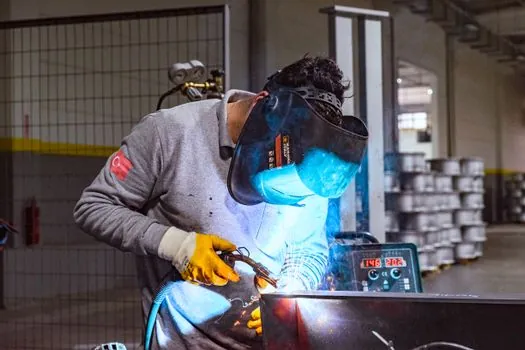
Welding smoke detection is the right answer in paint booths with weld repair stations, weld-cell enclosures with local exhaust, and any space where combustible solvent or hydraulic oil sits within reach of the arc, because the fire scenario is a weld ignition of a secondary fuel rather than the arc itself [S3][S4].
It is the wrong answer for open fabrication floors with continuous MIG activity, where the only defensible detection is fixed-temperature heat at 135°F plus AI VIFD on overhead cameras, and where any ionization or photoelectric spot unit should be physically removed from service because the nuisance-alarm rate guarantees it will be ignored [S1][S3][S5].
For oil-and-gas-adjacent welding, the cross-over spec is covered separately in the Smoke Detector Selection for Oil and Gas Facilities: 2026 Spec Map reference, and it should be read alongside this one whenever a weld bay sits inside a classified hazardous area [S2].
Two signals to watch over the next two quarters: UL 268 8th-edition and UL 217 8th-edition cooking-nuisance listings being extended to welding-nuisance testing, and FM 3232 listings expanding beyond the current handful of camera-analytics vendors, both of which would let AHJs accept camera-based detection on a code-equivalence basis rather than a supplementary basis [S2][S4].
The underlying component specifications are covered under welding cutting tool, and dust detector.