
Smoke detectors in industrial service break into four sensing families: ionization chambers, photoelectric (optical) scatter chambers, dual-sensor combinations, and aspirating smoke detection (ASD) units [S6].
The first engineering decision is matching the sensor physics to the expected fire signature, not picking the cheapest unit on the bill of materials, because misapplied ionization chambers in dusty HVAC returns are the single most common source of false alarms cited in plant incident write-ups.
Four Sensing Technologies and Their Fire-Signature Fit
Ionization chambers use a small radioactive source (typically Am-241) to ionize air and measure the current drop when smoke enters; they respond faster to flaming, low-particle fires with sub-micron aerosols, but are more prone to nuisance alarms from cooking aerosols and humidity. Photoelectric (optical) scatter detectors trigger when smoke particles scatter a light beam; they dominate on smoldering, high-particle fires that produce larger aerosols in the 0.3–10 µm range. Dual-sensor units combine both chambers in a single housing and are now the residential default in many jurisdictions, and increasingly specified in light-commercial tenancies. For high-sensitivity or high-airflow applications, an aspirating smoke detection system draws air through a pipe network to a central laser detector, with typical sensitivities two to three orders of magnitude above spot detectors. The same encyclopedia entry also covers the adjacent fixed gas detection family for areas where combustion-product gas sensing is the more appropriate primary layer. [S3]
Code regimes that touch the same ceiling space treat these families very differently: NFPA 72 in the U.S. recognizes all four types for general coverage, while EN 54-7 is the European product standard for point smoke detectors, and ISO 7240-7 governs ASD pipe-network design parameters. For area classification in hazardous locations, IEC 60079-29-2 covers selection, installation, and maintenance of detectors for combustible gases and vapors, which often share the same ceiling with smoke detection on a layered basis. Where ATEX is in scope, the detector must carry ATEX 2014/34/EU marking appropriate to the zone.
Selection Criteria by Application Profile
Five gates drive a defensible pick: (1) expected fire signature (flaming vs smoldering), (2) ambient contamination (dust, aerosols, steam), (3) ceiling height and stratification, (4) required detection time vs allowable nuisance-alarm rate, and (5) code regime and listing path. For an electronics assembly cell with 3 m ceilings and clean air, photoelectric scatter detectors are the workhorse. For a server hall where a smoldering PCB fire is the dominant risk, ASD with class A or class B pipe sensitivity is common, and ceiling spot detectors are secondary. For a flour mill or wood-pellet silo, ionization is disqualified and photoelectric with a verified insect-screen plus dust-immune firmware is required, or ASD with disc filters if the air is heavily loaded. [S3]
Reference designs in 2026 still center on the photoelectric scatter chamber: the EVAL-CN0583-SOM system-on-module integrates the ADPD188BI optical sensor, a MAX32660 microcontroller, regulated DC power, and an alarm GPIO, with a 2.2 V to 5.5 V VBATT supply range across 28 castellated pins [S1]. The BOM reflects the broader category: an LED, photodiode, low-power MCU, buzzer driver, and 3.3 V LDO dominate, with no exotic components, which is why the platform has been ported across multiple consumer and light-industrial SKUs. Carrier boards such as the EVAL-CN0583-CRR1 add an onboard MAX32625PICO debugger, USB-UART, an indicator LED, and a buzzer for rapid prototyping [S1].
Comparison of the Main Detector Types on Decision Criteria
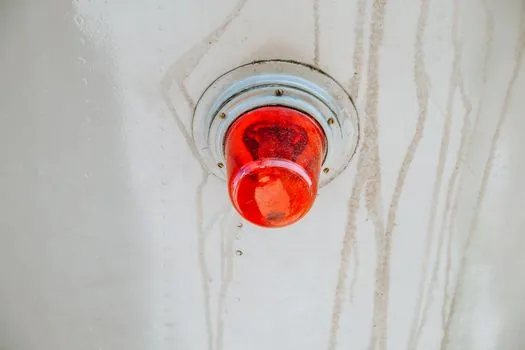
The dominant variants in a real plant spec can be lined up against four criteria. On flaming-fire response time, ionization and dual-sensor are typically the fastest, photoelectric is intermediate, and ASD depends on transport time through the pipe (often 30–120 s, a known limitation). On smoldering-fire response, photoelectric and dual-sensor are the strongest, ionization is the weakest, and ASD is the most sensitive by a wide margin. On nuisance-alarm resistance in dusty or humid environments, ASD with filtering and dual-sensor both score well, photoelectric is mid-pack, and ionization is the worst. [S6]
For ceiling geometry: spot detectors on flat ceilings are listed for roughly 80 m² of coverage in NFPA 72 spacing rules for standard sensitivity, dropping as ceiling height passes 4 m, while ASD pipe networks can cover thousands of square meters from a single detector when the pipe is laid out in a Code-compliant configuration. Aspirating systems also act as the workhorse for cold-storage warehouses below 0 °C, where spot detector reliability degrades and the sampled air is warmed at the detector, although low-temperature variants of conventional spot detectors exist. Adjacent detection layers are often required in parallel: a flame detector for clean-burn liquid or gas fires where smoke production is minimal, and a fixed gas detector for toxic or combustible gas release in process areas, with the smoke layer only one tier of a three- or four-tier fire and gas safety system.
Who the Standard Options Fit, and Who Should Reject Them
Photoelectric scatter detectors are the safe default for offices, schools, hospitality, healthcare, and light-commercial tenancies where the fire risk is dominated by smoldering electrical or upholstery fires, and where nuisance alarms carry a direct occupancy and evacuation cost. Ionization detectors still belong on the BOM for specific flammable-liquid or fast-flaming risk profiles, but they have been removed from many residential listings precisely because of cooking-nuisance behavior, and plant engineers should treat that removal as a signal: if the application is domestic-adjacent, default to photoelectric or dual-sensor. Dual-sensor is the right call when one device has to handle a mixed load of office and small-kitchen or workshop use, accepting the price premium to collapse two SKUs to one. [S6]
A buyer should reject a generic ionization or photoelectric spot detector in any of four conditions: ceiling height above 10 m, ambient dust above normal commercial levels, mandatory very-early-warning detection (e.g., semiconductor fab or hyperscale data hall), or area classification requiring ATEX/IECEx-rated hardware. In all four cases the correct move is aspirating detection, a flame detector, a heat detector, or an explosion-proof device, respectively. A plant engineer specifying linear heat detection for a cable tray or conveyor gallery should also treat that as an alternative when smoke transport is unreliable in high-airflow or high-stratification spaces, since heat cable ignores stratification entirely.
Standards, Listings, and Documented Limits
EN 54-7 is the harmonized European product standard for point smoke detectors using scattered-light, transmitted-light, or ionization principles, and is cited by CE-marked fire-system integrators across the EU. NFPA 72 in the U.S. governs spacing, placement, and notification appliance requirements, including the 30 ft (≈9.1 m) spacing rule for standard spot detectors on smooth ceilings. ISO 7240-7 covers point-type smoke detectors and ISO 7240-20 covers aspirating smoke detection. For hazardous-area equipment, IEC 60079-29-2 governs gas-detector selection and IEC 60079-31 covers dust ignition protection; the smoke detector itself, if installed in a classified zone, must carry ATEX 2014/34/EU marking for the appropriate equipment protection level (EPL). [S3]
Reference designs confirm the practical power envelope. The CN0583 SOM accepts 2.2 V to 5.5 V on VBATT (pin 1 and pin 13) and exposes 3.3 V-class logic on all GPIO, SPI, UART, and SWD lines, with ALARM_OUT on P0.5 and LED_OUT on P0.4 of the MAX32660 [S1]. The 28-pin dual in-line castellated layout is small enough to fit behind a standard detector base, which is why this generation of optical front ends has propagated across so many consumer SKUs. Layouts in BIM tools now also expose detector range as a visual overlay, e.g., the Autodesk Revit tutorial walks through editing a smoke detector family and switching to a reference level to review the 2D range guides, useful for the same engineers who must place them in the model [S3].
Field Use Cases and Real Failure Modes
Three use cases cover most plant decisions. In a cold-storage warehouse at -20 °C, ASD is the realistic answer: spot ionization or photoelectric detectors fail to meet the response time target at sustained sub-zero temperatures unless specifically listed for it, and the ASD sample air is conditioned at the detector housing. In a data center or telecom switch room, very-early-warning ASD is the dominant tier, with class A or class B pipe sensitivity and a pre-alarm threshold that triggers investigation before the fire-alarm threshold is reached. In a wood-products facility or flour mill, dust-immune photoelectric detectors with insect screens and verified cleaning cycles are the standard pick, with ionization entirely ruled out due to dust false alarms. [S4]
Documented failure modes cluster in three buckets. First, ceiling stratification: a buoyant smoke plume may pass under the detector layer entirely on high ceilings, which is why ASD or beam detectors are preferred above roughly 10 m. Second, contamination drift: dust-coated optical chambers slowly desensitize or, conversely, generate false alarms as the contamination itself scatters light, which is why the maintenance spec must lock down a cleaning interval and the test method (e.g., a calibrated test aerosol) for verification. Third, misapplied technology: ionization in a kitchen, photoelectric in a sodium-steam corridor, or any spot detector in a Class I Div 1 area without the right enclosure or ATEX marking, all of which the standards above exist to prevent.
Spec Discipline and Shortlist Logic

The defensible shortlist for a typical plant spec reads as follows. For office, lobby, and corridor coverage on a 2.4–3.6 m flat ceiling with no unusual contamination: EN 54-7 / UL 268 listed photoelectric spot detectors, sited per NFPA 72 30 ft spacing or per the local code's equivalent, with audible notification at 75 dBA at the pillow in sleeping-risk occupancies. For mixed-use floors with a kitchenette or workshop: EN 54-7 / UL 268 dual-sensor units, accepting the price premium. For data halls, cold storage, ESD-sensitive process, and high-ceiling spaces: EN 54-20 / ISO 7240-20 ASD with class A or B pipe design, a documented transport time, and a maintenance plan that includes filter and blower checks at intervals set by the manufacturer. [S3]
For hazardous-area process buildings: ATEX 2014/34/EU marked detectors, with the EPL matched to the zone (zone 1 typically EPL Gb, zone 2 EPL Gc), and the cable entry and conduit on the same hazardous-area spec. For conveyor galleries, cable trays, and other high-airflow or high-stratification spaces where smoke transport is unreliable: linear heat detection cable as a complement rather than a substitute for smoke detection, sized to the ambient temperature profile. Each entry on that shortlist should land with three documents: the product's EN 54 / UL / ATEX certificate, the manufacturer's spacing and derating curves for the ceiling type, and a written maintenance and test procedure. That trio is what survives a code review or an insurance survey, and the only way a smoke detector spec is genuinely closed out. For an adjacent code-driven buyer's map on a related safety product, see the flame detector price 2026 buyer's map, which lines up the same standards-based selection logic for a different fire signature.