
Chinese linear guide rail makers now ship interchangeable, ISO 9001 and CE certified carriages from 5 mm miniature profiles up to 85 mm heavy-duty blocks, with the top factories offering GCr15 (SUJ2) bearing steel raceways induction-hardened to HRC 58 to 62, dynamic load ratings to 282 kN on the SDS85BL, and four-row 45° contact arc geometry comparable to the major Japanese and German lines [S1][S4].
For a buyer, the practical question is no longer whether China can build to spec, but how to lock the right combination of accuracy grade, preload class, sealing and surface treatment without paying for over-engineering. A second, equally important, gate is verifying that a factory's interchangeability claim actually matches the DIN/ISO envelope the buyer is pulling out of an existing machine, because retrofit risk lives almost entirely in the mounting-hole pitch, rail height and block width, not the published load numbers [S4][S5].
Accuracy Grade Matrix: C, H, P, SP, UP and What Each Step Costs
Chinese suppliers segment precision into five levels on the same naming convention as the major Japanese catalogues: Common (C), High (H), Precision (P), Super Precision (SP) and Ultra Precision (UP), with motion parallelism on a 1000 mm rail ranging from 24 µm at C down to 6 µm at UP, and on a 2000 to 2500 mm rail from 31 µm down to 10 µm across the same ladder [S3]. On a 15 to 20 mm CH-series block, the per-grade H and N tolerance window tightens from ±0.1 mm at C, through ±0.03 mm at H and 0 to 0.03 mm at P, to 0 to 0.008 mm at UP, with mutual parallelism of 0.02 mm at C falling to 0.003 mm at UP [S3].
Buyers should treat these grades as a coupled set, not an à la carte menu. Motion accuracy on a 500 to 700 mm rail is 20 µm at C versus 2 µm at UP, a 10× jump that drives spindle finish on a grinder but is wasted on a packaging slide [S3]. Square-rail catalogues from major Chinese OEMs confirm the same five-grade ceiling on Normal ≤0.015 mm/m, High ≤0.009 mm/m, Precision ≤0.005 mm/m and Super Precision ≤0.003 mm/m running parallelism [S4][S5]. Specification to SP and above should always be paired with a laser-interferometry report and a defined rail-butting procedure, since stack-up errors on joined rails are the silent killer of sub-5 µm builds [S4].
Load Class and Block Geometry: Choosing Size, Preload and Block Type
Dynamic (C) and static (C₀) load ratings on Chinese SDS and HGH/HGW series are published per size, with the SDS15 at 8.33 kN / 13.5 kN rising in 14 size steps to the SDS85BL at 282 kN / 412 kN, and on the heavy-duty HG line from 27.5 kN / 44.6 kN at HG25 to 163.6 kN / 275.3 kN at HG65 [S1][S4]. Block length and width follow the same scaling, with the SDS block width growing from 34 mm at size 15 to 156 mm at size 85 and rail weight climbing from 1.5 kg/m to 35.2 kg/m over the same range [S1].
Preload is the second axis of choice and is typically specified as Z0 (0 to 0.02C clearance), Z0.05 (0.05 to 0.07C) and ZB (0.10 to 0.12C medium preload), and Chinese heavy-duty catalogues explicitly list all three against the same block, so a buyer can move rigidity up or down on one part number rather than re-engineering the carriage [S4]. A practical rule: select the size so the calculated maximum equivalent load on a single slider leaves the static safety factor above the published table value, and match the rail size to the mating ball-screw OD when used on the same axis (a 35 mm screw pairs with a 35 mm rail) [S3].
Miniature vs Standard vs Heavy-Duty: Three Form-Factor Lanes
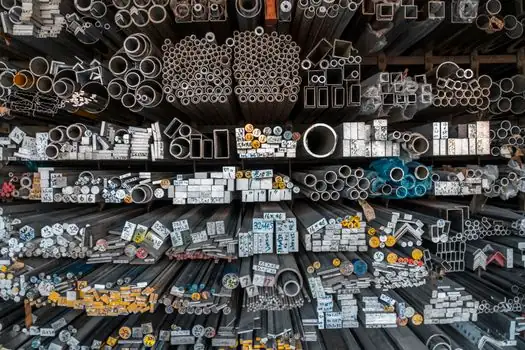
Chinese factories now run three clearly separated lanes. The miniature lane uses rail widths of 5 to 25 mm, low-profile heights of 3 to 15 mm, C0/C1 grades to ±0.005 mm, repeatability to ±1 µm, max speed to 2 m/s, operating temperature -20°C to +120°C, and dynamic load up to 1,200 N on hardened steel (HRC 58+) or SUS440C stainless carriages [S2]. This lane is the right pick for medical robotics, semiconductor wafer handling, cobot axis slides and laser alignment, not for press or gantry work [S2].
The standard lane covers sizes 15 to 65 mm in the square-rail line with HRC 58 to 62 raceways, GCr15 or austenitic stainless base material, black-oxide or hard-chrome finishes and operating range of -20°C to +80°C as standard, with high-temperature specials available [S5]. The heavy-duty lane is the same envelope but with a four-row circular-arc contact at 45° for equal radial, reverse-radial and lateral load capacity, induction-hardened raceways, single-piece rail lengths to 4000 mm and butt-jointing for unlimited travel, used on CNC machining centres, EDM, gantry mills and large metal-cutting tools [S4][S5]. Selecting between them is a load-life-environment calculation, not a brand question, and the heavy-duty line is typically specified only when both C-rating and vibration damping exceed what a standard block can deliver.
Materials, Sealing and Surface Treatment Options
Base material across Chinese offerings is vacuum-degassed GCr15 (SUJ2, AISI 52100) bearing steel for the standard and heavy-duty lines, with austenitic stainless as a stocked option, and on miniature rails hardened steel HRC 58+ or SUS440C stainless, with carbon steel, stainless and aluminium-alloy variants available on request [S2][S5]. Raceway hardness is consistently quoted at HRC 58 to 62 with deep induction hardening, and surface treatment is offered as black oxide (standard), hard chrome plating, electroless nickel plating, black chrome, Raydent and phosphate, with the last three aimed at corrosion-heavy environments [S4][S5].
Sealing is the second differentiator. Standard blocks are offered with end seals, side seals, bottom seals, double seals and metal scraper plates, and the high-end dust-proof system on the CH-series combines oil scraper, negative-pressure dust seal, dust-proof sheet, guide-rail bolt cover and metal scraper for cleanroom and woodworking use [S3]. Lubrication is typically pre-packed lithium-soap grease with optional centralized oil nipples, with the supplier recommending grease re-injection every 100 km of travel to hold rolling-fatigue life, and self-lubricating blocks plus application-specific greases available for high-temperature, vacuum or cleanroom service [S3][S4][S5].
Supplier Vet Map: Certifications, Interchangeability and Lead Time Signals
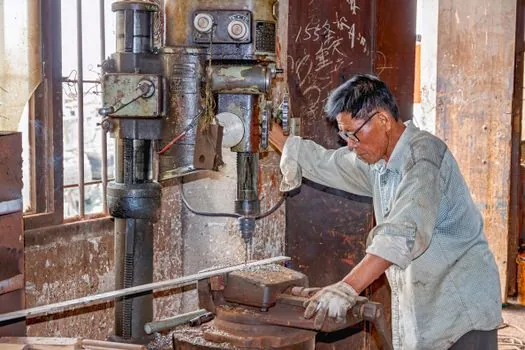
The first gate is documentation. Mature Chinese suppliers publish ISO 9001:2015, CE and RoHS certificates, with the heavy-duty lines additionally claiming DIN- and ISO-compliant mounting for drop-in replacement of major Japanese and German lines [S4][S5]. One Suzhou-based manufacturer operates a 33,333 m² site with 16,000 m² of built area, 10+ years in the trade, and lists five-grade accuracy, custom butt-jointing and full dust-proof sealing on its CH-series, which is the kind of footprint and capability stack a serious OEM buyer should require on first contact [S3].
The second gate is interchangeability. A practical test is to ask for a dimension print on the specific block, then spot-check rail width, block height, bolt-hole pitch and end-cap geometry against the incumbent supplier's catalogue, because the load numbers will almost always match, but the envelope is where retrofit surprises live [S4][S5]. On pricing, list prices for Chinese-made interchangeable blocks typically run well below the equivalent Japanese and European lines on standard C and H grades; SP and UP carry a smaller discount and longer lead time, so the cost case is strongest where the application does not require the top two grades. For buyers building a broader motion stack, the same sourcing logic on ball screws and adjacent components follows a similar factory footprint in Suzhou and Shenzhen, useful for consolidating vendors and freight.
Common Failure Modes and Procurement Risk Control
Most field failures on Chinese-sourced rails fall into four buckets: preload selection error (Z0 specified where ZB is required, leading to Brinelling under shock), wrong sealing for the environment (standard end seals specified in a wood or foundry dust load, accelerating wear), over-spec on accuracy (SP or UP on an axis that does not need it, with no interferometry report, so the cost is paid but the benefit is not realised), and interchangeability mismatch on bolt pitch that surfaces only at installation [S3][S4]. Each is a spec-side problem, not a quality-side problem, which is why the procurement checklist matters more than the supplier scorecard.
Two trackable signals to monitor on 2026 sourcing cycles: first, the spread of stocked stainless and Raydent-coated blocks as a proxy for how many Chinese factories have moved up from general automation into food, medical and marine, and second, the number of suppliers offering laser-interferometry test reports as a standard deliverable on SP and UP blocks, which is the clearest indicator that a factory is competing on accuracy rather than on interchangeability alone [S4][S5]. A parallel read on the broader linear motion procurement landscape confirms that the same spec ladder, supplier gate and failure-mode checklist apply whether the buyer is sourcing for CNC, packaging or warehouse robotics.
Spec-level background on the components involved: linear guide, crossed roller guide, and linear actuator.