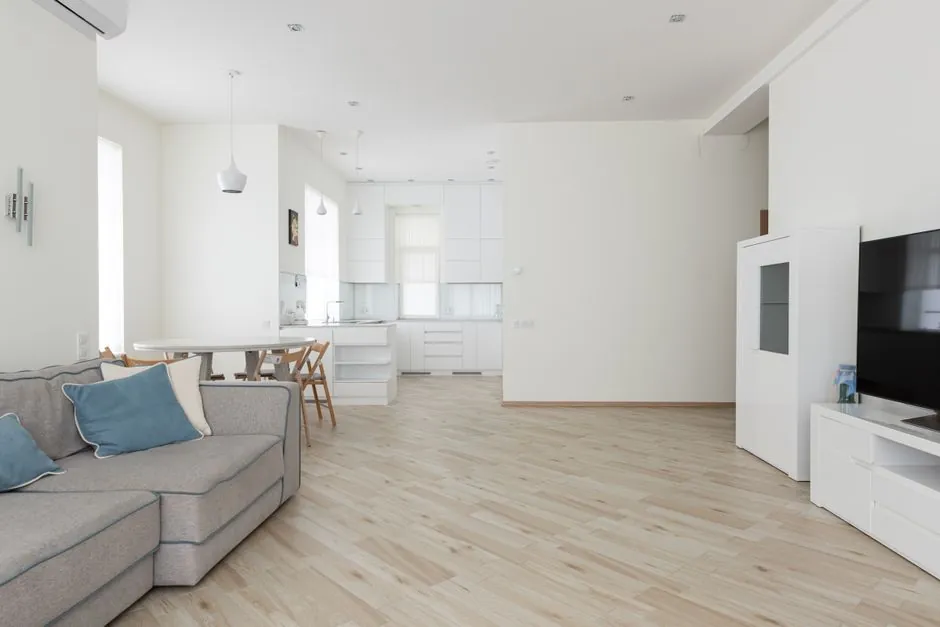
The wear layer, the transparent PVC cap above the décor film, is the single parameter in an SPC plank that determines how long the visible surface survives abrasion; total plank thickness does not [S4][S6].
Specifying a thicker plank with a thin wear layer is the most common procurement error in commercial fit-out, because the rigid core, IXPE pad, and click profile never touch a shoe, a trolley wheel, or a chair castor [S4]. For a baseline on what SPC flooring is, the SPC flooring overview explains the five-layer stack and where the wear layer sits within it.
Wear Layer vs Total Plank Thickness: Two Separate Jobs
Total SPC plank thickness is commonly sold in 5 mm, 6 mm, 7 mm, and 8 mm tiers, and it governs acoustic performance, subfloor tolerance, click-joint strength, and the feel of the floor underfoot [S1][S4]. It does not contribute to surface durability, because none of those millimetres ever see abrasion.
The wear layer, by contrast, is the clear protective cap on top of the printed design film, and it is the only layer that physically wears [S2][S3]. Standard U.S. market gradations are 8 mil (0.2 mm) light residential, 12 mil (0.3 mm) standard residential, 20 mil (0.5 mm) heavy residential / light commercial, and 22 to 30 mil (0.55 to 0.7 mm) full commercial [S5][S6].
For a broader view of how rigid-core flooring compares to other industrial surfaces, see the industrial flooring reference, which frames wear and load criteria across material families.
Commercial Wear Layer Tiers and EN 685 Mapping
European commercial specification anchors on EN 685 use classes, with three wear-layer tiers dominating CE Declarations of Performance: 0.3 mm (12 mil) for EN 685 Class 21/23 residential only, 0.5 mm (20 mil) for Class 33/42 general commercial, and 0.7 mm (28 mil) for Class 43 heavy commercial [S4].
Stated service life tracks the wear layer: roughly 5 to 8 years for 0.3 mm in residential use, 10 to 15 years for 0.5 mm in commercial, and 15 to 20+ years for 0.7 mm in airports, hospital corridors, and large retail [S4]. EN 660-2 is the abrasion test method referenced alongside EN 685 for these declarations [S4].
Why the UV Coating Is Not a Substitute for a Thicker Wear Layer

UV coating sits above the wear layer as the outermost, typically few-micrometre-thick cured film that resists micro-scratches, staining, and UV-driven fade; the SPC industry often markets it as the first line of defence [S3][S7]. The UV film does not add to the measured wear-layer thickness and does not replace the underlying 0.3 / 0.5 / 0.7 mm cap [S4].
Two SPC planks with identical 0.5 mm wear layers can look years apart in the same corridor if the UV coating chemistry, cure weight, or number of coats differ [S3]. Specifiers chasing a stated AC5 (Abrasion Class 5) heavy-commercial rating should confirm both the wear-layer thickness and the coating system on the data sheet, because AC1 to AC5 grade overall traffic suitability rather than cap thickness alone [S3].
AC Rating: A Traffic Filter, Not a Thickness Number
The AC (Abrasion Class) scale runs AC1 light residential through AC5 heavy commercial, and it is the practical traffic filter most retailers and OEM catalogues expose to end users [S3]. AC5, the highest common class, is rated for heavy commercial traffic and is the safe overspecification for busy family homes and rental properties alike [S3].
AC ratings should be read alongside, not in place of, the wear-layer number, because AC is derived from Taber-style abrasion tests on the finished panel, while the wear layer is a discrete geometric layer that can be measured optically under ASTM F410 [S1][S3]. When in doubt, ask the supplier for the test method used to generate the AC class, not just the class label.
Units, Reading the Data Sheet, and Common Specification Traps
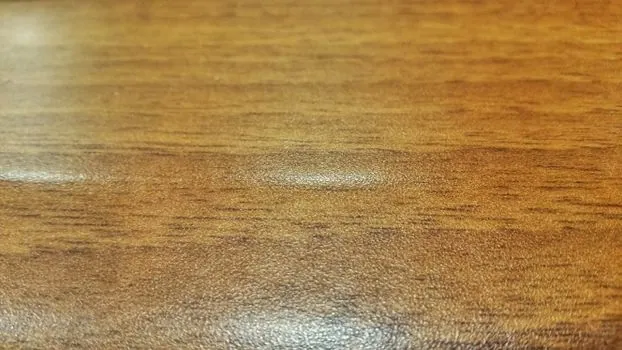
A mil is one thousandth of an inch, not a millimetre, so a 20 mil wear layer is roughly 0.5 mm; mixing the two units is the single most common error when comparing quotes from U.S. and European sources [S3][S5]. A listing that prints a single thickness figure, without naming the layer, is unreadable for procurement.
Ecoflors' direct comparison line is the cleanest rule of thumb on the record: an 8 mm SPC plank with a 0.3 mm wear layer is forecast to fail in a commercial corridor within 3 to 5 years, while a 5 mm SPC plank with a 0.7 mm wear layer is forecast to outlast it by a decade in the same space [S4]. The data sheet must list wear-layer depth, total thickness, core density, locking system, attached-pad composition, intended use class, and warranty terms, and the buyer should request the EN 685 or AC class document before ordering [S1][S4].
For procurement teams that also buy instrumentation, the same unit-discipline habit applies to gear like the coating thickness gauge, where a 20 µm vs 0.2 mil reading is the same physical thickness written two ways.
Matching Wear Layer to Space: A Decision Matrix
Match the wear layer to the worst-case traffic in the continuous run, not the quietest room, because once one zone wears through the décor film, the visual failure is global to the floor [S3][S4]. Underspecifying is the mistake discovered only after the furniture is in; overspecifying costs little and absorbs surprises such as a new pet or a converted home office [S3].
A practical mapping: 0.3 mm (12 mil) for bedrooms and low-traffic living rooms, 0.3 to 0.5 mm (12 to 20 mil) for kitchens, hallways, and family homes, 0.5 mm (20 mil) for rentals, offices, and most retail, and 0.7 mm (28 mil) plus AC5 for heavy commercial entrances, airports, and healthcare corridors [S3][S4][S5]. For broader process-control thinking on wear and replacement intervals, the CBM vs PdM vs RCM decision matrix translates similar logic to plant maintenance.
What the Wear Layer Does Not Do
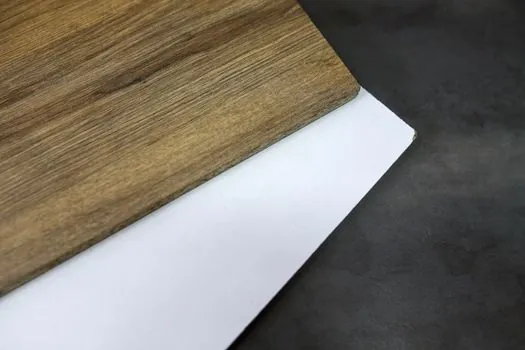
The wear layer does not improve impact-sound reduction; that role belongs to the IXPE or EVA underlay, which is typically rated at an 18 to 24 dB impact-sound drop in 1 mm thickness [S4]. It does not stiffen the click joint, hide subfloor waviness, or compensate for an unlevelled slab, all of which are properties of the SPC rigid core (commonly 3 to 6.5 mm) and the total stack [S1][S4].
Stain resistance and UV fade resistance are also coating-layer properties, not wear-layer properties, so a high-mil cap with a poor UV coat can still yellow under a south-facing window [S3][S7]. For surfaces where the buyers' eye reads gloss and clarity as much as it reads wear, request the UV coat weight (g/m²) and the number of passes alongside the wear-layer number [S3][S7].
Trackable Spec Signals to Watch in the Next Buying Cycle
Two numbers are worth tracking on every SPC quote received after October 2026: the wear-layer thickness expressed in millimetres (not mils), and the EN 685 use class on the CE Declaration of Performance, because those two fields together fix both durability and warranty exposure [S4].
Third signal: insist on the AC rating plus the abrasion test method (Taber wheels, cycles, mass loss) printed on the data sheet, so a quoted AC5 can be compared like-for-like between suppliers [S1][S3]. A fourth useful data point is the IXPE underlay thickness separately from total plank thickness, since 1 mm IXPE is what delivers the 18 to 24 dB impact-sound figure that some suppliers incorrectly attribute to the wear layer [S4].