Material selection in additive manufacturing is a three-variable problem: alloy chemistry, powder design (particle size distribution, morphology, flow), and process parameters such as laser power, spot size, and gas flow collectively define the final part's density, microstructure, and mechanical performance [S5]. Engineers who treat feedstock as a static input the way they would a CNC bar stock typically see higher scrap rates, because laser powder bed fusion, directed energy deposition, and binder jet each transform the raw material as the part is built [S5].
The five primary material classes used in general industrial 3D printing are polymers, metals, ceramics, composites, and sand, with thermoplastics such as ABS, PETG, PLA, and TPU dominating polymer extrusion workflows [S3]. Metal powder bed systems extend into aluminum, titanium, stainless, and tool-steel alloys; ceramic and composite feedstocks remain more specialised but are growing into tooling and high-temperature applications [S1][S3].
Process Family Drives Compatible Material Form
The seven ISO/ASTM-defined AM categories: VAT photopolymerisation, material jetting, binder jetting, material extrusion, powder bed fusion, sheet lamination, and directed energy deposition, each constrain the physical form of the feedstock they accept [S7]. VAT photopolymerisation and material jetting consume liquid photopolymer resins; binder jetting works with metal, sand, or ceramic powders bound by a deposited adhesive; powder bed fusion requires spreadable metal or polymer powder with tight particle size distribution, typically 10 to 63 micrometres for L-PBF [S5][S7].
Material extrusion is the most permissive category, accepting filaments of ABS, PETG, PLA, TPU, and reinforced composites, which is why it dominates low-cost general fabrication despite lower dimensional accuracy than powder bed routes [S3][S4]. Sheet lamination consumes paper, polymer, or metal foils bonded layer by layer, and is the route used for low-cost full-colour models and some composite tooling [S7].
Polymers: Thermoplastics, Photopolymers, and Elastomers
Polymer additive manufacturing splits into thermoplastic filament (FDM/FFF), thermoplastic powder (SLS), photopolymer resin (SLA/DLP), and elastomeric resins (DLP/LCD). Thermoplastics such as ABS, PETG, PLA, and TPU are the workhorse general-fabrication materials, valued for low cost and broad printer compatibility [S3]. Photopolymer resins in dental and medical workflows have gained FDA clearance for specific appliances and offer biocompatibility that traditional acrylic-urethane blends do not match [S2].
Elastomeric resins are now specified for footwear midsoles and similar cyclic-load parts: leading elastic resins achieve over 1,000,000 compression cycles with under 3% change in shape or performance, surpassing traditional PU and EVA foam that typically degrade between 20,000 and 100,000 cycles [S2]. TPU and thermoset polyurethane powders and liquids extend the elastomer option into both powder bed and resin workflows [S2].
Metals: Alloy, Powder Design, and L-PBF Constraints
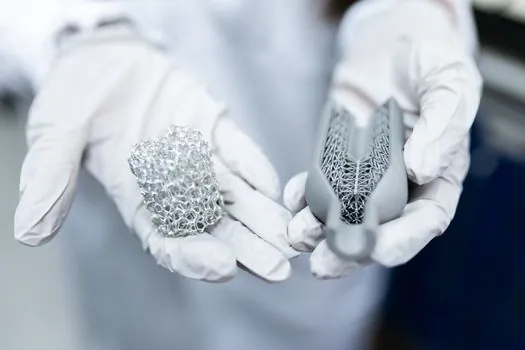
In laser powder bed fusion, end-part properties are determined by the interaction of alloy selection, powder design, and process design, because the raw material undergoes a transformation as the part is being built [S5]. Alloy selection defines the possible performance range for strength, thermal behaviour, corrosion resistance, and conductivity, while powder design aligns the input material to the additive process and the end-use application, with features fine-tunable for specific parts [S5].
Powder design variables include particle size distribution, morphology, flowability, and apparent density, all of which interact with machine specifications such as laser power, spot size, and gas flow, and with alloy-specific concerns including volatiles and reactivity [S5]. Storage and handling considerations also feed back into powder design, because reactive alloys such as aluminum and titanium oxidise rapidly and require controlled-atmosphere logistics [S5]. Heat treatments can shift final properties, but cannot compensate for poor decisions in feedstock or process windows [S5].
Ceramics, Composites, and Sand: Specialty Feedstocks
Ceramic additive manufacturing uses powder bed, binder jetting, and material extrusion routes, with feedstock chemistry selected for thermal shock resistance, dielectric behaviour, or biocompatibility depending on whether the target application is aerospace, electronics, or medical [S1][S3]. Composite feedstocks combine a base polymer or metal matrix with chopped or continuous fibre reinforcement; Markforged-style systems lay continuous fibre within a polymer matrix, while chopped-fibre filaments are drop-in replacements for standard FDM materials [S4].
Sand binder jetting is the dominant process for foundry pattern production, where phenolic-bonded sand is jetted with a binder to produce complex cores and moulds that would be impractical to manufacture by traditional pattern-making [S3].
Selection Criteria Comparison Across Material Classes
A spec-first comparison for general fabrication lines up the five material classes against four decision criteria: cost per kilogram, achievable tolerance, maximum service temperature, and post-processing burden. Polymers (ABS, PETG, PLA, TPU) score lowest on cost and post-processing burden but are capped near 100 to 200 degrees Celsius continuous service and hold tolerances around +/- 0.2 millimetre on desktop extrusion systems [S3][S4]. Photopolymers and elastomeric resins reach tighter tolerances via SLA/DLP but cost more per kilogram and require UV post-cure [S2].
Metals (aluminum, titanium, stainless, tool steel) carry the highest raw-material cost, often 50 to 200 USD per kilogram for aerospace-grade titanium powder, but deliver the highest service temperatures, often above 600 degrees Celsius for nickel and cobalt alloys, and can hold +/- 0.1 millimetre or better after machining [S5]. Ceramics and composites sit between these poles on cost and offer the best high-temperature performance, but typically require extensive post-processing such as sintering, infiltration, or machining to reach final density and tolerance [S1][S3]. Sand binder jetted parts are effectively single-use tooling, so cost-per-part is evaluated against traditional pattern-making, not against functional part cost [S3].
Where Material Selection Goes Wrong in General Fabrication
Specifying a polymer-grade extrusion system for a part that needs sustained service above 200 degrees Celsius is the most common failure mode, because ABS, PETG, PLA, and standard TPU all soften well below the operating range of many automotive under-hood and industrial process environments [S3]. The inverse mistake, specifying a high-cost metal L-PBF build for a part that could be moulded in polycarbonate, drives part cost up by 10x to 100x without functional benefit [S5].
Powder contamination and reuse strategy is the second frequent failure point: L-PBF powder that exceeds the supplier's recommended oxygen pickup limit or particle size drift produces parts with porosity above acceptable thresholds, and heat treatments cannot rescue a build with poor as-built density [S5]. For a broader view on how spec-first selection logic applies to adjacent process equipment, see this optical glass selection for mold and die making reference, which applies the same criteria-based approach to a different materials workflow.
Standards, Qualification, and Industrial Adoption Signals
Qualification of AM parts requires both material qualification (MQ) and part qualification (PQ) data, and the customer-supplier relationship is the lever that determines whether qualification data is generated early enough to avoid late-stage design changes [S5]. The U.S. Navy's Project Peculiar Document PPD 802-8436658, approved in 2026, establishes a streamlined technical pathway for substituting legacy cast and wrought parts with additively manufactured metallic components across submarine construction, maintenance, and combat-ready repair [S3].
On the production side, automotive and aerospace serial production parts have validated that tight collaboration between powder suppliers, machine builders, and part designers is what carries a build from prototype to high-yield production, not the alloy choice in isolation [S5]. For facilities planning new AM capacity, this spec-first selection map for explosion-proof electrical gear covers the adjacent question of safely housing powder-handling and laser systems in classified areas, a frequent gap in general-fabrication shop retrofits.
Track two signals over the next quarter: the rollout of additional AM-specific federal and defence qualification documents beyond PPD 802-8436658, and the publication of powder-supplier technical data sheets that report oxygen pickup and particle size drift limits per build cycle, both of which directly determine whether general-fabrication shops can move L-PBF from prototyping to serial production without re-qualifying every part.
For the relevant spec sheets and selection criteria, see additive manufacturing material, advanced material, and chemical material.