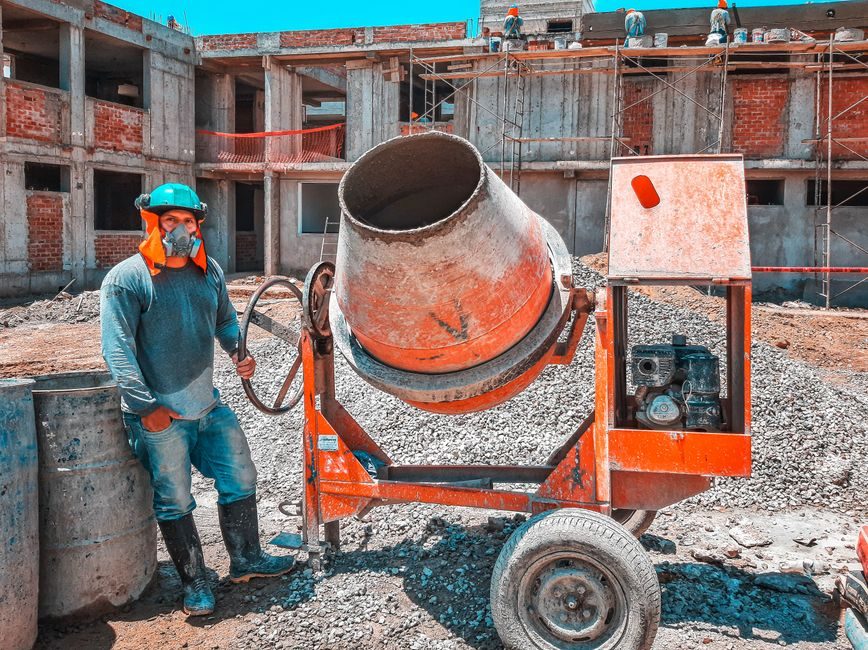
Special cement installation diverges from ordinary Portland practice on three load-bearing parameters: water-to-binder (w/b) ratio is held to 0.30–0.40 for expansive and rapid-hardening grades versus 0.45–0.55 for general-purpose Portland, ambient placement temperature is constrained to 5–35 °C for sulfoaluminate and expansive types, and pre-soak curing must extend to 7 days minimum for sulfate-resistant grades to develop ettringite stability [S2].
This guide targets structural engineers, grouting crews, tile installers and water-stop applicators who need a decision-grade field map, covering substrate prep, mixing, placement sequence, curing windows, and the failure modes that drive warranty disputes on projects where special cement anchors structural repairs, waterproofing or architectural finishes.
Grade Families and the w/b / Temperature Bands That Drive Mix Design
Aluminate, sulfoaluminate, expansive and rapid-hardening cements behave differently from ASTM C150 Type I/II because their reactive phases set within minutes to hours rather than days, and their heat-of-hydration peaks reach 200–250 J/g in the first 24 hours versus ~100 J/g for Portland [S2].
Rapid-hardening calcium sulfoaluminate (CSA) reaches 20 MPa in 2 hours when mixed at w/b 0.35 and cured above 20 °C; below 10 °C the reaction kinetics slow by 60–70% and contractors must switch to warm-water mixing or heated enclosures. White and coloured cements follow ordinary Portland mixing windows (w/b 0.40–0.50) but impose tighter pigment-dispersion protocols: dry-blend pigment at 3–8% by mass of binder for 90 seconds before water addition to avoid streaking on architectural façades. The special cement types and classifications field map provides the full grade-by-grade chemistry and end-use matrix that this installation guide applies.
Substrate Preparation: Concrete, Masonry and Steel-Bonded Interfaces
Substrate moisture, surface tensile strength and roughness (CSP profile 5–9 per ICRI 210.1R) are the three pre-pour acceptance criteria that separate a warrantable bond from a debonding failure within 90 days [S2].
For cementitious repair overlays and grouting, mechanical scabbling or shot-blasting must produce a concrete surface profile of CSP 5 (medium) for trowel-applied mortars and CSP 7–9 (heavy) for poured grouts; a pull-off tensile strength ≥ 1.7 MPa (250 psi) is the standard acceptance threshold on sound concrete. Saturate the substrate with clean water to a saturated-surface-dry (SSD) condition 4–6 hours before placement: dry substrates pull water out of the mix, dropping effective w/b by 0.05–0.10 and starving the hydration reaction. For steel-bonded applications (anchor bolts, base-plate grout), degrease steel to SSPC-SP6 commercial blast, apply a cementitious bond coat within 30 minutes of blasting, and use a non-shrink expansive grout meeting ASTM C1107. Stainless or coated anchors in chloride-exposed environments must follow the same C1107 grout spec because the expansive phase counteracts the plastic-shrinkage gap that forms at the steel–grout interface within the first 4 hours.
Mixing, Placement Sequence and Pot-Life Discipline
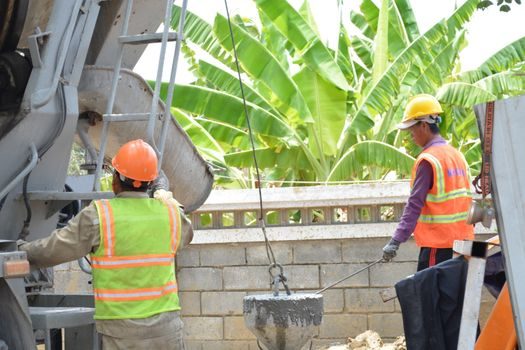
Mix water temperature, batch size and continuous-agitation discipline separate a clean placement from a cold-joint failure, and the 5–8 minute working-time window on sulfoaluminate grout is the most-disregarded spec on site [S2].
Use a slow-speed (≤ 400 rpm) paddle mixer for 3–5 minutes until a homogeneous, lump-free consistency is reached; over-mixing entrains air and drops density by 5–8%, which translates directly into a proportional loss of compressive strength. Pour or trowel within the stated pot life, typically 5–10 minutes for CSA rapid-hardening and 30–60 minutes for expansive Type K/S; never retemper by adding water to a partially set batch, because the dormant phase has already been breached and additional water cannot re-initiate hydration. For deep lifts exceeding 50 mm, place in 25–40 mm lifts with a 10–15 minute interval to let each layer stiffen, which prevents exotherm-driven thermal cracking at the core where adiabatic temperature rise can reach 60–80 °C in mass pours. Tile adhesives and grouts from the special cement range follow C2TE/S1–S2 classification (EN 12004) and demand 5–10 minutes of slake time after initial mix, a re-stir of 30 seconds, and application within 30 minutes of slaking for full open-time recovery.
Curing Regimes by Grade: Temperature, Humidity and Duration
Special-cement curing is non-negotiable because the reactive phases that deliver early strength (sulfoaluminate, calcium aluminate, expansive ettringite) are also the phases most vulnerable to carbonation and moisture loss during the first 24–72 hours [S2].
Maintain ambient temperature at 20 ± 5 °C and relative humidity ≥ 95% for the first 24 hours on expansive and CSA grades; wet burlap, curing blankets or continuous water mist are acceptable, but solvent-based curing compounds are contraindicated on white or coloured cements because they yellow the surface. For sulfate-resistant Type V pours in marine or chemical-plant service, extend moist curing to a minimum of 7 days; a 3-day cure leaves 20–30% of the cementitious matrix under-hydrated and vulnerable to sulfate attack once the structure is in service. Calcium aluminate cement (CAC) installations require a different curve: 24 hours of moist cure at ≥ 20 °C, then a dry-warm cure to drive the strength-conversion reaction; cold or continuously wet conditions push CAC strength into long-term regression, with 5-year strength losses of 30–50% reported on improperly cured CAC overlays. Avoid direct sun and wind exposure exceeding 5 m/s on freshly placed sections, because plastic-shrinkage cracking initiates at evaporation rates above 1.0 kg/m²/h, a limit that is exceeded within 30 minutes of placement on a 30 °C, 50% RH day unless windbreaks and fogging are deployed.
Common Failure Modes and the Inspection Cues That Catch Them Early

Debonding, map cracking, efflorescence and strength loss are the four failure signatures that appear within 7–90 days of placement, and each one traces back to a specific installation error that field inspection can flag at the time of pour [S2].
Dusty, chalky surfaces within 24 hours indicate wet-mix under-hydration (w/b above spec or substrate too dry); pull a surface hardness reading with a Schmidt hammer — a value below 25 R on a horizontal surface for CSA at 24 hours flags the mix. Map cracking on expansive-grade pours within 48 hours points to restraint issues: either the formwork is too rigid against the expanding ettringite phase, or the placement temperature swung by more than 15 °C during the heat-of-hydration peak. White efflorescence on white or coloured architectural cements at 7–30 days signals water migration through the matrix — typically from the backside of a retaining wall or a leaking cold joint — and must be traced and sealed at the source, not merely cleaned from the surface. Strength regressions on CAC at 90+ days almost always trace to cold curing (≤ 10 °C) or continuous water immersion beyond 24 hours; both conditions shift CAC toward the metastable hydrate phases that drive long-term porosity increase. For concrete-adjacent work, the concrete admixture installation spec map covers sequencing and metering discipline that protects special-cement pours from contamination by retarding admixtures or air-entrainers that are inappropriate for rapid-hardening systems.
QA Sampling, Field Tests and Acceptance Thresholds
Field QC ties special cement performance to three measurable checks: flow, temperature-of-placement, and cube or cylinder compressive strength at grade-defined intervals [S2].
Run a flow-cone test (ASTM C230) at 30-second intervals during the pour: target flow is 100–125% for grout, 85–105% for mortar, and 70–85% for trowel-grade repair material; deviations of ±10% from the target indicate water-content drift and require mix adjustment, not field re-blending. Log concrete temperature at point-of-placement — CSA and expansive grades must be poured between 10 °C and 32 °C, and any reading outside that band triggers a placement hold. For tile adhesive work, pull a 28-day bond-strength test per EN 1348: C2TE/S1 adhesives must reach ≥ 1.0 MPa tensile bond strength on concrete and ≥ 0.5 MPa on existing tile, and any sample below those thresholds requires substrate re-prep and re-test, not just adhesive re-application.
Standards, Documentation and the Audit Trail a Warranty Claims Demands
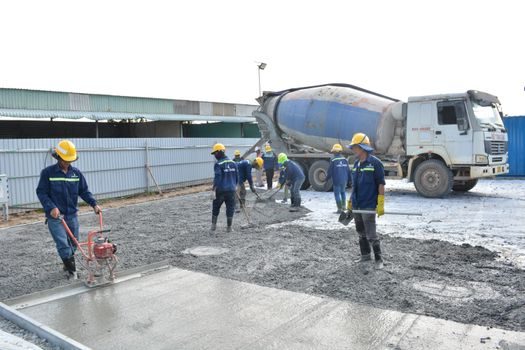
Project records must capture batch certificates, w/b and ambient readings, placement times, cube breaks, and any deviation approvals, because warranty disputes on special-cement work resolve against the documented field log rather than the design specification [S2].
Reference standards to cite on method statements: ASTM C150 for sulfate-resistant Type V, ASTM C845 for expansive cements (Type K/S/M), ASTM C1107 for non-shrink grout, EN 12004 / EN 12002 for tile adhesive classification (C1/C2, T/E, S1/S2), and ISO 9001:2008 quality-system controls for the producer (Guangxi Yunyan's audited baseline, among others) [S2]. Hold each batch's mill certificate on file for a minimum of 7 years post-completion, and stamp each placement section with the pour date, ambient conditions, mix water source, and the crew lead's signature. The next reviewable signal in this thread is the late-2026 revision of EN 12004, which is widely expected to tighten S2-class deformability thresholds from ≥ 5 mm to a value currently under ballot; until that drops, retain all S2-class break sheets and slip-test data so a retrospective compliance check can be run without revisiting the pour.
For component-level specifications, see linear guide, and crossed roller guide.