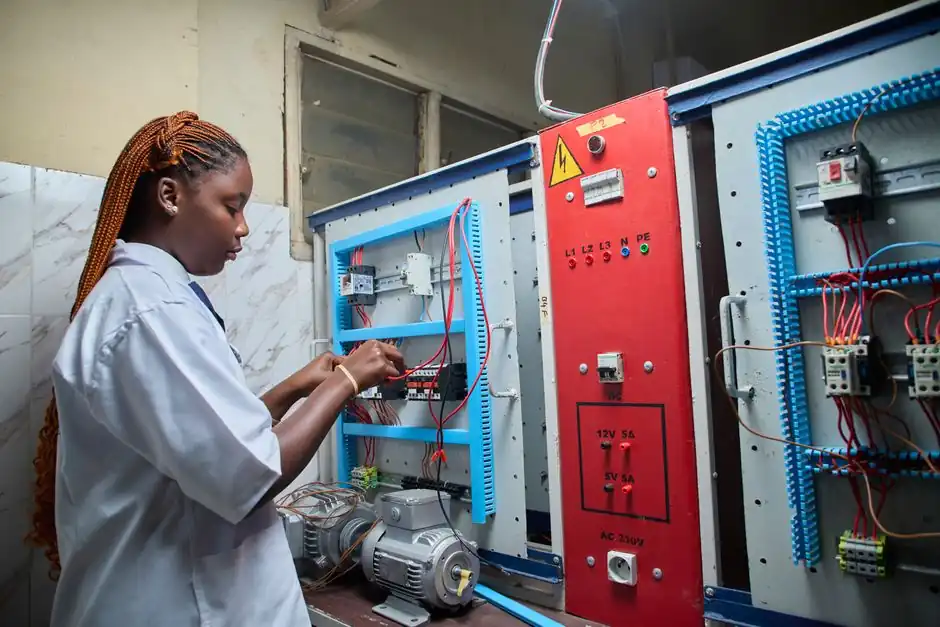
IEC 61439 governs low-voltage switchgear and controlgear assemblies up to 1,000 V AC or 1,500 V DC, covering design, construction, verification, and testing [S6].
Machine builders must select the applicable Part 2 or Part 3 route, define assembly ratings and interfaces, and verify thermal performance, short-circuit withstand, insulation, and protection against electric shock [S1][S3].
Scope and responsibility under IEC 61439
IEC 61439-1:2020 defines general rules, service conditions, construction requirements, technical characteristics, and verification requirements for low-voltage switchgear and controlgear assemblies [S1]. It is the common framework, while the relevant part from Part 2 onward applies together with the cited Part 1 requirements; Part 2 applies where Parts 3 onward do not cover the assembly [S1].
The series was structured with Part 1 as general rules and separate product-specific parts for power-control assemblies and distribution-board applications [S3]. This structure matters because a machine panel assembled from compliant individual components is not automatically a verified IEC 61439 assembly. The original manufacturer must verify the complete combination, including its circuits, enclosures, interfaces, and installed equipment [S3].
Part 2 addresses power-control assemblies, while IEC 61439-3:2024 addresses distribution boards intended to be operated by ordinary persons [S2][S3]. Machine applications can fall into either route depending on function, operating authority, and the applicable assembly type, so the procurement description should state the classification rather than rely on the generic phrase “IEC 61439 compliant” [S1][S3].
Part 3 boundaries for ordinary-person distribution boards
The standard therefore defines a specific scope rather than a blanket approval for every low-voltage distribution board.
For machine builders, these limits distinguish a Part 3 distribution board from a power-control assembly under Part 2 [S2][S3]. A panel intended for qualified operators, machine control, motor starting, or coordinated power functions should not be called a distribution board operated by ordinary persons merely because it distributes outgoing circuits. The applicable part must be fixed before ratings and verification are specified.
This product-level selection belongs inside an assembly verification process rather than replacing the assembly’s thermal, short-circuit, dielectric, and protective-earth verification [S3].
Selection criteria for machine power panels
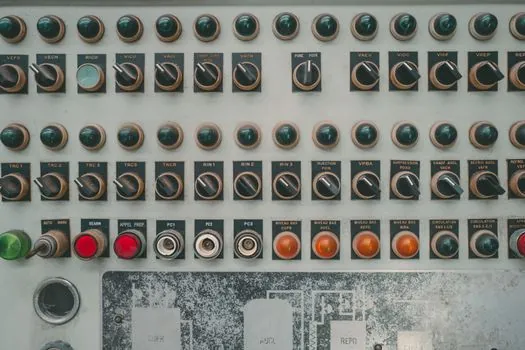
Machine-panel selection starts with the assembly function, rated voltage, current, circuit arrangement, and applicable Part 2 or Part 3 classification [S1][S3]. For Part 2, the relevant circuit and product requirements must be identified because Part 1 alone does not establish complete assembly conformity [S1].
Verification must address temperature rise, short-circuit withstand, dielectric properties, and routine checks. The construction guide addresses temperature-rise limits, thermal verification and calculation under IEC 60890, short-circuit withstand verification by design, power-frequency withstand testing, and impulse-voltage testing [S3]. These are assembly-level considerations that cannot be closed by selecting certified breakers alone.
IEC 61439-1:2020 introduced a group rated current for circuits within a loaded assembly and refocused temperature-rise verification on that characteristic [S1]. That changes how buyers define circuit grouping and load allocation in the single-line diagram. A list of individual breaker ratings is not an adequate substitute for the assembly’s group rated current and verified thermal arrangement.
The 2020 edition also added requirements for DC and introduced Class I and Class II assembly concepts for protection against electric shock [S1]. Machine systems with substantial DC control or auxiliary circuits should therefore document the DC ratings and the applicable electric-shock classification, rather than copying ratings prepared for an AC-only motor panel.
Comparison of assembly routes and verification options
IEC 61439-2 is the Part 2 route for power-control assemblies when no later Part covers the design [S1][S3]. Both routes sit on the common Part 1 framework for definitions, construction, characteristics, and verification [S1].
Part 3 offers an explicit product scope and current limits but is not suitable for every machine panel [S2]. Part 2 is more appropriate when the assembly performs power-control functions, but it requires detailed circuit-specific design and verification rather than automatic acceptance under Part 3. On operating authority, Part 3 favors ordinary-person access, Part 2 addresses qualified power-control applications, and on scope, Part 3 is limited to the stated DBO envelope [S1][S2].
On thermal evidence, both routes require assembly-level treatment, including the group rated current introduced by IEC 61439-1:2020 [S1]. On short-circuit evidence, the manufacturer can use the verification methods permitted by the relevant requirements, including design verification, rather than assuming every assembly needs the same physical destructive test [S3]. The key decision is therefore not “tested or not tested,” but whether the declared evidence matches the assembly, its ratings, and its Part 2 or Part 3 route.
For external mechanical connections, machine designers still need to coordinate enclosure and accessory components with the verified assembly. Where a panel uses keyed or threaded mechanical restraints, the locking assembly must not be allowed to compromise the enclosure’s verified protection or access arrangement. This is an interface-control issue, not evidence that the enclosure automatically meets IEC 61439.
Construction, verification, and production control

An IEC 61439 assembly must remain traceable to its declared ratings and construction. The guide separates main verifications by the original manufacturer, routine verification by the assembly manufacturer, additional checks during testing, final documentation, and declarations or test certificates [S3]. This verification chain is one of the strongest practical arguments for keeping assembly construction under controlled configuration management.
Routine verification under Part 2 includes dielectric-property checks, and the guide covers final documentation as a distinct stage [S3]. Machine builders should therefore treat modified outgoing circuits, replaced breakers, changed busbar arrangements, added vents, or revised gland layouts as potential design changes. The original verification evidence must be reviewed before the altered assembly is released for production or shipment.
Enclosure classification also affects the design file. The construction guide treats open-type and enclosed assemblies, external design, installation conditions, functional classification, IP protection, IK protection, and forms of internal separation as distinct subjects [S3]. IP, IK, and internal separation should therefore be specified as separate requirements. A single enclosure rating cannot substitute for the separation needed by the circuit arrangement.
Short-circuit withstand must be matched to the plant rather than inferred from the enclosure. The guide addresses short-circuit current, suitability of the assembly to the plant, selection of the distribution system, and verification by design [S3]. For machine applications, the upstream installation contribution, prospective fault current, protective-device coordination, and busbar system must be reconciled before the panel nameplate is accepted.
Limits that prevent invalid IEC 61439 claims
IEC 61439 certification applies to the assessed assembly, not a marketing label transferred from individual components. Component standards such as IEC 60898-1, IEC 61008, IEC 61009, IEC 62606, IEC 62423, and IEC 60269-3 support Part 3 device selection, but they do not replace the complete assembly verification required by the IEC 61439 series [S2].
The 2020 general-rules edition introduced treatment of power electronic converter systems, switch-mode power supplies, uninterruptible power supplies, and adjustable-speed power-drive systems when incorporated into assemblies [S1]. Those products are tested to their particular product standards, while their incorporation into the assembly must comply with IEC 61439. Machine panels containing drives or converters therefore need two distinct evidence paths: product-level compliance and assembly-level conformity.
National adoption can also affect the contractual specification. EN IEC 61439-1:2021 was approved by CENELEC on 2020-06-24 and identifies itself as identical to IEC 61439-1:2020 [S5]. Its national implementation date was 2021-11-21, with conflicting national standards withdrawn by 2024-05-21 [S5]. Procurement in European markets should distinguish the IEC edition from the applicable EN or national adoption instead of combining both designations without checking the governing document.
Machine builders should also avoid claiming ordinary-person operation under Part 3 unless the access level, outgoing devices, voltage, and currents meet the DBO scope [S2]. If the panel is guarded, operated by trained personnel, or assigned power-control duties, Part 2 or the applicable product-specific route is the more defensible specification.
Document package for compliant assembly procurement
A procurement package should identify the exact standard and part, assembly classification, rated voltage, current data, circuit grouping, protection class, and intended operating authority. IEC 61439-1:2020 supplies the general framework and requires conformity to be assessed with the relevant Part 2 or Part 3 requirements [S1]. The technical file should then connect the single-line diagram to thermal, short-circuit, dielectric, and routine-verification evidence [S3].
Machine-specific interfaces also need explicit treatment. Control transformers, drives, converters, auxiliaries, gland plates, doors, and outgoing equipment must be identified within the assembly record. Where a mechanical connection uses a shaft collar or shaft key on a relevant rotating component, the procurement package should identify its material, dimensions, and mechanical duty separately from the electrical verification.
The next engineering node is a pre-production design review against the named IEC 61439 part. Trackable evidence should include the approved single-line diagram, group rated current, enclosure and separation data, short-circuit withstand calculation, dielectric verification, routine test records, declaration of conformity, and test certificate [S1][S3]. Any production change should close through the same configuration review rather than relying on component certificates alone.