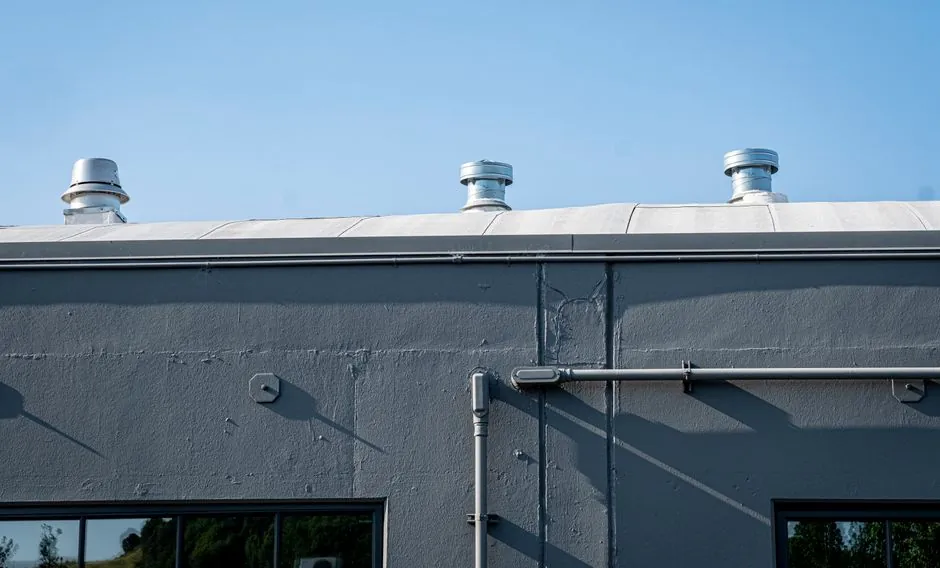
A spray polyurethane foam roof is a two-layer system: closed-cell SPF (minimum 2.5 lb/ft³ density, typically 2.7–3.0 lb/ft³ for walkable surfaces) sprayed through a plural-component rig at 115–130 °F, then sealed with an elastomeric coating that takes the UV and abrasion the foam itself cannot survive [S2][S4].
The substrate gets a seamless, self-flashing, fully adhered membrane with R-6 to R-7 per inch, the highest R-value per inch of any common commercial roofing material, and a service life commonly cited at 30 to 40+ years when the topcoat is recoated on schedule [S3][S4].
Foam Layer: Density, Expansion, and Application Window
SPF is formed by reacting an A-side isocyanate with a B-side polyol through heated high-pressure hoses and a mixing gun; the liquid expands to roughly 30 times its original volume and skins over in seconds, locking into a closed-cell, monolithic shell bonded directly to the deck [S2][S4].
For commercial roofing, only high-density closed-cell foam is acceptable; the SPFA-aligned threshold is at least 2.5 lb/ft³ (roughly 2.5 psi compressive strength at that density), and 2.7–3.0 lb/ft³ is the practical band if the roof will be walked on for HVAC service or recoat work, because anything softer deforms under foot traffic [S4]. SprayWorks Equipment and similar material distributors stock 0.5 lb (open-cell), 2 lb, and 3 lb formulations, but only the 2 lb-and-up closed-cell grades belong on a roof [S3].
Open-cell spray foam, by contrast, is reserved for interior insulation and soundproofing; it absorbs water and lacks the closed-cell compressive strength that a roof assembly demands, so a supplier quoting open-cell for a roof deck is a red flag, not a value option [S4].
Elastomeric Topcoat: Why the Foam Has to Be Sealed
SPF itself has essentially no UV resistance: leave it uncoated and the surface powders off within a few years, which is why every credible SPF system is sold as foam-plus-coating, never as foam alone [S2][S4][S5].
The coating chemistries specified across manufacturer guides are silicone, acrylic, urethane, and butyl rubber, all classed as elastomeric, meaning they stretch and recover with the foam's daily thermal movement instead of cracking off [S4]. The silicone sub-class dominates the U.S. commercial market because it holds up under ponding water, which acrylics tolerate poorly and where the foam would otherwise be exposed after a coating split [S4].
Manufacturer-published products in this category include Gaco Western and Henry silicone roof coatings, Gaco's own F2733RHFO closed-cell roofing foam designed to be used under GacoFlex topcoats, and acrylic elastomerics such as APOC 252 Sunwhite sold in 5-gallon pails to the DIY recoat market [S3][S5][S8]. Acrylic elastomeric reflective sealers, for example the RC865-2 white coating carried by major building-materials retailers, are formulated as a UV shield and cool-roof surface over foam rather than as a standalone weather membrane [S1].
Coating Thickness: 20 to 40 Mils Is the Working Band

American WeatherStar's installer-facing guidance, tied to SPFA methodology, calls for a minimum 20 mils of silicone topcoat over SPF, with up to 40 mils where the chemistry or warranty demands a heavier film [S4]. Twenty mils is roughly 0.020 in, or about the thickness of a heavy trash bag, which is enough to absorb the foam's daily expansion-contraction cycling without exposing cells.
For acrylic and urethane topcoats, the equivalent dry-film thickness band is similar in magnitude but typically verified by the coating manufacturer's published coverage rate in gallons per 100 ft² rather than a fixed mil spec, so a recoat contractor should always pull the data sheet for the specific SKU instead of assuming 20 mils carries across chemistries [S4]. The role of the topcoat is broader than UV blocking: it also serves as the sacrificial abrasion layer that takes foot traffic, hail, and ponding-water chemistry, which is why recoating on a 8 to 10 year cycle is the documented field practice for keeping an SPF roof in service indefinitely [S5].
Coating Options Compared on Four Decision Criteria
On UV resistance, silicone and urethane outperform acrylic and butyl, with silicone especially tolerant of ponding water; on walkability and abrasion resistance, urethane and silicone lead, while acrylics scuff faster; on cold-weather flexibility, butyl and urethane stay elastic longest, with silicone stiffening at very low temperatures; and on recoat cost per square, acrylic is typically the cheapest, silicone the most expensive, with urethane and butyl in between [S4].
For reroofing over an existing substrate, the SPF-plus-elastomeric system is unusually forgiving because the foam adheres to BUR, modified bitumen, concrete, metal, and most single-ply membranes after proper prep, eliminating tear-off in many cases and sidestepping the landfill volume that a full replacement would generate [S2][S5]. This is the same logic that drives retrofit strategies in adjacent building-envelope work, where avoiding demolition waste is itself a design constraint, as discussed in expansion joint detailing.
Substrate Prep, Granule Choice, and the DIY Recoat Reality

Coating adhesion lives or dies on surface prep: a power washer (minimum roughly 2,000 psi class) is the standard tool, and field reports from a 2,100 ft² DIY recoat describe a full two-day cleaning pass before any coating is rolled on [S5]. Without that step, the new elastomer sits on dust and chalk rather than on foam, and the failure shows up as peeling within one or two seasons.
The fine white granules sometimes broadcast into the topcoat are a contested detail: contractors apply them for UV and aesthetics, but the same long-term homeowner account reports the granules shed into gutters and yards over a decade, with no observed bird-peck deterrent effect on the un-granulated surface [S5]. Where granules are specified, they are rolled into the wet base coat, not dropped into a finished film.
The elastomeric category as a whole spans thin rubberized paints applied at roughly $120 per 5-gallon pail for acrylics, up through silicone systems sold through roofing-materials distributors and OEM lines such as GacoFlex, each with its own primer and reinforcement fabric schedule; the polyurethane elastomer reference page covers the underlying base chemistry that links SPF B-side resins to these topcoats.
What SPF Roofing Is For, and Where It Is Not
SPF roofing fits flat or low-slope commercial decks, irregular geometries with many penetrations (the foam self-flashes around curbs and pipes), and reroof projects where tear-off is impractical, including occupied buildings where the existing roof must stay weathertight during work [S2][S4].
It is a poor fit for steep-slope residential shingle applications, for homeowner DIY installation of the foam itself (the chemistry, heated plural-component rigs, and respirator discipline are professional-grade), and for any project where a maintenance recoat every 8 to 10 years is not actually going to happen, because uncoated foam degrades fast under UV [S4][S5]. It also requires a qualified contractor, since SPFA-aligned training typically takes months to years before a crew is considered proficient on a commercial roof [S4].
Field Economics and Service-Life Signals

Manufacturer and installer sources converge on a 30 to 40+ year roof life when the silicone or acrylic topcoat is renewed on a roughly 8 to 10 year cycle, with one long-term SPF owner reporting indefinite service over 20+ years once the recoat discipline is in place [S3][S5].
Two trackable signals to watch on any SPF asset are: (1) dry-film thickness of the existing topcoat, verified by coating thickness gauge readings at multiple grid points, with anything below 15 to 20 mils flagged for recoat; and (2) waterproof coating integrity at ponding areas, where pinholes and micro-cracks appear first after roughly a decade of service.
For the industrial coating reference frame, SPF topcoats sit at the soft, elastomeric end of the spectrum, sharing more with polyurethane insulation behavior on the foam side than with high-build epoxies on the steel side, which is why generic industrial-coating thickness rules do not transfer directly to a foam roof.