SPC (stone plastic composite) flooring is built as a five-layer laminate: a UV-cured topcoat, a transparent PVC wear layer, a printed decor film, a CaCO3-filled rigid core, and an optional acoustic underpad, with overall thickness ranging 3.5-6.5 mm and wear layer 0.2-0.7 mm (8-28 mil class) [S1][S5].
The five layers are interdependent rather than independent, and the system fails at its weakest layer. A 28-mil wear layer bonded to a recycled, high-filler core can still crack at the click-lock within three years because impact energy transmits upward through an over-hardened core [S1]. For a broader view of how layered flooring systems compare to other industrial surfaces, see the industrial flooring reference.
Layer-by-Layer Function and Material
The top UV coating is a polyurethane or acrylate layer cured with UV light, often loaded with Al2O3 or ceramic beads; suppliers quote the number of roller passes and the Al2O3 content as the two quality handles, since a low-solids UV coat will scratch prematurely and accelerate wear-layer failure by 2-3x [S1]. Beneath it, the wear layer is a clear, virgin or recycled PVC film, measured in mil (0.001 in, equal to 0.0254 mm) rather than millimetres, with 12 mil approximately 0.30 mm, 20 mil approximately 0.51 mm, and 28 mil approximately 0.71 mm [S3][S5].
The decor (print) film sits below the wear layer and is itself a multi-layer material: a transparent PVC or PET base film carries a gravure- or flexo-printed ink layer for wood, stone, or marble patterns, finished with a corona or primer treatment to bond to the wear layer above [S2]. The SPC core is the structural centre, typically 60% calcium carbonate (powdered limestone) with PVC and stabilisers, which delivers the dimensional stability and dent resistance that distinguish rigid core from flexible LVT [S4]. The bottom underpad, usually IXPE, EVA, or cork, is pre-attached in many programs and adds acoustic damping plus a moisture barrier, raising finished system height and affecting door-clearance planning [S1][S5].
Wear Layer Thickness Selection Matrix
Wear layer thickness is the most directly user-specifiable variable, and the practical industry bands are 6-12 mil for residential bedrooms and home offices, 12-20 mil for hallways, kitchens, and living rooms, 20-28 mil for light commercial such as small offices and low-traffic retail, and 28+ mil for heavy commercial including hospitals, schools, and large retail stores [S3]. The selection matrix for full construction pairs a 3.5-4.0 mm plank with an 8-12 mil wear layer for value residential, 4.0-5.0 mm with about 12 mil for mainstream residential, 5.0-6.0 mm with 12-20 mil for rental and hospitality, and 5.0-6.5 mm with about 20 mil for retail and office corridors [S5].
A 5 mm plank carrying a 0.5 mm (about 20 mil) wear layer frequently outperforms a thicker plank with a lighter residential wear layer in a busy retail program, because total thickness mainly governs rigidity, click-joint geometry, and transition height, while the wear layer alone governs abrasion and scuff resistance [S5]. Comparing the three main rigid-flooring constructions: SPC at roughly 60% CaCO3 core is denser, thinner, and more dent-resistant than WPC, while flexible LVT lacks the rigid core and relies entirely on its wear layer for surface durability [S4].
Decor Film Structure and Design Options
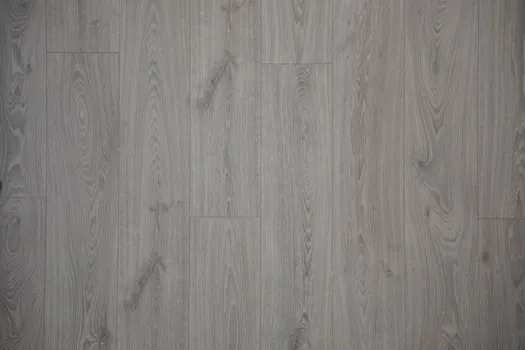
Decor film is a thin, multi-component printed layer, not a single sheet, comprising a transparent PVC or PET base film, a gravure or flexographic eco-friendly ink layer carrying the pattern, and a corona-treated or primer-coated surface layer for adhesion to the wear layer above [S2]. The base film supplies dimensional stability so the printed ink does not distort during the hot-press lamination to the core, and the surface treatment is what prevents delamination at the wear-layer interface. For an overview of how printed films and laminates fit into broader industrial surface specifications, the SPC flooring entry covers the parent product.
Common design categories fall into three families: wood grain (oak, walnut, maple, ash) for the largest residential share; stone and marble patterns (marble, slate, granite) common in commercial and modern interiors; and concrete or industrial textures gaining share in minimalist architecture [S2]. High-resolution gravure printing plus EIR (embossed-in-register) texture aligns surface relief with the printed grain, which is what allows a printed SPC plank to read as natural hardwood rather than a flat photograph.
SPC Core Composition and the Wooden-Bucket Effect
The SPC core is the load-bearing layer, and its CaCO3-to-PVC ratio controls both rigidity and click-lock life; a core that is too rich in calcium carbonate transmits impact upward and accelerates surface wear, while one that is too soft deflects under load and stresses the click profile [S1]. Industry-side testing against ASTM F3261 and EN ISO 10582 is cited as the baseline for layer-stack verification in commercial programs [S1].
This interdependence is the so-called wooden-bucket effect: the plank fails at its weakest layer, not its best, so a 28-mil wear layer over a recycled-content core still produces click-lock failure within roughly three years, while a 12-mil wear layer over a virgin-PVC, properly formulated core can hold a residential installation for the rated lifespan [S1]. The relevant comparison points when auditing a supplier are: virgin vs. recycled PVC in the wear layer, measured mil thickness (not the label), CaCO3-to-PVC ratio and density in the core, and material type plus adhesive quality on any pre-attached underpad [S1]. For spec writers, the lamps and light fittings reference is a useful cross-check on how a layered-system spec audit is structured in adjacent industries.
Specifying Total Thickness, Backing, and Verification

Total plank thickness is configured in the 3.5-8 mm band depending on the program, and it sets rigidity, click profile, finished floor height, door-clearance, and carton-loading density, while the underpad choice (IXPE, EVA, or cork) adds acoustic performance and a built-in moisture barrier [S5]. Acoustic backing selection should be confirmed alongside the carton identification and replacement-stock plan in rental and hospitality programs, where the floor is expected to be turned over rather than left in place for 20 years [S5].
Pre-shipment verification of a layered SPC program reduces to four checks: confirm the wear-layer callout in mil and convert to mm (12 mil is 0.30 mm, 20 mil is 0.51 mm, 28 mil is 0.71 mm), confirm CaCO3-to-PVC ratio and virgin-vs-recycled status on the core, confirm decor-film DPI resolution and whether EIR embossing is in register, and confirm attached-pad material, thickness, and adhesive [S1][S3][S5]. Two further signals worth tracking into the next sourcing cycle: EN ISO 10582 and ASTM F3261 revisions, and any published updates to the 6-12 mil / 12-20 mil / 20-28 mil / 28+ mil residential-to-commercial wear-layer bands cited in current OEM guides [S1][S3].
See also our earlier report, Expansion Joint: Why a Waterstop Plus a Surface Sealant Is the Default.