
Spherical plain bearings are specified by inner-ring bore, sliding-contact material, and load direction, with DIN ISO 12240-3 governing metric geometry; the Nadella/DURBAL DGE-AW axial steel/PTFE series runs 10–360 mm bore at 0.04 kg for a 10 mm unit [S1].
Selection work starts with three load cases (radial, angular-contact, axial/thrust), then the bore/length series, then the liner system, and only then lubrication and housing tolerance. Bearings in this family tolerate misalignment up to several degrees — useful on hydraulic cylinders, king-pins, and suspension links — and the steel/PTFE composite shown in [S1] is the workhorse material for maintenance-free service in dry or marginally lubricated pivots.
Load case and series map (DIN ISO 12240-3)
Three series families are typically used: E (radial), EW (angular-contact), and G/AW (axial/thrust). The DGE-AW axial series cited above follows the G-type geometry of DIN ISO 12240-3, with single-split outer rings of heat-treated, hardened steel bonded with PTFE-fabric [S1]. Radial-load spherical plain bearings (GE series) carry the highest static and dynamic load ratings per millimetre of bore; angular-contact types (GEW, EGW) accept combined radial + axial loads; axial types (GX, DGE-AW) are limited to thrust load with a low radial allowance. The reference [S3] SAE AIR 1594C-2010 covers plain-bearing selection for landing gear, which is a useful cross-check when an aerospace-derated or traceable lot is required for non-aerospace pivots. For comparison with rolling-element alternatives, see the tapered roller bearing sizing guide — the two technologies split on misalignment tolerance, not on basic load capacity.
Bore, mass and envelope envelope envelope constraints
Bore range drives every downstream decision. DGE-AW is published from 10 mm to 360 mm, with 10 mm at roughly 0.04 kg per piece [S1]. Mass scales roughly with bore squared times length; a 100 mm unit in the same family typically lands in the 1.5–2.5 kg range depending on series. The 360 mm upper limit is a practical supply ceiling — above that, forged custom rings or sleeved-cartridge constructions become necessary. For mounted pillow-block packaging, the China pillow block bearing suppliers map is a more useful starting point than a bare spherical plain bearing.
Sliding-contact materials compared
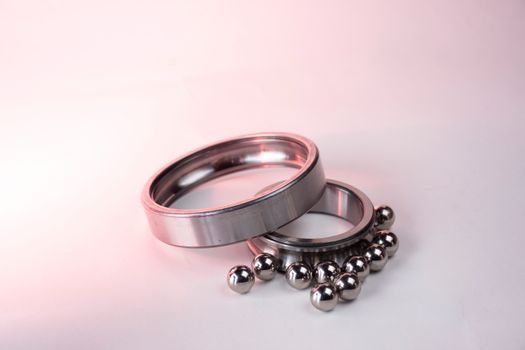
Four material pairings cover ~90% of industrial service: (1) steel/PTFE fabric (maintenance-free, low friction ~0.04–0.10, dry or marginal lube, –50 to +200 °C typical envelope), (2) steel/PTFE composite (lower cost, slightly higher wear under oscillation), (3) steel/steel through-hardened (high-load, shock-tolerant, requires regular lubrication), and (4) bronze/PTFE (marine and water-submerged). The DGE-AW unit in [S1] uses option 1: outer ring heat-treated steel, single split, PTFE-fabric bonded liner. Compared with rolling-element bearings, the spherical plain bearing encyclopedia entry is the canonical reference for material-trade-off tables. Steel/PTFE is the default unless shock loading or sustained temperatures above ~200 °C are in scope.
Load rating, life and misalignment envelope
Static load rating C0 is the limiting parameter for oscillating or slow-pivoting service; dynamic load rating C applies when continuous rotation exceeds roughly 1 rev/min equivalent. DIN ISO 12240-3 publishes C and C0 in tabular form per bore/series — for a 30 mm GE-series radial unit, C0 is typically in the 100–200 kN range depending on series; for a DGE-AW 30 mm axial, expect roughly half that. Misalignment capability is a key reason this bearing type is chosen over rolling-element units: GE radial types accept ~3–6°, GEW angular types ~2–4°, G axial types ~1–3°, depending on bore size (smaller bore = more angular freedom in absolute terms). When the design envelope is genuinely tight on space, a linear guide or ball bearing arrangement may serve better, but neither matches spherical plain misalignment tolerance. [S1]
Vendor, sourcing and 2026 supply signals
Mainland China remains the dominant manufacturing base for commodity spherical plain bearings; Made-in-China lists Zhejiang/Ningbo suppliers at roughly US$2.00–45.00 per piece with MOQ 100 pieces across the standard series [S5]. European branded lines (Nadella, SKF, INA, DURBAL) hold the premium tier for documented DIN ISO 12240-3 conformance, lot traceability, and aerospace-derated material certification [S1]. The general-purpose product description in [S4] confirms the operating envelope: high radial load capacity, marginal-lubrication tolerance, and self-lubrication through bonded liner — all standard across the category. Buyers specifying for hydraulic-cylinder, king-pin, or off-highway pivots in 2026 should expect 4–8 week lead times on European brands at 30–100 mm bore, and 2–4 weeks on Chinese-origin equivalents, with pricing gaps of 2–4× at the same nominal size.
Selection checklist and failure modes
Five-step gate for any spherical plain bearing spec: (1) load case — radial, angular, or axial; (2) bore and width per DIN ISO 12240-3 series letter; (3) C and C0 vs applied load with a 1.5–2.0× safety factor on static and 1.0–1.3× on dynamic; (4) liner material vs temperature and lubrication regime; (5) housing tolerance and misalignment allowance. Common failure modes to spec against: liner wear under oscillation below 5° (PTFE-fabric bonds last longer than bare PTFE), brinelling on shock-loaded steel/steel pairs, and corrosion pitting on non-stainless rings in wash-down service. Where the application is closer to a slewing ring than a pivot, escalate to a crossed-roller guide such as the crossed-roller guide range, which gives higher rotational precision at the cost of misalignment tolerance. [S2]
Trackable next signals: Nadella/DURBAL catalogue updates for DIN ISO 12240-3 series E and EW for 2026–2027, and any shift in Zhejiang/Ningbo export pricing for 30–100 mm G/AW units in the next two quarters [S1][S5]. Engineers specifying alongside linear motion can cross-reference the linear bearing encyclopedia entry when the application mixes pivoting with sliding travel.