
Spiral duct is sized by converting required airflow (CFM) into a round cross-section using the velocity method, then verifying pressure class and gauge against SMACNA HVAC Duct Construction Standards for the operating static pressure.
This guide covers the engineering inputs (CFM, FPM, friction rate), the four sizing methods, the round-to-rectangular equivalence rules, gauge/steel selection, and the duty envelopes where spiral round is the right pick over rectangular flat-oval construction.
What inputs drive the calculation
Three numbers govern the size: airflow Q in CFM (or m3/s for SI), target face velocity v in FPM (typically 1,500-2,500 FPM for supply, 1,000-1,800 FPM for return), and the allowable friction rate f in in.wg per 100 ft. The cross-sectional area A = Q / v (ft2), and the round diameter d = sqrt(4A/pi). A 4,000 CFM supply at 2,000 FPM needs 2.0 ft2 of area, which is a 19.0 in round duct; the same duty in a 2,400 CFM return at 1,500 FPM needs 1.6 ft2, or about 17.2 in diameter. [S5]
For metric, the equivalent expressions are A = Q / v with Q in m3/s and v in m/s, giving d in metres; 1,500 FPM equals 7.6 m/s, a common commercial supply value. The friction rate is read from a duct friction chart (Darcy-Weisbach or ASHRAE chart) at the chosen velocity and equivalent length; a default 0.10 in.wg per 100 ft works for most low-pressure supply runs, dropping to 0.08 for return and rising to 0.15-0.20 in.wg per 100 ft for higher-velocity ductwork feeding VAV terminals.
Four sizing methods and when to use each
Equal-friction (constant friction rate) is the default for short, simple runs: every branch is sized to the same f in in.wg per 100 ft, so pressures rebalance at the terminal. Static-regain sizes each branch so its static pressure at the takeoff matches the main downstream, suiting long ductwork with 5 or more branches. Constant-velocity holds v fixed at every section, useful for cleanroom and process exhaust where deposition or noise control is critical, at the cost of larger ducts and higher gauge. Constant-air-volume (CAV) terminal sizing is the same velocity method applied at the box; it is not a duct sizing method but is often confused with one. [S5]
For most commercial HVAC, equal-friction is the engineering baseline. Static-regain is the upgrade for hospitals, labs, and large office air handlers with long horizontal mains. Constant-velocity is reserved for dust collection, fume exhaust, and semiconductor make-up air where 1,500-3,500 FPM and code-listed spark-resistant construction matter.
Round-to-rectangular equivalence rules

A round duct outperforms a rectangular one with the same cross-sectional area: it has lower perimeter, lower wetted surface, and roughly 15-20 percent less friction loss at the same airflow. The standard equivalence tables (and ASHRAE Fundamentals Chapter 21) convert a round of diameter d to a rectangular of sides a x b that carries the same airflow at the same friction rate, where the hydraulic diameter is preserved. Practical rule: a rectangular with aspect ratio up to about 4:1 is fair; above 8:1 the equivalent round drops sharply in capacity, and the specifier should reconsider the layout or step up to flat-oval spiral. [S2]
Commonly stocked spiral round sizes run 4 in, 6 in, 8 in, 10 in, 12 in, 14 in, 16 in, 18 in, 20 in, 22 in, 24 in, 30 in, 36 in, and 42 in, with 48 in and larger available on made-to-order lead times. Lock-forming seam spiral is standard for low-pressure galvanized; welded or flanged spiral is used above +/- 10 in.wg static class. The full spiral duct product family spans single-wall galvanized, double-wall insulated, and stainless 304/316 variants, with PVC and aluminium coatings for corrosive atmospheres.
Steel gauge and pressure class selection
Gauge is set by static pressure class, duct size, and SMACNA HVAC Duct Construction Standards (Metal and Flexible). For 4-10 in round at +/- 1 in.wg class, 26 gauge galvanized is typical; 12-26 in round at the same class is 24 gauge; 28-36 in round steps to 22 gauge; 42 in and larger often goes 20 gauge. At +/- 2 in.wg class, gauge increases by one to two steps; at +/- 3 in.wg and above, factory transverse joint reinforcement is mandatory. Stainless 304 is the workhorse for kitchen exhaust and general food-grade duty; stainless 316 is required for chlorides, lab fumes, and coastal atmospheres. [S2]
For process exhaust at high temperature, the gauge table is not the controlling document; the temperature, dwell time, and code listing (NFPA 96 for kitchen, NFPA 91 for process) are. A typical restaurant kitchen uses 20 gauge 304 stainless with watertight welded seams and a listed grease duct wrap; a semiconductor fab make-up air loop uses 22 gauge galvanized with gasketed flanges. [S5]
Material and finish selection by atmosphere
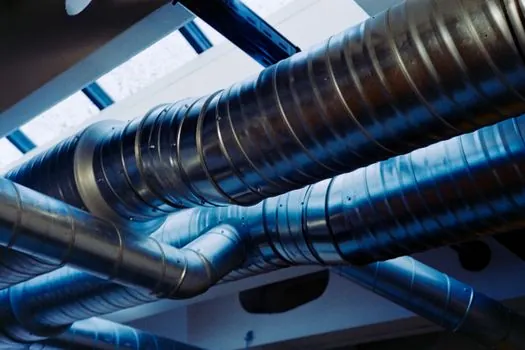
Galvanized steel (G60 or G90 coating) is the default for supply, return, and general exhaust. Aluminium is lighter and corrosion-resistant, used for outdoor intake and cleanroom supply where iron contamination is a concern. Stainless 304/316 is specified for kitchen grease, lab fume, pool natatorium, and any chloride exposure; PVC-coated or Heresite-coated galvanized is a lower-cost alternative for mildly corrosive exhaust. Fibreglass-reinforced plastic (FRP) is used for chemical scrubber outlets and acid exhaust where 316 stainless would still corrode. [S2]
For double-wall construction with insulation, the outer shell is usually 24 gauge galvanized, the inner shell is 26 gauge galvanized (or stainless/aluminium per duty), and the cavity is filled with 1.0-2.0 in of fibreglass or mineral wool at R-4.4 to R-8.0. Acoustical performance matters for schools and theatres: a 2 in lined double-wall duct typically achieves 0.5-1.0 sabin per linear foot insertion loss in the 250-1,000 Hz octave bands, sufficient for most spec language. The linear guide and other mechanical-room components follow their own sizing paths, but the airflow calc upstream feeds both.
Joint and seal selection
Low-pressure spiral (under +/- 2 in.wg) uses a drive slip-cleat or pocket-lock joint sealed with butyl tape and reinforced with sheet-metal screws every 6-8 in. Medium-pressure (up to +/- 6 in.wg) uses flanged rings (TDC or TDF) with a gasket rated to the operating temperature. High-pressure (above +/- 6 in.wg) uses bolted companion flanges with EPDM or neoprene gaskets. Sealing class per SMACNA: A (transverse only) for conditioned spaces, B (transverse plus longitudinal) for most return and exhaust, C (all joints sealed) for high-pressure and outdoor duct.
For outdoor duct, slope the run at 1/8 in per foot back to the air handler and provide a drain point; condensate on the cold-side insulation layer is the most common cause of duct failure in this service. For wiring duct and lighting equipment and electric lamps inside the mechanical room, the same engineering-due-diligence habit applies, but the load is electrical, not pneumatic.
Who should NOT default to spiral round

Plenum clearance under a 12 in structural slab leaves no room for a 22 in round; rectangular flat-oval or fully rectangular is the right call. Tight above-ceiling routing with multiple 90-degree turns also favours rectangular; spiral round loses its friction-rate advantage when fittings dominate the equivalent length. For very high static (above +/- 10 in.wg, e.g. industrial dust collection mains), welded rectangular is the more economical pressure class, since round gauge steps are coarse and oversized. And for short residential branch runs (under 12 in diameter, under 25 ft), flexible duct is the standard field-fabricated option; spiral round is not cost-effective at that scale. [S2]
If the specifier is choosing between four realistic options, the comparison is straightforward: galvanized spiral round is the lowest cost per CFM at low pressure; stainless 304 spiral round is the workhorse for kitchen and lab duty; PVC-coated spiral round is the lower-cost corrosive-exhaust pick; FRP or solid PP duct is the chemical-duty choice but at 2-4x the cost per ft. Pick by duty, not by habit.
Limitations, failure modes, and what to verify
The three most common spiral duct failure modes are seam cracking under negative pressure (mitigated by going one gauge heavier and using a notched-seam or welded-seam product), condensate drip from uninsulated outdoor runs (mitigated by full-perimeter insulation and sloped drainage), and joint leakage at medium pressure (mitigated by stepping up to flanged rings and gasketed seams). Stiffener rings or intermediate reinforcement is required at any diameter-to-gauge ratio that exceeds the SMACNA table for the operating static class. The crossed roller guide and other precision components in the air-handling unit are far tighter tolerance than ductwork and should not be confused with it. [S4]
For verify-before-purchase, the specifier should confirm: SMACNA HVAC Duct Construction Standards edition referenced on the submittal, gauge per the static class table, seam type (lock-form, notched, or welded), joint type by pressure class, sealant class A/B/C, and material certificate for 304 vs 316. The related polycarbonate selection for rail: grades, flammability, and acoustic data reference follows similar submittal-discipline logic. For projects where ductwork sits inside a larger supply package, the Air Quality Monitoring Market Sizing and Hardware Share article documents how monitoring budgets track the same building-engineering cycle.