
Spray generally permits a thicker coating per pass than brush or roller because atomization gives the applicator direct control over material delivery and deposition [S1][S2].
For large, flat surfaces, roller or spray application is much faster than brush application for oil-based coatings [S1].
What Film Build per Coat Means
Film build per coat is the wet or dry thickness deposited in one application pass. Most oil-based coatings can be brushed, while roller and spray application cover large, flat surfaces faster [S1].
Spray, Brush, and Roller Compared
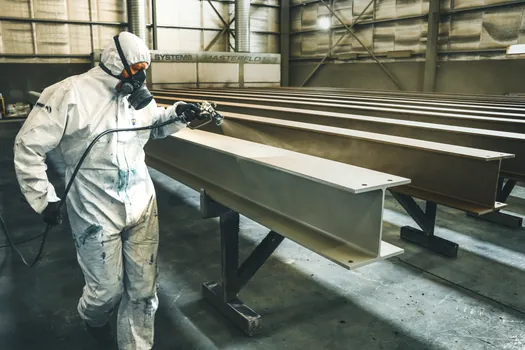
Spray offers the greatest potential control over thickness and can place more material on the substrate in one pass, but tip size, equipment output, atomization, travel speed, and operator technique determine whether that advantage becomes a controlled film or a sag [S2].
Brush application can be adjusted through brush loading, pressure, brush angle, travel distance, speed, and product viscosity [S3]. A thicker roller can carry more coating, but it does not replace a second coat when the required build has not been reached [S2].
Spray and brush can produce similar practical yield when the same target film build is maintained, but spray generally creates a more even layer with less repeated hand work [S7]. For exposed siding, spraying may improve coverage into lap lines, followed by back-rolling while the coat remains wet to improve uniformity and adhesion [S6].
Choosing the Method by Use Case

Use spray for large open steel, concrete, masonry, or roof areas where high throughput and uniform field coverage justify equipment setup and overspray control.
Use rollers on large surfaces where airborne overspray could contaminate adjacent equipment, occupied buildings, or finished components.
On open siding, most professionals spray for speed and penetration into lap lines and then back-roll the wet coat for adhesion and an even film [S6]. Spray the broad field, then back-roll or back-brush the wet coating where uniformity, texture, lap-line coverage, or wet-film distribution requires correction [S6].
Limits That Prevent a Universal Film Build
Neither method guarantees a fixed thickness per coat. Coating viscosity, solids content, substrate roughness, temperature, evaporation rate, operator skill, and the time available before setting all change the acceptable working area and resulting film [S2][S3].
Spray can produce runs, sags, overspray, and dry-spray defects when output exceeds the coating's ability to wet the substrate evenly. A larger tip does not independently determine film build: output rate, fan pattern, spray distance, speed, and product behavior also matter [S2].
Brush and roller can leave ridges, lap marks, missed areas, or insufficient build, especially if the applicator overloads the tool or works the material after it begins to set.
Control Procedure for Correct Film Build
Sourcing and Specification Discipline
Use the coating manufacturer's application data sheet as the controlling document for approved methods, spreading rate, recoat interval, environmental limits, and target dry-film thickness. Application method is product-specific, and deviation from the specified method can conflict with warranty or approved-system requirements [S4].
Use ASTM D4414 for wet-film thickness measurement during application, as identified in the roof-coating application reference [S4]. For industrial surface preparation, specify the coating system separately from application method, including profile, cleanliness, adhesion criteria, and coating thickness requirements.
The broader selection for liquid-applied industrial coating systems should be made by substrate, exposure environment, required film build, solids content, cure chemistry, and service life. A thicker coat per pass is valuable only if it remains uniform, bonded, free of defects, and within the coating's approved application limits [S1][S4].
Before release, verify that the actual dry-film build meets the specification across low, medium, and high areas, with special attention to edges, welds, fasteners, lap lines, and any location that received less material during spraying or rolling.