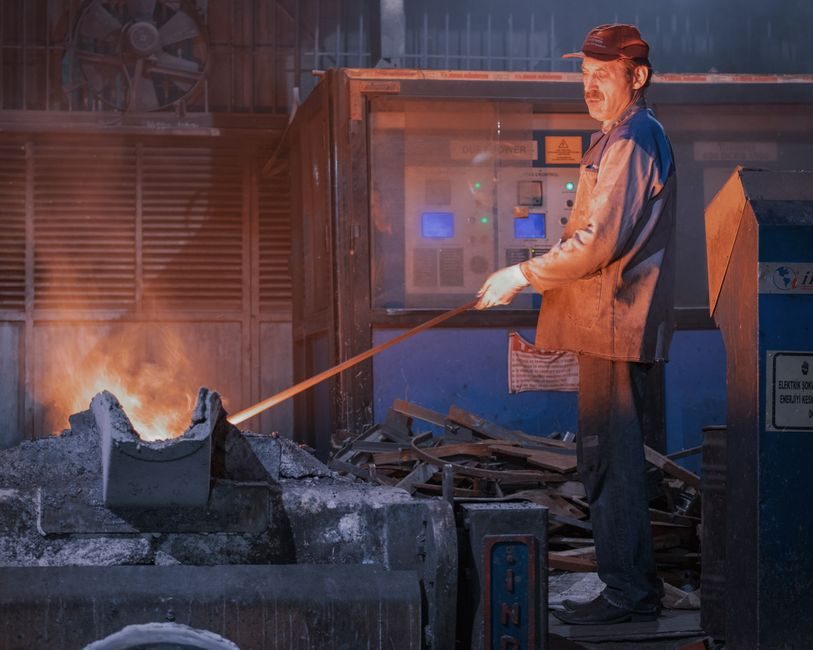
Squeeze casting machines combine the metal fill of gravity casting with the pressurised solidification of a forging press, and the selection pivot is intensification pressure: published parametric work on A390 aluminium places usable squeezing pressure in the 50-150 MPa range over the casting, applied and held until solidification completes [S2].
The class is therefore specified when a part cannot meet mechanical-property targets through gravity die casting yet does not justify the cycle cost of closed-die forging — the operating envelope covers aluminium and magnesium structural castings, brake callipers, suspension arms and high-integrity hydraulic housings where radiographic soundness and ductility are non-negotiable.
Pressure Class and Intensification Ratio
Specific pressure on the solidifying shell — not clamp tonnage on the die — is the parameter that drives density and feeding in squeeze casting; the densification mechanism is direct plastic deformation of the just-formed solid skin under sustained hydraulic load, which collapses the shrinkage micro-porosity that would otherwise survive in conventional castings [S1].
For vertical direct-acting squeeze casting presses, the hydraulic cylinder area divides the available clamp force to give a theoretical peak intensification; in practice a 200-ton press with a 250 mm intensifier ram delivers roughly 80 MPa on a 500 mm² projected casting footprint, which is the typical mid-range operating point for A390 cylinder-head and knuckle work. The pressure must be built up within roughly 0.5-2 s of die closure and held through the full solidification window — typically 15-45 s for a 5-15 kg aluminium casting — so hydraulic accumulator sizing, not just nominal tonnage, separates a real squeeze-casting machine from a press that merely clamps.
Machine Architecture: Vertical vs Horizontal, Plunger Geometry
Three architectures dominate the global supply: vertical direct-acting hydraulic presses (most common for structural castings, 50-800 ton), horizontal shot-sleeve machines derived from cold-chamber die casting machine platforms with a heavy locking unit (used for longer, flatter parts such as subframes), and bottom-pour / inverted-ram configurations that fill upward and press downward, preferred for symmetrical cylinder-head-type geometries where filling time must be decoupled from the pressurisation ramp. [S1]
Selection pivots on part geometry first: deep, symmetrical housings favour the vertical direct-acting press; long, thin-walled automotive structural parts favour horizontal; and parts with thin webs and thick bosses favour bottom-pour because the pressurised metal front arrives last at the thick section, which is where shrinkage porosity would otherwise form. The plunger head should be a free-floating, self-aligning geometry with a 3-8° draft and a thermal barrier (typically a cast-iron or refractory insert) so that 50-150 MPa pressure does not extract too much heat from the casting prematurely.
Alloy Window and Process Parameter Map

Wrought-and-cast crossover alloys — A356, A357, A390, 6061 in the aluminium family, AZ91 and AM60 in magnesium — are the workhorses; published parametric data on A390 shows that superheat, die preheat and pressure interact non-linearly, with peak tensile and elongation achieved when liquid superheat sits in the 60-120 °C above the liquidus, die preheat is held at 200-300 °C, and applied pressure is in the 75-125 MPa band [S2].
A390 under those conditions reaches UTS of roughly 280-320 MPa with elongation of 4-7%, against 220-260 MPa and 1-3% in the same alloy gravity-cast — a property jump large enough that, for high-stress components, the squeeze-casting decision is a material upgrade, not a process tweak. Magnesium alloys behave similarly but the process window is narrower: magnesium melt cannot exceed roughly 680 °C before oxide-inclusion risk rises, and the pressure-hold time must be longer because magnesium's higher specific heat delays complete solidification by 20-30% versus aluminium at the same section thickness [S1].
Selection Criteria: A Decision Matrix
Four criteria separate a fit-for-purpose specification from a generic press buy: intensification pressure (must hold 50-150 MPa on the projected area until end-of-solidification), thermal control (die preheat 200-300 °C with active heating channels, not just die-heater bands), cycle discipline (fill + pressure build-up inside 2 s, hold 15-45 s for a 5-15 kg Al part), and quench-or-cool path (controlled die cooling to fix T6 temper response, or in-die quench if the alloy and geometry permit). [S2]
A practical comparison: for a 4-8 kg A356 structural part, a 150-ton vertical press at 100 MPa intensification with a 30-second hold is the typical matched equipment set; for an A390 cylinder head at 8-15 kg, the same supplier moves to a 300-400 ton press with 80-120 MPa intensification and a 45-second hold; for a magnesium subframe at 5-10 kg, an enclosed, inert-gas-purged cell with a 200-ton press at 75-100 MPa and active die cooling is the minimum credible package. The squeeze casting machine decision is therefore a coupled choice of tonnage, intensification, thermal control and safety enclosure — quoting any one in isolation misleads.
Where Squeeze Casting Earns Its Place — and Where It Does Not
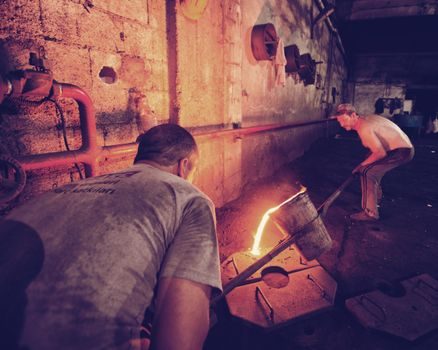
Use squeeze casting when the part carries cyclic or impact load (suspension, knuckle, calliper), when radiographic soundness must reach ASTM E505 Level 2 or tighter, when post-process HIP is being considered as a cost-down alternative, or when the alloy is a high-Si or Mg-rich composition that is hard to feed in gravity or low-pressure modes; in each of these cases the property uplift from 50-150 MPa pressurised solidification directly offsets the higher capex of a hydraulic press over a gravity die casting machine. [S3]
Do not use squeeze casting for thin-wall cosmetic parts (cycle time is dominated by hold, not fill), for short-run prototypes where the die cost cannot be amortised, or for ferrous parts unless the press is specifically built for high-temperature ferrous melt (above 1500 °C melt temperature, die life, refractory and safety requirements diverge sharply and the machine class is no longer the same as the aluminium press). The trade-off versus vacuum die casting machine routes is straightforward: vacuum gives you porosity reduction by gas evacuation down to roughly 5-50 mbar absolute, squeeze casting gives you porosity elimination by mechanical feeding — when the spec asks for <1% porosity and >8% elongation in A356/A357, the squeeze route is the only one that hits the target without HIP.
Controls, Sensors and Process Windows
Modern squeeze casting cells ship with closed-loop pressure profiling (setpoint ±2 MPa throughout the hold), die-temperature mapping via 6-12 thermocouples per die half, real-time plunger position feedback, and SPC data capture on every shot; this is the minimum sensor stack that lets the operator run a process-window chart rather than a point recipe. [S1]
Acceptable process-window margins from published work: liquid superheat tolerance ±10 °C around the setpoint, die-preheat tolerance ±15 °C, intensification pressure tolerance ±5 MPa, and plunger arrival delay under 0.3 s of the programmed ramp — excursions outside these bands produce measurable drops in UTS and elongation, with A390 showing roughly a 4-6% UTS penalty per 10 °C of die-preheat undershoot at fixed pressure [S2]. For magnesium work, an oxygen-level sensor in the cell (target <50 ppm O₂) and a gas-purge cycle between shots are baseline, not optional, because the alloy's combustion envelope is much narrower than aluminium's.
Standards, Sourcing and Supplier Reality
No single ISO or ASTM standard governs the squeeze casting machine as a whole product; instead the machine must satisfy the pressure-vessel and hydraulic safety regime of the install country (PED 2014/68/EU in Europe, ASME BPVC Section VIII for the hydraulic accumulators in North America), and the castings produced are evaluated against ASTM E505 (radiographic), ASTM E8/E8M (tensile), and the alloy-specific composition limits of AA and ASTM/EN standards. [S2]
Quotations from Chinese and Indian suppliers cluster in the USD 80,000-250,000 band for a 150-300 ton vertical press, USD 250,000-600,000 for a 400-800 ton press with full thermal control and inert-gas enclosure, and roughly USD 600,000-1.2 million for a horizontal, large-tonnage cell with integrated trim press and robotic deflashing — these ranges shift with hydraulic-versus-servo-electric actuation, with servo-electric presses carrying roughly a 20-30% premium but offering 15-25% energy savings and cleaner process water. Buyer due-diligence should always ask for a witnessed pressure-hold test at the supplier floor with the buyer's die installed, because tonnage nameplate claims are not predictive of intensification delivered at the part.
For related process choices, the comparison Squeeze Casting vs Hot Chamber Die Casting: Alloy, Pressure and Cycle Logic walks the alloy and cycle logic in detail, while the broader Aluminum Die Casting Machine vs Vacuum Die Casting Machine: 6 Spec Levers piece covers the vacuum-route alternative. Two signals to track over the next 12 months: tightening of ASTM E505 acceptance levels by Tier-1 automotive buyers as aluminum die casting machine giga-presses raise the property floor, and the publication of revised NFPA / EN safety guidance for inert-gas-purged magnesium squeeze cells.