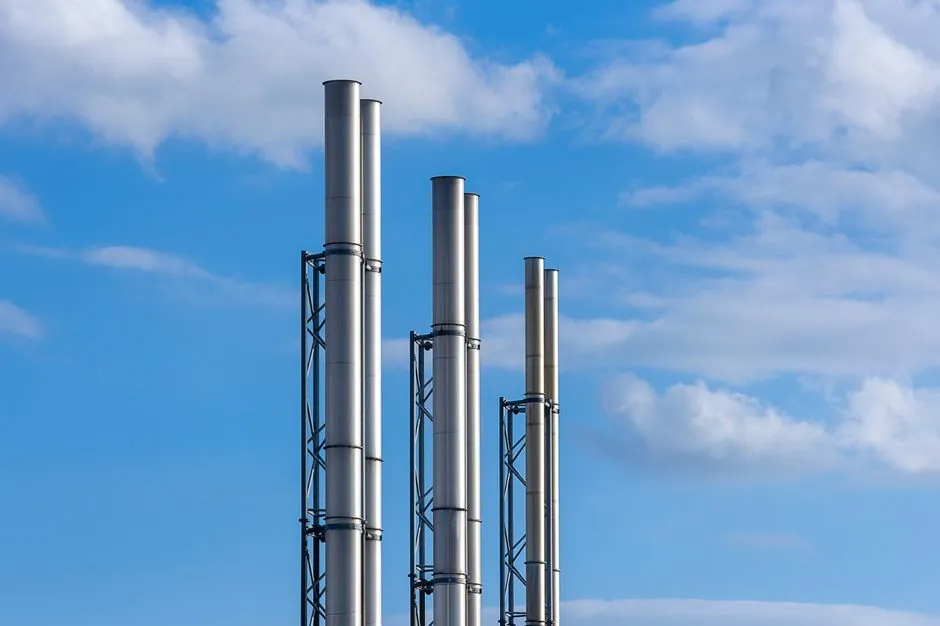
Stainless steel pipe is classified along two orthogonal axes: the manufacturing route, which decides whether a longitudinal seam exists, and the metallurgical family, which sets chromium, nickel, molybdenum content and thus the corrosion/temperature envelope [S1][S2].
The first axis distinguishes seamless pipe (produced from solid billet by hot-rolling or extrusion) from welded pipe, which is further split into EFW (electric fusion), ERW (electric resistance), HFW (high frequency), and SAW (submerged arc, spiral or long seam) [S4]. The second axis splits the material into five families: austenitic, ferritic, martensitic, duplex, and super duplex, each tied to a different crystal structure and PREN range [S2][S3].
Manufacturing Route: Seamless vs EFW / ERW / HFW / SAW Welded
Seamless pipe is made by piercing a solid round billet and elongating it over a mandrel, so no longitudinal weld exists. That is why it is the default for high-pressure and high-temperature service such as oil and gas, refinery hydrocrackers, and boiler tubes, where a seam would be the weakest link [S4].
Welded pipe starts from coil or plate rolled into a circular section, then joined by one of four processes: EFW (electric fusion welding), ERW (electric resistance welding, weld runs across the section), HFW (high frequency welding), and SAW (submerged arc welding, spiral or long seam) [S4]. Welded pipe is consistently cheaper because the feedstock is continuous coil, and it covers most low- and medium-pressure plumbing, structural, and process lines. ERW remains the workhorse for general-purpose service, while SAW spiral seam is the format of choice for large-diameter water and structural pipe.
Five Metallurgical Families and Their Property Windows
Stainless steel is defined as a ferrous alloy with at least 10.5% chromium and typically under 1.2% carbon; the chromium forms a passive Cr2O3 film that gives the corrosion resistance the family is known for [S2]. The five families diverge in microstructure: austenitic is FCC and non-magnetic; ferritic is BCC and magnetic with low nickel; martensitic is hardenable by heat treatment; duplex is roughly 50/50 austenite/ferrite and offers about double the yield strength of standard austenitic; super duplex pushes alloy content further to reach PREN above 40 for aggressive chloride service [S2][S3].
Composition windows matter more than the family name on a P&ID. Austenitic grades carry 16–26% Cr and 6–22% Ni, ferritic grades 10.5–30% Cr with little or no nickel, and martensitic grades are tuned for hardness rather than corrosion [S3]. The duplex/super-duplex branch is selected when yield strength and chloride pitting resistance dominate the design, which is why it now appears in seawater cooling, desalination, and offshore flowlines. For a broader view of where stainless pipe sits inside the overall stainless-steel alloy landscape, the family-by-family split above is the working mental model.
Grades 304, 304L, 316, 316L, 321: Where Each One Earns Its Keep
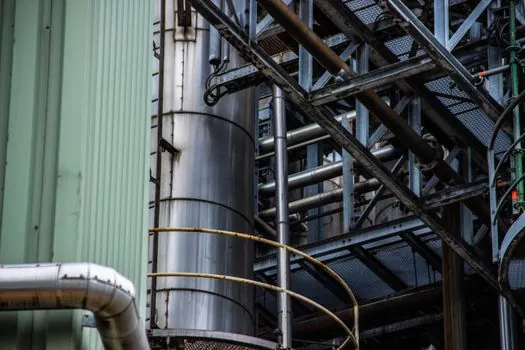
SS 304 (UNS S30400, the classic 18Cr/8Ni or 18/8) is the most specified stainless pipe grade, with continuous service up to 870°C (1,598°F) and good behaviour in air, fresh water, and mild chemicals. It is the default for food processing, water treatment, and architectural piping, and is delivered to ASTM A312 for pipe and ASTM A213 for tube [S1][S3].
SS 304L (UNS S30403) holds carbon at 0.03% maximum versus 0.08% in standard 304, which prevents chromium-carbide precipitation in the weld heat-affected zone and so blocks intergranular corrosion after welding [S3]. SS 316 (UNS S31600) adds 2–3% Mo to the 304 base, lifting PREN from roughly 18 to about 23, which is the jump that makes 316 the grade for chloride, seawater, and acidic chemical service. SS 316L (UNS S31603) is the low-carbon twin of 316 (0.03% C max) and is the de facto pick for most welded industrial piping exposed to chlorides, since it welds cleanly without post-weld heat treatment in most cases [S3]. SS 321 (UNS S32100) is titanium-stabilised, which ties up carbon between 425–870°C and is the choice for exhaust manifolds, furnace parts under thermal cycling, and refinery heater tubes [S3].
These grades map cleanly to the dimensional and tolerance regime of ASTM A312 for austenitic pipe and ASTM A213 for austenitic boiler and heat-exchanger tube; ASTM A269 covers general-service seamless and welded austenitic tubing, while ASTM A790/ASME SA790 covers duplex pipe and ASTM A789/ASME SA789 covers duplex tube [S1]. The same stainless pipe family can therefore be ordered to different ASTM specifications depending on whether the duty is process, boiler, sanitary, or structural.
Decision Comparison: Which Pipe Type for Which Service
The matrix below lines the main options up against four selection criteria engineers actually score on: typical service, chloride tolerance, temperature ceiling, and relative cost. Use it as a first-pass filter before opening a datasheet. [S1]
Seamless austenitic 304/304L suits general-purpose, low-chloride process and water service to 870°C, costs the least of the corrosion-resistant options, and is the right pick when chloride is below roughly 200 ppm and pressure is moderate. Seamless or welded austenitic 316/316L is the correct step when chloride exposure, marine atmosphere, or acidic chemicals appear, still rated to 870°C continuous, with cost roughly 20–35% above 304/304L depending on diameter and schedule. Welded austenitic (ERW/EFW) pipe in 304/316 is the economic pick for low- and medium-pressure plumbing, structural, and mechanical service, with the seam being acceptable because pressure is bounded. Duplex (e.g. 2205, to ASTM A790) is selected when the design needs roughly double the yield strength of 304/316 and chloride pitting resistance, and is common in offshore, desalination, and chemical process. Super duplex (PREN above 40) is reserved for the most aggressive chloride and sour service, with cost typically 2–3 times that of 316L [S3][S4].
For comparison context outside the stainless family, the general steel-pipe grades (e.g. Type E ERW, Type S seamless, ASTM A53 Grade A/B) are stronger but sacrifice the passive Cr2O3 film, so they are not a drop-in substitute once corrosion or sanitary duty enters the spec [S5].
Standards, Sanitary Service, and Sourcing Discipline
ASTM A312 is the workhorse specification for seamless, welded, and heavily cold-worked austenitic pipe, with controlled chemical composition, mechanical properties, heat-treatment condition, and wall-thickness tolerance. The standard is what links a 304L or 316L order to a verifiable chemistry certificate and a reproducible heat-treatment condition, and it is the spec most EPC and process-plant requisitions cite by name [S1].
ASTM A213 covers seamless austenitic tube for boilers, superheaters, and heat exchangers, where the smaller diameters and tighter tolerances are set by the heat-transfer duty. ASTM A269 covers general-service seamless and welded austenitic tubing, while A270 is the sanitary tube spec used in food, beverage, dairy, and pharmaceutical plants where the internal surface finish, electropolish, and crevice-free joints are part of the cleaning validation. ASTM A789 (tube) and A790 (pipe), both also published as ASME SA789/SA790, are the duplex/super-duplex equivalents and are mandatory for the chloride services discussed above [S1].
For the buyer side, the standard reference above is the entry ticket; the practical selection then walks down the four decision criteria (chloride, temperature, pressure, cost) and the two manufacturing questions (seamless vs welded, and which welding process). The same selection logic, when applied to a related commodity like pneumatic tubing materials and pressure limits, reduces to the same four-criterion scoring, which is why stainless 316L tubing shows up in cleanroom pneumatic drops the same way it shows up in pharma process lines. Two trackable signals to watch through the rest of 2026 are nickel and molybdenum price direction, since both feed directly into 316/316L and super-duplex surcharges, and any tightening of ASTM A312/A790 revision activity around chloride pitting testing.