
Pneumatic tubing dispenses filtered, compressed air to valves, actuators, and tools, with most industrial systems operating between 6 and 40 bar (87–580 psi) and requiring leak-free, contamination-free lines for downstream pneumatic components [S3].
Material choice, not just diameter, sets the ceiling on working pressure, temperature, and chemical compatibility; nylon routinely rates to 800 psi with a 200°F (≈93°C) upper limit, while polyurethane (PUR) trades pressure ceiling for flexibility and abrasion resistance [S5].
Material Comparison: PUR vs Nylon vs PE vs PVC vs PTFE
Polyurethane is the flexible, abrasion-resistant workhorse for robotics, packaging, and any line subject to repeated flexing or vibration; it tolerates oils, fuels, and many solvents and is the typical pick for dynamic routing inside automated cells [S4]. Nylon is a semi-rigid thermoplastic rated for higher pressure (up to 800 psi) and higher temperature (up to 200°F per AutomationDirect), with smooth bore, chemical resistance, and stress-crack resistance that suit HVAC and compressed-air mains [S5]. Polyethylene (PE) is the lightweight, moisture- and gas-impermeable option for fluid handling in medical, beverage, and agricultural service, prized for puncture and cracking resistance rather than peak pressure [S2]. PVC is lightweight, flexible, and broadly chemically compatible with fuels, gases, oils, and low-grade acids, and is widely used where cost and flexibility outweigh temperature ceiling [S2]. PTFE sits at the top of the chemical- and temperature-resistance ladder and is the default for aggressive media, but its stiffness and price make it a specialist pick rather than a general-purpose line [S5].
On a four-criterion decision matrix (cost, flexibility, pressure/temperature ceiling, chemical resistance), PE and PVC lead on cost and flexibility but trail on pressure/temperature; PUR leads on flexibility and abrasion but is mid-pack on pressure; nylon leads on pressure/temperature for a moderate price; PTFE wins chemical and thermal resistance at a premium and with the stiffest bend behaviour.
Advantages of Pneumatic Tubing and Pneumatic Systems
Compressed air is abundant, free at the point of use, and restocks continuously, which makes pneumatics a low marginal-cost actuation medium compared with hydraulic or electric drives in many point-of-use applications [S7]. Modern thermoplastic tubing is lightweight, easy to route through walls, ceilings, and floors, and integrates with push-to-connect fittings that cut installation time and allow field reconfiguration without specialised tooling [S2]. Pneumatic systems also dissipate heat safely, tolerate overload by stalling without damage, and store energy in the distribution network itself, giving the system a buffer against short demand spikes [S3].
For larger transport networks, the operating principle of the wider pneumatic family extends to capsule systems, where air-propelled carriers run at up to 8 m/s (some systems reach 11 m/s), moving samples, documents, and small parts between stations in seconds rather than the minutes a courier would need on foot [S1].
Disadvantages and Engineering Constraints
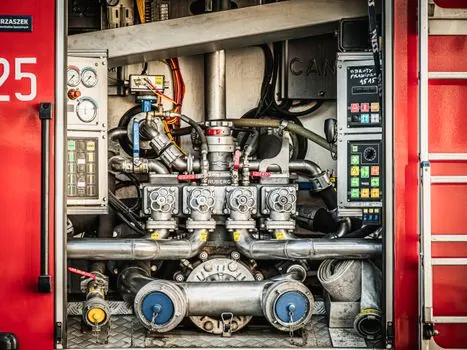
Pneumatic systems are compressible, so positioning accuracy and stiffness are inherently lower than hydraulic or electric-servo equivalents; this rules pneumatics out for precision force or motion control without supplemental position feedback [S3]. Compressed air carries moisture and particulates, so filtration and drying are mandatory upstream of the tubing, and any leak in the line directly hurts energy efficiency because the system has to keep compressing more air to hold setpoint [S3]. Tubing in dynamic service also has a finite flex life, and undersized or over-pressured lines kink, burst, or work-hardened-crack long before the upstream compressor or valve reaches its service interval.
Capsule-type pneumatic transport, as one pneumatic-tubing subclass, is also constrained by carrier geometry: most systems accept only containers 5–20 cm in diameter with payloads up to around 5 kg, which makes them unsuitable for bulky or heavy items [S1].
Selection Gates: Pressure, Temperature, Media, Bending, Connection
Working pressure and safety factor come first: the tube's rated pressure at the design temperature must exceed the maximum system pressure, with a typical 4:1 safety factor on burst pressure for industrial air service [S3]. Temperature window matters equally, because a tube rated to 10 bar at 20°C may derate sharply above 60°C, and PUR softens, while PTFE and metal-reinforced lines hold their rating. Media compatibility covers not just the conveyed fluid but also the ambient environment, including oils, solvents, UV, and ozone, that the outer jacket will see over its service life [S2].
Bend radius and minimum bending radius define routing: a tube forced below its minimum bend radius kinks, which locally reduces cross-section and accelerates fatigue failure. Connection method drives OD tolerance, because push-to-connect fittings typically require tighter OD tolerances than compression or barbed joints, and a mismatched tube can leak at the fitting long before the tube body fails. For dynamic, high-cycle service, pairing the line with a properly sized pneumatic actuator downstream and an exhaust-side silencer keeps cycle noise and back-pressure inside the manufacturer's published envelope; for a side-by-side read on silencer trade-offs, see this pneumatic silencer comparison and the TCO breakdown.
Installation, Sizing, and Lifecycle Notes
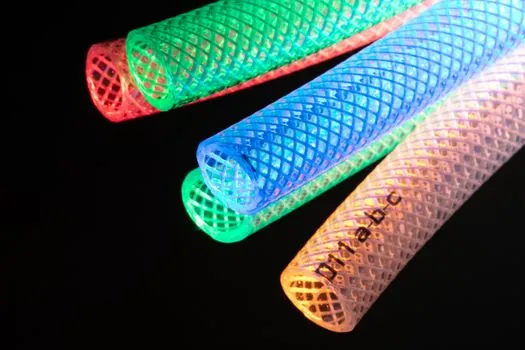
OD and wall thickness must be selected together, because flow capacity scales with the inner cross-section while burst pressure scales with wall; the wrong combination either starves the downstream device or wastes money on an over-rated tube [S2]. Push-to-connect fittings speed install but only hold reliably on round, within-tolerance OD tubing, so specifying a tube that meets the fitting maker's tolerance class (often ±0.05 mm on small-bore metric tube) avoids the chronic slow-leak that erodes energy efficiency over years of service. Routing should avoid tight clamps, sharp edges, and continuous flexing below the published minimum bend radius, and dynamic sections should be supported at intervals that prevent whip and abrasion against adjacent structures [S3].
For sites handling flammable atmospheres or static-sensitive powders, dissipative or anti-static tubing formulations (carbon-loaded PUR, for example) should be selected and grounded per the relevant hazardous-area code rather than relying on standard black PE or PVC. Where the line ties into instrumentation downstream, the same spec discipline that governs the air line also governs the lighting equipment and electric lamps on the machine, because both ride on the same maintenance and documentation cadence.
Who Pneumatic Tubing Is For, and Where It Is the Wrong Pick
Pneumatic tubing is the right call for general factory compressed-air distribution, low-cost automation, packaging and pick-and-place machinery, food and beverage fluid handling with food-grade PUR, and any application where simplicity, speed of install, and low cost matter more than positioning precision [S4]. It is also the right backbone for hospital capsule transport, laboratory sample handling, and small-parts logistics where a 10–15 minute on-foot run can be compressed to under a minute through a 8–11 m/s pneumatic carrier network [S1].
It is the wrong pick for precision force or position control, for high-temperature service above the tube's derated pressure/temperature point, for aggressive chemicals outside the polymer's compatibility list, and for any system where leakage into the surrounding area is unacceptable, because unlike hydraulics, pneumatics always leaks by design at fittings, valves, and exhausts. A construction machinery and equipment platform that needs precise metering, or a process line that needs repeatable stiffness, belongs on hydraulic or electric-servo actuation, not on a pneumatic distribution system.
The next trackable signals to watch are manufacturer-published updates to nylon and PTFE pressure/temperature curves for 2026 product lines, and any revision to push-to-connect fitting tolerance classes that would tighten OD specs on small-bore metric tubing. For sites standardising across cells, request each supplier's rated-pressure-versus-temperature chart and minimum-bend-radius table before locking the BOM, and re-verify after every fitting-platform change.