
Static pressure molding is not a universal acoustic treatment, but it can reduce noise when replacing noisy pressure-driven operations, provided that vibration, enclosure, and hydraulic controls are addressed.
The decision should be based on operator-position sound pressure levels, measured over representative production cycles, rather than on the process name or a single peak reading [S2].
What static pressure molding changes
Static pressure molding uses a controlled pressure condition to form the casting, so its acoustic benefit is indirect rather than automatic. The process can reduce impact noise when pressure loss, fluid acceleration, and mold movement are better controlled than in a conventional impact-intensive line. Pressure loss studies are used to quantify the pressure required for molding, which makes pressure data a useful diagnostic before equipment changes are specified [S1].
The relevant reference equipment is the static pressure molding machine, but the machine type alone does not determine the sound level. The same operating principle can produce different results when hydraulic pulsations, valve switching, clamp impacts, cooling equipment, or room reflections dominate the acoustic field [S2].
Three measurable checks are required before claiming a noise improvement: an A-weighted level at the operator position, a peak level during mold closing and opening, and a shift-average level during continuous production. The 75 dB target described for molding lines is intended to reduce long-term hearing-damage risk [S2].
How the noise reduction is produced
Static pressure molding can help when the existing noise is generated by pressure-driven flow events rather than by an unavoidable impact. Molding machines produce distinct signatures from hydraulic pump pulsations, valve switching, mold closing and opening impacts, injection-pressure surges, and cooling-system operation [S2].
A process comparison based on four criteria gives a more defensible selection:
Static pressure molding versus a conventional impact-intensive line versus a standard low-pressure line should be compared by peak impact energy, hydraulic pulsation, operator-position sound pressure, and effect on cycle time. Static pressure molding is attractive where the acoustic benefit comes from eliminating high-energy pressure events, but it is weaker where the dominant source is a pump, air exhaust, cooling system, or fixed building plant.
For a shop that already operates an automatic molding line, the same four checks should include the existing line’s measured baseline, the proposed machine’s peak level, the A-weighted shift average, and any production-rate penalty. Conventional production environments typically range from 80 to 95 dB, while the proposed target is 75 dB [S2].
Pressure remains a process variable with a direct effect on part formation. It holds the plastic in the mold during cooling and solidification and helps prevent material from flowing back out after filling [S5]. Acoustic improvement must therefore be checked against fill, holding, dimensional consistency, and cycle-time requirements rather than pursued as an isolated noise-setting exercise.
Selection criteria for quieter equipment

The first selection criterion is source identification. A molding line’s measured sound can combine several components, so changing the forming process while leaving a loud auxiliary system unchanged may produce little practical benefit. A useful survey separates machine-generated noise from ventilation, grinders, scrubbers, bar-feeders, and other plant equipment [S3].
The second criterion is vibration transmission. A quieter pressure profile does not guarantee a quieter floor if the clamp frame, tie bars, hoses, or foundation transmit structure-borne vibration. The acoustic-control measures identified for molding machinery include vibration isolation, acoustic enclosure design, hydraulic-system optimization, and operating-parameter adjustment [S2].
The third criterion is maintenance condition. Pressure pulsations, valve leakage, worn hoses, unbalanced moving components, and degraded vibration mounts can add noise independently of the forming method. The fourth criterion is operating practice: startup, shutdown, empty cycles, material changes, and mold changes should be included in the measurement plan because they can create peaks that disappear in a steady-cycle average [S2].
This method suits process engineers, safety managers, and production buyers who can compare the same part and cycle before and after the change. It does not fit a decision based only on equipment price, power consumption, or the claim that one process is inherently quiet. The molding line must be tested as an installed system with its auxiliary equipment, enclosure, and operator position.
Where the process is not enough
Static pressure molding does not remove every sound source in a production hall. High-pressure pumps, pneumatic equipment, exhaust systems, ventilation, impact tools, and material-handling devices can dominate the operator’s acoustic environment.
It is also not enough to confuse a lower peak with a safer exposure. Peak events, sustained levels, and worker exposure over the full shift are different measurements. The 75 dB objective requires both peak control at high-impact events and sustained-level management during continuous cycles [S2].
Acoustic enclosures also have limits. They can reduce direct transmission, but a poorly sealed enclosure can amplify or redistribute sound, and added mass may increase vibration into the floor unless the supports are engineered. The control strategy must preserve access for operators, material feed, mold changes, safety guarding, cooling, and maintenance.
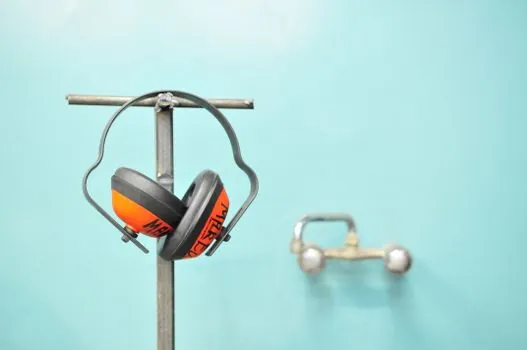
Hearing protection remains necessary when the source cannot be reduced adequately. One shop-floor discussion describes mandatory hearing protection and annual hearing testing while noting that these measures do not eliminate the underlying noise [S3]. Acoustic improvement and administrative protection therefore serve different purposes: the former reduces exposure at source, while the latter limits individual exposure when residual sound remains.
Measurement, standards, and acceptance
A valid acceptance test requires repeatable positions, weighting, and operating conditions. The 75 dB target in molding-machine guidance is tied to A-weighted sound pressure levels at operator positions about 1–2 m from the machine and evaluated over a standard work shift [S2]. ISO 11690 is identified in that guidance as relevant to industrial noise control, but the standard should be applied as part of a complete acoustic assessment rather than treated as proof that one machine design meets every workplace requirement [S2].
Three acceptance criteria are practical: no uncontrolled peak above the selected limit, a shift-average level at or below the agreed target, and no loss of production rate or part quality. The baseline should use the same machine, mold, material, cycle, microphone position, weighting, and operating state as the proposed installation. This paired approach provides a defensible reduction figure rather than a comparison between different products or production conditions.
For procurement, the request should separate process parameters from acoustic guarantees. Specify the target in dB(A), operator distance, operating cycle, averaging period, and peak criteria. Also require hydraulic operating data, cooling requirements, isolation details, enclosure access, and the test method. This prevents a nominally quieter static pressure molding machine from masking an unchanged pump, valve, or ventilation system.
Verdict for plant engineers
Static pressure molding can reduce shop-floor noise when it removes a dominant impact or pressure-loss mechanism and when the rest of the line is acoustically controlled. It cannot guarantee a floor-level reduction on its own, and a 75 dB result must be demonstrated at the operator position over representative production rather than inferred from a machine specification [S2].
The next engineering step is to log at least three production states, including steady cycling, mold movement, and peak pressure events, at a defined operator position 1–2 m from the machine. Compare A-weighted averages and peaks with the baseline, then track whether the proposed cold box core machine or other auxiliary equipment introduces new noise signatures.
Two trackable signals determine the commercial case: the measured dB(A) reduction from the installed baseline and any cycle-time or part-quality penalty. If the reduction does not reach the agreed 75 dB target or requires unacceptable production compromises, retain static pressure as a process option and address vibration isolation, enclosure, hydraulic pulsation, and building services as separate work packages [S2].