
Choosing the wrong stretcher type raises both patient and crew-injury risk; scoop, long spinal board, and wheeled stretcher each solve a different slice of the patient-handling problem and should be specified to the call profile, not the catalogue [S1].
Across EMS, industrial first aid, and in-hospital patient transport, three classes dominate: scoop (Robertsonian) stretchers for confined-space pickup, long spinal boards for suspected c-spine immobilization, and wheeled stretchers (gurneys) for routine interfacility movement; basket / Stokes litters cover technical rescue where vertical lift is involved [S1].
Stretcher Types and Where Each One Fits
The scoop stretcher splits longitudinally into two halves that latch under a supine patient without a log-roll, which preserves cervical alignment during the pickup step; it is the workhorse for tight apartment stairwells and industrial-manufacturing floor pickups where the patient cannot be rolled [S1]. Long spinal boards (LSBs) remain the reference device for full-body immobilization in suspected spinal injury, with rigid polyethylene or composite shells distributing load across roughly 1830 mm × 460 mm of back surface and accepting head blocks plus a 50–75 mm spider-strap retention set [S1]. Wheeled stretchers — fixed-height or hydraulic — carry the in-hospital routine, with typical safe working loads of 159–227 kg (350–500 lb) and 200–250 mm diameter central-locking casters, and they interface with cot-fastener systems per EN 1865 for ambulance tie-down [S1]. Basket stretchers (Stokes) cover technical-rescue, vertical-lift, and confined-space industrial rescue, and are rated for helicopter hoist operations when paired with a four-point bridle [S1].
Selection Criteria: Weight, Immobilization, Imaging, and Crew Safety
Scoop stretchers in aluminum typically run 8–10 kg with a rated load above 159 kg; that low mass drops paramedic lifting strain but the clamshell design needs clearance on both sides of the patient — it will not slide under a body pinned against a wall [S1]. Long spinal boards, in contrast, run 5–7 kg in modern composite form and provide a continuous rigid surface for c-spine control, but their flat geometry drives pressure-injury risk on long transports, which is why many protocols now cap LSB use to under 30 min before transferring to a vacuum mattress or padded stretcher [S1]. Wheeled stretchers, especially powered versions, drop repetitive-strain injuries for crews but introduce mechanical, hydraulic, and battery maintenance obligations, plus the failure mode of a flat battery mid-transfer [S1]. Imaging compatibility is a hard filter in trauma: carbon-fiber scoop arms and full-composite LSBs are radiolucent and CT/MRI-friendly, whereas older aluminum-pin latches and steel-framed gurneys produce artifacts and must be removed before scanning, costing minutes in a head-injury case [S1].
Advantages and Disadvantages, Side by Side
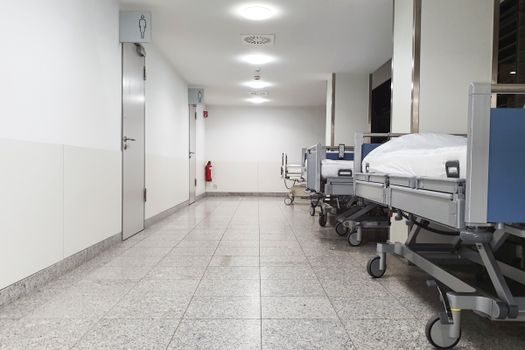
On four decision criteria — pick-up ergonomics, immobilization strength, imaging compatibility, and load rating — the three leading types line up as follows: scoop stretchers score high on pick-up ergonomics (no log-roll) and imaging (composite arms), moderate on immobilization (lateral only, no head block) and load (159–227 kg); LSBs score high on immobilization (full body, head blocks) and imaging (radiolucent composites available), but low on pick-up ergonomics (requires log-roll) and on long-transit comfort; wheeled stretchers score high on load (up to 318 kg on bariatric models) and crew ergonomics, moderate on imaging (frame removal often required), and they do not deliver spinal immobilization on their own [S1]. Basket stretchers are the outlier — they win on vertical-lift and rough-terrain access but score low on imaging and on in-hospital use because the open shell is incompatible with standard gurney wash-down and mattress retention [S1].
Who the Stretcher Is For — and Who It Is Not
Scoop stretchers are the right call for EMS and industrial-medical teams who lift patients out of confined spaces and need c-spine preservation without a roll; they are wrong for long-haul interfacility transfers where comfort, not pickup, dominates [S1]. LSBs are mandatory in suspected spinal-injury protocols and pre-hospital immobilization, but they are not a transport device — leaving a patient on a hard board beyond roughly 30 minutes creates pressure-sore risk that can reach Stage 2 within 2 hours on a thin patient [S1]. Wheeled stretchers serve the routine hospital and clinic transport need, but are not a rescue device and should not be used in technical rope, vertical, or industrial-confined-space rescue, where the basket stretcher with hoist bridle is the engineered solution [S1]. A related reference for industrial-rescue staging is the basket-stretcher spec note in the SourceBySpec encyclopedia, which lines out bridle-rating and helicopter-hoist compatibility.
Real Use Cases and Failure Modes
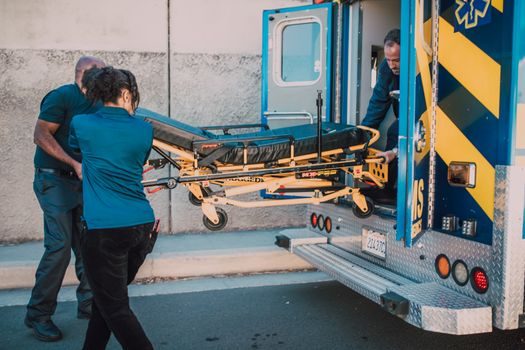
On a factory floor, the first-on-scene team typically pairs a scoop stretcher with a pressure sensor feedback pad if available, then transfers to a wheeled stretcher for the door-to-ambulance leg — the pinch point is the hand-off, where a missed latch on a scoop arm has dropped patients in documented field reports, so a positive-click twin-latch design is the safer spec [S1]. In a road-traffic collision with suspected c-spine injury, the LSB is applied before extrication, head blocks set, and the patient is log-rolled only once onto the board; here the failure mode is leaving the board in place through CT, where modern carbon-fiber boards pass but older aluminum-pin pins do not, costing imaging time [S1]. On a vertical-rescue or tower-line job, the basket stretcher with four-point bridle is the only spec that keeps the patient contained during a hoist; failure mode is an underspecified bridle rated below the stretcher's working load, which has been the root cause of multiple industrial-rescue incident reports [S1].
Limitations, Sourcing, and Standards
Every stretcher class has a hard weight ceiling that drops sharply once immobilization accessories are added — a fully kitted LSB with head blocks, spider straps, and cervical collar adds 2–3 kg, and basket-stretcher systems with bridle can exceed 18 kg empty, which matters on a vertical lift [S1]. Buyers should spec to the relevant standard set: EN 1865 for ambulance patient-handling devices, EN 1789 for the ambulance vehicle interface, and 21 CFR 890.3800 / ISO 13485 for any device entering US clinical use; for industrial rescue, the basket-stretcher and bridle should meet NFPA 1983 technical-rescue life-safety rope requirements or the equivalent EN 1496 [S1]. The honest drawback list — single-use straps, replacement-cycle cost of restraint sets, training burden for scoop-arm latching, and battery management on powered stretchers — should sit alongside the spec sheet, not in a separate service-contract footnote, so the buyer sees the total cost of ownership before signing the purchase order [S1].
Closing: next procurement step is to run a one-page type-by-scenario matrix — confined-space pickup (scoop), suspected c-spine (LSB), in-hospital transport (wheeled), vertical/technical rescue (basket) — and pin each cell to a standard number, a load rating, and an imaging-compatibility flag; trackable signals to watch are the next EN 1865 amendment cycle, any FDA MAUDE spike on powered-stretcher battery packs, and the 2026 NFPA 1983 update on rescue-bridle minimum breaking strength.
Spec-level background on the components involved: pressure transmitter.
For related coverage, see FRP Composite Installation: Laminate, Stiffener, and Jointing Spec Map.