Off-the-shelf tensile testing machines span four orders of magnitude in force capacity, from 0.02 N micro-load cells used on single fibers up to 2,000 kN hydraulic frames that pull rebar and structural steel to fracture [S1][S7].
Selecting the right machine is not a brand decision first, it is a capacity-and-standard decision: the test piece, the governing ASTM or ISO method, and the required accuracy class (commonly ±1% of indicated load) drive frame stiffness, grip type, and controller choice [S3][S4].
Force Capacity Tiers and What Each Tier Actually Pulls
Capacity banding is the single biggest cost driver on a tensile testing machine, and the public OEM catalogs line up on the same four tiers: micro, low force, mid-range, and high force [S2].
Micro testers cover sub-gram to low-Newton loads (typical minimum 0.02 N full scale) and are specified for biological fibers, single filaments, and thin films where specimen stiffness is in the mN range [S1][S2]. Low-force machines, generally up to 10 kN, are the workhorses for elastomers, technical textiles, paper, and films; the high-elongation behavior of rubber and nonwovens needs the long travel of these frames more than raw force [S2][S3].
Mid-range electromechanical frames carry the bulk of metals, rigid plastics, and composites work, with dual-column designs typically rated 50 kN to 300 kN; this is the tier where ASTM E8 / ISO 6892-1 metal tensile tests, ASTM D638 plastic tests, and ASTM D3039 composite tests all converge on common fixtures [S2][S5]. High-force electrohydraulic systems start around 300 kN and run to 2,000 kN (450 kip), covering rebar, wire rope, large-diameter bolts, and pre-stressed concrete specimens where specimen preparation and grip alignment dominate the test method [S2].
Frame Type: Electromechanical vs Electrohydraulic, and Why It Matters
Electromechanical frames use a servo-driven ball screw or lead screw to move the crosshead, and they are the default pick for capacities up to 300 kN because of their low noise floor, no hydraulic oil, and better displacement resolution at low crosshead speeds [S2][S5].
Electrohydraulic frames use a servovalve-controlled actuator, and they are specified when the test needs high force (above ~300 kN), high cycle life at peak load, or dynamic/servo-hydraulic fatigue-style profiles on the same rig; typical oil-pressure actuators sustain 2,000 kN continuous without the column bending that a ball-screw frame would hit at that rating [S2]. For most QA labs running static tensile tests on metals, plastics, and textiles, a dual-column electromechanical frame between 50 kN and 300 kN is the right starting point; switch to hydraulic only when specimen force or test type (e.g. ASTM A370 reinforcing-bar tests) makes it unavoidable [S5].
Grips, Extensometers, and the Hardware That Decides Your Data Quality
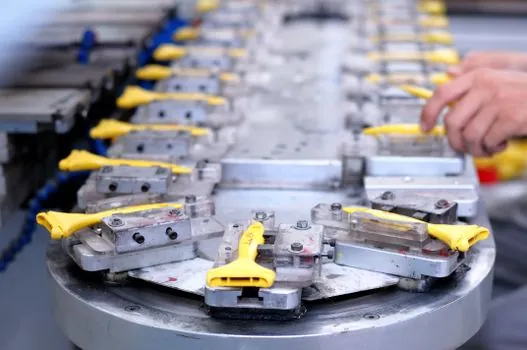
Misaligned or wrong-type grips are the dominant source of bad tensile data, not the load frame, and grip selection must match specimen geometry, material ductility, and the standard being run [S4].
Wedge grips handle flat metal coupons and rigid plastics; vise grips (screw-action or pneumatic) suit soft specimens like rubber, foam, and films where the gripping pressure must be controlled to avoid crushing; threaded-end grips are mandatory for high-force metal bar and bolt specimens where a shoulder pull-out would invalidate the test [S4][S5]. For high-elongation materials, mechanical or optical extensometers (class 0.5 or better per ISO 9513) are required to capture yield and modulus accurately, because crosshead travel alone mixes frame deflection into the strain reading [S1][S5].
For textile labs, the practical specification is a dual-column machine rated to at least 5 kN with pneumatic flat-face grips, ±1% load-cell accuracy, a 1-500 mm/min crosshead speed range, and a controller that ships with pre-loaded methods for ISO 13934-1 (strip method) and ISO 13934-2 (grab method) on woven, knitted, and nonwoven fabrics [S3].
Standards, Accuracy Class, and What "Compliant" Actually Means
A tensile machine is not just an asset, it is a calibrated instrument, and the standards it must satisfy vary by material and industry: ASTM E8/E8M for metallic materials, ISO 6892-1 for metals at ambient temperature, ASTM D638 for plastics, ASTM D3039 for polymer-matrix composites, ASTM A370 for steel products, ISO 13934-1/2 for textiles, and ASTM D5034 for woven-fabric grab tests [S1][S3][S5].
Buyers should require a traceable calibration certificate referencing these standards, and a controller that can lock the operator out of editing the test method parameters so that audit trails stay clean [S3][S5].
Selection Criteria Compared: Micro vs Low vs Mid vs High Force
The four capacity tiers differ on more than just kN rating; the decision matrix that actually matters is force range, specimen form, typical test standard, and approximate installed cost band [S2][S5].
Micro (0.02 N to a few N) is for single fibers, thin films, and biological specimens, typically ISO 5079 or ASTM D3822; expect a bench-top unit, low throughput, and the highest cost per newton of any tier. Low force (up to 10 kN) covers rubber, foam, paper, technical textiles, and small plastics, typically ASTM D412, ISO 13934, and ASTM D882; this is where most incoming-QA labs land and the ROI is fastest. Mid-range (50-300 kN, dual-column electromechanical) handles the bulk of ASTM E8, ISO 6892-1, ASTM D638, and ASTM A370 bar tests; this tier is the safe default for a shared materials lab serving metals, plastics, and composites. High force (300-2,000 kN, electrohydraulic) is for rebar, large-diameter pipe, wire rope, structural fasteners, and concrete cylinders, typically ASTM A615, ASTM A370, and ISO 15630; expect a dedicated foundation, hydraulic supply, and 3-phase power [S2][S5].
Who Should NOT Buy the Cheapest Benchtop
Buyers who should skip a low-cost single-column benchtop are: any lab that needs dual-column stiffness for metals testing above 50 kN, where frame compliance will inflate strain readings and corrupt the modulus calculation [S2][S5]; labs running ISO 13934-1 strip tests on heavyweight industrial textiles, where 5 kN to 10 kN capacity and proper pneumatic grips are mandatory to get repeatable grab vs strip results [S3]; and any facility running ASTM E8 on threaded round bars, where hydraulic wedge grips and a Class 0.5 extensometer are not optional, the cheap bench frame simply will not hold alignment [S4][S5].
The other common mis-spec is buying on peak kN alone: a 300 kN machine with a Class 2 load cell is worse than a 100 kN machine with a Class 0.5 load cell, because the data scatter on yield and modulus will be larger than the difference you are trying to measure [S3][S4].
What a Sensible Shortlist Looks Like for 2026

A defensible shortlist in 2026 starts with a written test requirement: list the materials, the governing ASTM/ISO standard per material, the required force range per material, the elongation range, the throughput (specimens per shift), and the accuracy class the lab must hold [S3][S5].
For a shared QA lab covering metals, plastics, and textiles, a typical spec is one dual-column electromechanical frame rated 50 kN to 100 kN with interchangeable wedge and pneumatic grips, a Class 0.5 extensometer, a controller with pre-loaded ASTM E8, ISO 6892-1, ASTM D638, and ISO 13934 methods, and a separate low-force 5 kN bench unit dedicated to textiles and films to keep the high-force frame free for metals [S2][S3][S5]. For a heavy-industry or construction-materials lab, the shortlist shifts to a 600 kN to 1,000 kN electrohydraulic frame with threaded-end and wedge grips, ASTM A370 and ISO 15630 method packs, and a dedicated high-pressure hydraulic supply, which pairs naturally with the type of construction machinery and equipment procurement programs these labs typically run [S2]. Buyers should also verify the controller supports the tensile testing machine method library natively rather than via third-party plug-ins, because that is where audit failures and downtime tend to originate.
Spec-level background on the components involved: linear guide.
Related analysis: Sand Blasting Machine Sizing: Nozzle CFM, Pot Pressure, Media Match.