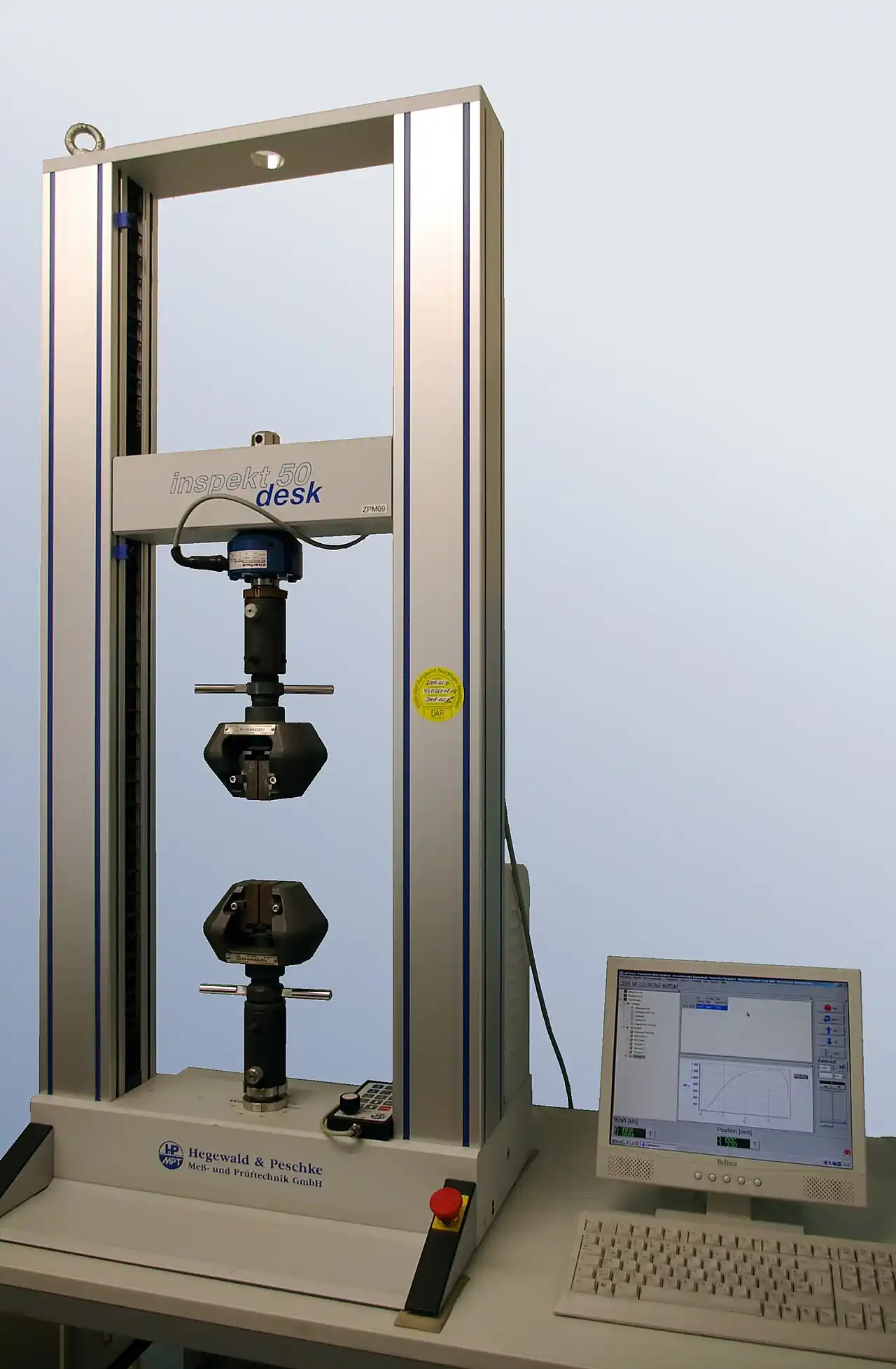
A tensile testing machine applies a controlled, continuously increasing uniaxial pull to a prepared specimen and records the force and the resulting elongation until the material yields or fractures. From that force-elongation record it derives the stress-strain curve and the design properties engineers depend on: yield strength, ultimate tensile strength, modulus of elasticity, and elongation at break. Most commercial frames are sold as universal testing machines (UTM) because the same column, load cell, and crosshead also run compression, flexure, peel, and shear with a fixture change.
The terms "tensile testing machine," "universal testing machine," and "load frame" are used interchangeably in catalogs. The distinction is configuration rather than hardware: a tensile test pulls the specimen apart in tension, while the same frame in compression or bending is just the other test mode. This guide treats the frame as a measurement system, decodes the accuracy classes of ISO 7500-1 and ASTM E4, the strain-control methods of ISO 6892-1 and ASTM E8, and the grip and extensometer choices an engineer must lock down before issuing a purchase order.
This guide is written for industrial purchasing engineers and design engineers. It covers 6 chapters from what the machine is and how it works, through frame and drive types, force and strain accuracy classes, grips and specimens, spec-sheet decoding, to the selection decision sequence, with 7 selection FAQs and manufacturer comparisons. All parameters reference public standards: ASTM E8/E8M and ISO 6892-1 for the tension test, ISO 7500-1 and ASTM E4 for force verification, and ISO 9513 and ASTM E83 for extensometer classification.
Chapter 1 / 06
What is a Tensile Testing Machine
A tensile testing machine is a load frame that subjects a machined or cut specimen to a continuously increasing uniaxial tensile force applied along its axis, while measuring force and elongation simultaneously, until the specimen yields or breaks. The output is the engineering stress-strain curve, and from that curve the operator extracts the mechanical properties that govern structural design: yield strength, ultimate tensile strength, elongation, reduction of area, and the elastic modulus. It is one of the most fundamental instruments in any materials laboratory, used to release incoming raw material, qualify welds and heat treatments, and validate that a part will carry its design load with margin.
Functionally the machine has five subsystems. First, a stiff reaction structure, usually a single-column or twin-column frame, that resists the test force without flexing enough to corrupt the reading. Second, a moving crosshead driven through the specimen at a controlled rate. Third, a load cell, the force transducer that turns the applied force into an electrical signal, which is the heart of the measurement chain. Fourth, grips and fixtures that transmit the force into the specimen without slip or off-axis bending. Fifth, an extensometer that reads true strain on the gauge length, plus the controller and software that command the test and compute the results. The accuracy of the whole system is no better than the weakest of these links.
The reason a dedicated machine is required, rather than simply hanging weights, is control and traceability. A meaningful tension test must apply force at a defined, standard-specified rate, hold the specimen in pure axial alignment, and report force and strain that are traceable to national standards within a stated error band. ISO 6892-1 and ASTM E8/E8M define how the metals test is run; ISO 7500-1 and ASTM E4 define how the force-measuring system is calibrated; ISO 9513 and ASTM E83 classify the extensometer. A frame that cannot demonstrate compliance with these documents cannot produce data that an auditor, a customer, or a regulator will accept.
The application scale is broad. The same class of frame, scaled in capacity, tests fine wire and thin film at a few newtons, sheet metal and plastics at hundreds of newtons to tens of kilonewtons, structural steel bar and bolts at hundreds of kilonewtons, and chain, cable, and heavy forgings into the thousands of kilonewtons. Industries that depend on it daily include steelmaking and metals service centers, automotive and aerospace, plastics and rubber compounders, construction-products manufacturers testing rebar and fasteners, and medical-device and packaging makers. Because the property values feed directly into safety margins, the tension test is among the most heavily standardized measurements in industry.
Four engineering metrics dominate the value of a frame: force capacity, force accuracy class, strain measurement accuracy, and test-rate control fidelity. Together these set what the machine can break, how trustworthy the numbers are, and whether modulus and proof stress can be reported at all. A frame chosen on capacity and price alone, without confirming its accuracy class, extensometer class, and rate-control method, will pass an internal check but fail an accredited audit, which is the most common and most expensive selection error in this category.
Chapter 2 / 06
Frame and Drive Types
Tensile frames divide first by drive system and second by mechanical layout. The drive determines the force range, the speed and waveform capability, and the running cost; the layout determines stiffness, test space, and footprint. The most consequential choice is electromechanical versus servohydraulic, because it sets the entire envelope of what tests the machine can perform. The table below compares the two drive systems on the metrics that drive selection.
Electromechanical frames use an AC servo motor turning a precision ball screw or lead screw to convert rotation into linear crosshead motion. They are the workhorse of static testing, typically from about 1 kN up to 300 kN, and deliver clean, quiet, low-vibration travel with crosshead speed held within roughly 0.1 to 0.5 percent over a range commonly spanning 0.001 to 1,000 mm/min. Position resolution can reach about 0.001 mm, which matters for low-strain modulus work. The screw drive is inherently safer, because it limits the rate of crosshead runaway if commanded incorrectly. For metals, plastics, textiles, composites, and most quality-control work below a few hundred kilonewtons, electromechanical is the default and usually the lower total-cost choice.
Servohydraulic frames use a servo valve metering pressurized oil to a cylinder; the piston drives the crosshead or actuator. They are reserved for high-capacity static testing, where capacities of 1,000 to 2,000 kN and beyond are routine, and for dynamic and fatigue testing, where high loading rates and cyclic waveforms are required. If specimens regularly demand forces above roughly 300 kN, or if the program calls for fatigue, cyclic, or high-rate loading, a servohydraulic system is almost always the more durable and cost-effective answer. The trade-offs are a hydraulic power unit, higher acoustic noise, oil maintenance, and higher energy use, which is why labs do not buy hydraulic capability they do not need.
By mechanical layout, frames split into single-column and twin-column (dual-column) designs. Single-column tabletop frames are compact and economical, suited to low forces, commonly up to a couple of kilonewtons, for film, foil, fine wire, and small plastic parts. Twin-column frames carry the load symmetrically through two screws or two strain columns, giving higher stiffness and capacity; they appear as tabletop units up to roughly 50 kN and as floor-standing models from tens of kilonewtons up to several hundred kilonewtons. Floor frames add a tall test space for long specimens and the room to mount large grips and environmental chambers.
A separate but important distinction is static versus dynamic capability. A static frame applies a monotonic ramp to a single break and reports quasi-static properties. A dynamic frame, almost always servohydraulic or a specialized electrodynamic linear-motor design, applies oscillating waveforms for fatigue, fracture mechanics, and high-rate work. Buying a static frame for a fatigue program, or an oversized dynamic frame for routine quality control, are both classic mismatches. Define the test list first; the test list, not the catalog, selects the drive and layout.
Chapter 3 / 06
Force and Strain Accuracy Classes
The trustworthiness of a tensile result rests on two independent accuracy chains: the force-measuring system and the strain-measuring system. Each is governed by its own standard and its own class scheme, and a frame is only as credible as the weaker of the two. Buyers who compare frames on capacity and price but never check the accuracy class are comparing the wrong numbers. The table below summarizes the four governing standards and their classes.
Standard
Governs
Class scheme
Tightest common class
ISO 7500-1
Force-measuring system
Class 0.5 / 1 / 2 / 3
±0.5% (Class 0.5)
ASTM E4
Force verification
Single requirement
±1.0% of force
ISO 9513
Extensometer system
Class 0.2 / 0.5 / 1 / 2
±0.2% (Class 0.2)
ASTM E83
Extensometer system
Class A / B-1 / B-2 / C
±0.5% (Class B-1)
Force accuracy is set by ISO 7500-1 and its close counterpart ASTM E4. ISO 7500-1 defines classes 0.5, 1, 2, and 3, where the class number is the permissible relative error of indicated force: Class 0.5 allows plus or minus 0.5 percent, Class 1 allows plus or minus 1.0 percent, and Class 2 allows plus or minus 2.0 percent. ASTM E4 states a single requirement of plus or minus 1.0 percent of indicated force, equivalent to ISO Class 1, which is how the majority of general-purpose machines are calibrated. Verification applies at least five force points, typically 20, 40, 60, 80, and 100 percent of each range, using a reference force transducer traceable to a national standard. Both standards call for recalibration at intervals no longer than 12 months.
A subtle but critical point is the lower verified limit. The accuracy class holds only from the lowest verified force up to full scale, not down to zero. A single high-capacity load cell loses its class at small loads, so a 100 kN cell used to break a 1 kN wire is operating far outside its accurate region. This is why labs that test across a wide force span buy interchangeable load cells rather than rely on one large cell, and why "30 to 70 percent of cell rating" is the practical sweet spot for the peak test force.
Strain accuracy is set by ISO 9513 and ASTM E83, and it matters because crosshead travel is not specimen strain. Crosshead displacement includes grip slip, specimen seating, and elastic deflection of the frame and load string, so it overstates strain, most severely in the low-strain elastic region. Modulus of elasticity and offset proof stress such as Rp0.2 therefore require an extensometer reading strain directly on the gauge length. ISO 9513 assigns class numbers, for example 0.2 and 0.5, while ASTM E83 assigns class letters, for example B-1, B-2, and C. An ISO 9513 Class 0.5 device holds about 0.5 percent of reading plus a small fixed error on the order of a micrometer; a Class B-1 device under ASTM E83 is the corresponding high-precision tier.
Extensometers come as contacting clip-on and non-contact video or laser types. Clip-on axial extensometers attach to the gauge length with knife edges and are the precise, economical default for modulus and yield. Video extensometers track gauge marks optically, never touch the specimen, survive fracture, and measure very large strains, which makes them the practical choice for elastomers, films, and tests where the specimen flies apart at break. The trade-offs are higher cost and sensitivity to lighting, focus, and mark contrast. Whichever type is fitted, the test report should cite the extensometer class, because a frame with a Class 1 force system and an uncalibrated extensometer cannot legitimately report modulus.
Chapter 4 / 06
Grips, Fixtures, and Specimens
Between the load cell and the specimen sit the grips, and they fail more tensile tests than any electronic fault. The grip must transmit the full test force into the specimen, hold it in pure axial alignment, and neither slip nor break it inside the jaws. The right grip depends on the material, the specimen geometry, and the peak force. The table below maps grip types to typical use.
Wedge grips are the standard for metals and are the type recommended in ASTM E8. Their geometry is self-tightening: as the specimen is pulled, it draws the jaws deeper into the narrowing grip body, so clamping force rises in proportion to the applied load and resists slip exactly when slip is most likely. Wedge grips are made in manual, pneumatic, and hydraulic actuation. Pneumatic wedge and side-action grips are practical up to roughly 30 kN, beyond which hydraulic wedge action provides the clamping force without crushing the operator's effort. Wedge grips are usually supplied with alignment aids, because off-axis loading introduces bending stress that biases yield and tensile results.
Soft and extensible materials behave differently. Elastomers, films, and soft polymers need the constant clamping pressure of pneumatic side-action grips, which hold the specimen without the progressive crushing a wedge applies, and they tolerate the necking and thinning these materials show. Yarn, fiber, wire, and suture use capstan, thread, or rope grips that wrap or knot the specimen to spread the gripping stress and avoid a stress concentration at the jaw line. Parts with holes or lugs are best tested with pin or clevis fixtures that load through the hole as the part is actually used.
The most common grip failures are slip and break-in-jaw, and they trace to a short list of causes: worn or wrong jaw inserts for the specimen thickness, insufficient clamping pressure, poor axial alignment, or a grip rated below the test force. The fix is to match the jaw insert to the specimen, set adequate pressure, verify alignment within the standard's bending limits, and confirm the grip rating is at least the worst-case fracture force. A grip that fractures specimens inside the jaws produces low, scattered strength values that look like a material problem but are a fixturing problem.
Specimen geometry is itself standardized, because the property values are only comparable when the gauge geometry is fixed. ASTM E8/E8M and ISO 6892-1 define the specimen shapes and dimensions. For metals, the standard round specimen commonly uses a 0.500 in (12.5 mm) nominal diameter with a 2 in (50 mm) gauge length, while sheet and strip use flat specimens; alternative gauge lengths of 25 mm (1 in) for limited material and 200 mm (8 in) for full-width sheet elongation are recognized. The extensometer gauge length must match the specimen gauge length so that the measured strain refers to the correct reference length. Getting the specimen wrong invalidates the test no matter how accurate the frame.
Chapter 5 / 06
Key Specification Parameters
A tensile frame spec sheet can list dozens of lines, but only a handful change the buying decision. The parameters below are the ones that determine whether the frame can run your test list, pass an audit, and produce the property values your drawings call out. Each is explained in the order an engineer should evaluate it.
Force capacity is the maximum force the frame and its load string can apply, quoted in kN. It must exceed the worst-case fracture force of the strongest specimen, and the load cell, grips, and fixtures must each be rated to that force as well; the weakest link sets the safe limit. Static electromechanical frames span roughly 1 kN tabletop to 600 kN floor, while servohydraulic frames reach 1,000 to 2,000 kN and beyond. Do not confuse frame capacity with load cell capacity: a 300 kN frame may be fitted with a 50 kN cell for a given job.
Force accuracy class is the ISO 7500-1 class (0.5, 1, 2) or ASTM E4 conformance (±1.0%) of the force-measuring system, valid only above the load cell's lower verified limit. Strain accuracy class is the ISO 9513 class (0.2, 0.5) or ASTM E83 class (B-1, B-2, C) of the extensometer. These two classes, not the headline capacity, decide whether the data are accreditable. Request the actual calibration certificate and its date, since both standards require recalibration within 12 months.
Crosshead speed and rate control describe how fast and how precisely the machine drives the specimen. Electromechanical frames commonly span 0.001 to 1,000 mm/min with speed held within 0.1 to 0.5 percent. Equally important is the rate-control method: ISO 6892-1 Method A1 closes the loop on extensometer strain feedback, Method A2 holds a fixed crosshead rate chosen to approximate the target strain rate, and Method B controls a stress rate in the elastic region. For yield and offset determination the strain rate should not exceed roughly 0.008 per second. A frame that cannot perform closed-loop strain-rate control cannot run Method A1.
Test space and daylight set the largest specimen and fixture the frame accepts: vertical test space (crosshead travel plus working height) and horizontal throat or column spacing. Long specimens, large grips, and environmental chambers all consume test space, so size the frame for the fixtures, not just the bare specimen. Stiffness matters for low-elongation and modulus work, because a flexible frame stores elastic energy that distorts the early curve and amplifies energy release at brittle fracture.
The property outputs the machine must deliver are the real deliverable, and they follow standardized definitions:
Yield strength / proof stress (Rp0.2): the 0.2 percent offset proof stress, found by drawing a line parallel to the elastic slope from 0.2 percent strain and reading its intersection with the curve. Requires an extensometer.
Tensile strength (Rm, UTS): the maximum engineering stress reached, the peak of the engineering stress-strain curve before necking causes the load to fall.
Elongation at break (A): permanent elongation at fracture as a percentage of the original gauge length, a direct measure of ductility.
Modulus of elasticity (E): the slope of the initial linear elastic region, the material stiffness; only meaningful with an extensometer.
Reduction of area (Z): the percentage decrease in cross-section at the fracture, a second ductility measure for round specimens.
Software, data, and compliance close the spec. Confirm the controller supports the exact standards in scope (ASTM E8/E8M, ISO 6892-1, plus any plastics, rubber, or product standards), exports raw data, and computes the required properties with the correct offset and rate logic. For regulated labs, confirm electronic-records features and audit-trail support. A frame that mechanically meets the test but whose software cannot compute Rp0.2 by the required method, or cannot export traceable data, will not satisfy an accredited quality system.
Chapter 6 / 06
Selection Decision Factors
To turn the preceding chapters into a specific model, follow the decision sequence below. Most selection mistakes come not from a single wrong answer but from deciding capacity and brand before defining the test list and the accuracy class. These eight steps can serve as a fixed RFQ template.
Define the test list and standards: list every test (tension, and any compression, flexure, peel), every material, and every governing standard (ASTM E8/E8M, ISO 6892-1, plus product standards). The test list, not the catalog, selects the machine.
Force capacity and drive: set frame capacity above the worst-case fracture force with margin, then choose electromechanical for static work up to a few hundred kN, or servohydraulic for very high force, fatigue, or dynamic loading. Plan interchangeable load cells so peak force sits within 30 to 70 percent of the cell in use.
Force accuracy class: specify ISO 7500-1 Class 1 (or ASTM E4, ±1.0%) for general quality control, or Class 0.5 for reference and arbitration work. Confirm the class holds across your lowest expected force, not just at full scale.
Strain measurement: choose the extensometer by ISO 9513 class (0.5 or 0.2) or ASTM E83 class (B-1, B-2, C). Use contacting clip-on for metals modulus and yield; use video or laser non-contact for elastomers, films, and tests that destroy the gauge length at break.
Grips and fixtures: wedge grips for metals per ASTM E8; pneumatic side-action for soft and extensible materials; pin or clevis for lugs and connectors. Confirm every grip and fixture is rated to the full test force and supplied with alignment aids.
Test space and environment: size vertical and horizontal test space for the largest specimen plus its grips and any chamber. Specify temperature chambers or furnaces if elevated or low-temperature properties are in scope.
Software and data integrity: verify the controller runs the named standards with correct offset and rate-control logic, computes Rp0.2, Rm, A, E, and Z, exports raw and traceable data, and, for regulated labs, supports audit trails and electronic records.
Total cost of ownership (TCO): purchase price plus load cells and grips, annual ISO 7500-1 and ISO 9513 calibration (both due within 12 months), spare jaw inserts, and accreditation-failure risk. A frame that saves money upfront but cannot pass an accredited audit costs far more when results are rejected.
One frequently overlooked dimension is manufacturer serviceability: local accredited calibration capability, jaw-insert and load-cell availability, software support and standard updates, and field-engineer response time. Instron, ZwickRoell, MTS, ADMET, Shimadzu, and Tinius Olsen maintain calibration and service networks, including in China, which is why they are the dependable choice for accredited and high-stakes laboratories. Lower-cost regional makers can supply ISO 7500-1 Class 1 frames adequate for internal quality control, provided their calibration traceability and after-sales support are verified before purchase rather than assumed.
FAQ
What is the difference between a tensile testing machine and a universal testing machine?
A universal testing machine (UTM) is a load frame that can apply both tension and compression, so the same frame can run tensile, compression, flexure, peel, and shear tests by swapping fixtures. A tensile testing machine is a UTM configured and used for tension: it pulls a specimen apart along one axis until yield or fracture while recording force and elongation. In practice the hardware is identical, a frame with a load cell, a moving crosshead, grips, and an extensometer; the distinction is the test mode and the fixtures fitted. Most commercial single-axis static frames are sold as universal testing machines precisely because the same column and load cell serve both directions.
How do I choose between an electromechanical and a servohydraulic frame?
Electromechanical frames use an AC servo motor driving a precision ball or lead screw to move the crosshead, and they dominate static testing from roughly 1 kN to 300 kN. They deliver clean, quiet, low-vibration motion, fine speed control typically held within 0.1 to 0.5 percent over 0.001 to 1000 mm/min, and crosshead position resolution down to about 0.001 mm, which suits modulus and proof-stress work. Servohydraulic frames use a servo valve metering oil to a cylinder and are chosen above roughly 300 kN, where capacities reach 1000 to 2000 kN and beyond, and for dynamic or fatigue duty where high loading rates and cyclic waveforms are required. Rule of thumb: static metals and plastics up to a few hundred kN go electromechanical; very high static force, fatigue, and dynamic testing go servohydraulic.
What force accuracy class does ISO 7500-1 or ASTM E4 require?
ISO 7500-1 defines force accuracy classes 0.5, 1, 2, and 3, where the class number is the permissible relative error of the indicated force: Class 0.5 allows plus or minus 0.5 percent, Class 1 allows plus or minus 1.0 percent, and Class 2 allows plus or minus 2.0 percent. ASTM E4 sets a single requirement of plus or minus 1.0 percent of indicated force, equivalent to ISO Class 1, which is how most general-purpose machines are calibrated. Verification uses at least five force points, typically 20, 40, 60, 80, and 100 percent of each range, against a reference device traceable to a national standard. Both standards recommend recalibration at intervals no longer than 12 months. The class only holds down to the lower verified limit of the load cell, so a single high-capacity cell loses accuracy at small loads.
Why do I need an extensometer if the machine already records crosshead travel?
Crosshead displacement includes grip slip, specimen seating, and elastic deflection of the load frame and load string, so it overstates specimen strain, especially in the early elastic region. Modulus of elasticity and offset proof stress such as Rp0.2 cannot be measured reliably from crosshead travel; they require strain read directly on the gauge length by an extensometer. Contacting clip-on extensometers and non-contact video extensometers are classified by ISO 9513, which assigns class numbers such as 0.5 and 0.2, and by ASTM E83, which assigns class letters such as B-1, B-2, and C. An ISO 9513 class 0.5 device holds about 0.5 percent of reading plus a small fixed error. Use the extensometer through yield, then it can be removed before fracture if it is not rated to survive specimen break.
What is the difference between ISO 6892-1 Method A and Method B?
ISO 6892-1 controls test rate two ways. Method A targets a defined strain rate and exists in two forms: A1 is closed-loop strain-rate control using the extensometer feedback, and A2 is open-loop, holding a fixed crosshead separation rate chosen to approximate the target strain rate. Method B controls a stress rate in the elastic region and a crosshead rate afterward. Method A minimizes the influence of strain-rate sensitivity on yield and proof values and reduces measurement scatter, and its closed-loop A1 form can shorten test time on continuously yielding material by around 30 percent. For yield and offset determination the rate should not exceed roughly 0.008 per second. ASTM E8 broadly aligns with Method A behavior but the permitted rates differ, so a result quoted to one standard is not automatically valid to the other.
Which grips should I use for metals, and how do I avoid jaw slip?
Wedge grips are the standard choice for metals and are the type recommended in ASTM E8, because the wedge geometry self-tightens: as the specimen is pulled, it draws the jaws deeper into the narrowing body, raising clamping force in proportion to load and resisting slip. They come in manual, pneumatic, and hydraulic actuation; pneumatic grips are practical up to around 30 kN, while higher capacities move to hydraulic wedge action. Slip and premature fracture in the jaws usually come from worn jaw faces, the wrong jaw insert for the specimen thickness, poor axial alignment, or insufficient clamping pressure. Soft materials such as elastomers and films instead use pneumatic side-action grips that hold constant pressure without crushing. Always confirm the grip rating matches the load cell capacity and that alignment is within the standard's bending limits. Size the load cell so the peak force sits between roughly 30 and 70 percent of its rating, because the force accuracy class holds only down to the cell's lower verified limit.
Which manufacturers and series cover industrial tensile testing?
Instron, ZwickRoell, MTS, ADMET, Shimadzu, and Tinius Olsen are the established static and dynamic frame makers. Instron static electromechanical frames span single-column tabletop units up to about 2 kN, dual-column tabletop units to about 50 kN, and floor models to about 600 kN, with interchangeable static load cells from roughly 500 N to 600 kN; the long-running 5900 series was succeeded by the 6800 series. MTS Criterion and ZwickRoell electromechanical lines cover comparable static ranges, and MTS and Instron servohydraulic frames handle high-force static and fatigue work into the thousands of kN. Shimadzu Autograph and Tinius Olsen frames serve metals, plastics, textiles, and composites. Chinese makers such as Wance, MTS Systems' local partners, and others supply ISO 7500-1 Class 1 frames at lower cost for non-critical quality-control loops. Match the maker to the required accuracy class, capacity, and standard accreditation rather than to brand alone.