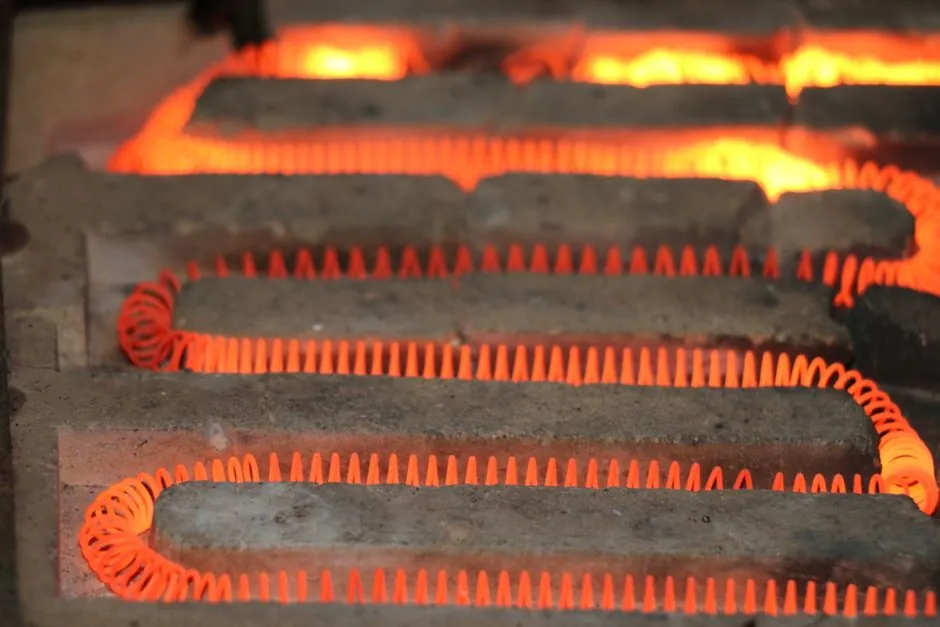
A thermal mass flow meter (TMF) infers gas mass flow from convective heat loss off a heated sensor, so its output stays valid without separate pressure or temperature compensation, which is the main reason compressed-air, biogas, and flare-gas skids keep specifying it.
Selection breaks into four physical decisions: capillary (bypass) versus inline insertion, low-flow cutoff, accuracy class, and hazardous-area certification. Each one narrows the supplier list faster than any catalog price filter.
Operating principle and the two sensor families
Every thermal mass flow meter uses at least one temperature-dependent measuring resistor exposed to the flow medium, with at least one arranged in the flow cross-section, and a second resistor compensating for process-gas temperature drift [S1]. The Wiegleb/Heimel/Ross patent US4972708A (filed 1989-06-22, granted 1990-11-27) makes that geometry explicit: a thin-film resistor on a ceramic insulating member is bonded to a ceramic support tube with glass solder, so the resistor is fully encapsulated against corrosive or hot gases [S1].
Capillary-tube meters (also called bypass or laminar-flow elements) generate a small differential pressure that forces a fixed fraction of the main flow through a sensor bundle. Inline insertion meters place a single probe directly in the pipe, so they are preferred on larger diameters where bypass flow would be impractical. For a primer on the broader thermal mass flowmeter category, the difference matters because capillary units are usually more accurate at low Reynolds numbers, while insertion probes are far cheaper on 6 in and larger lines.
Selection criteria that actually move the quote
Accuracy is the first gate. Most general-purpose TMF units are specced at ±1 to ±2 percent of full scale, while laboratory-grade capillary meters can reach ±0.5 percent when factory-calibrated on the actual gas mix [S3]. Repeatability, not accuracy, is the spec most operations teams should ask for first, because it drives day-to-day mass-balance closure.
Turndown is the second gate. A 100:1 turndown is common on capillary designs, while insertion probes rarely exceed 50:1 before low-flow cutoff becomes unstable. If the duty includes digester gas with wide composition swings, lean toward a unit that supports multi-gas calibration, since thermal conductivity varies sharply with H2S, CO2, and CH4 fractions.
Process connection is the third gate. Capillary meters typically land in 1/4 in to 1 in NPT or flanged bodies, while insertion probes use 1-1/2 in or 2 in hot-tap retractors so they can be installed on a live line. Materials follow the gas: 316L stainless for clean compressed air, Hastelloy for chlorine trace, PTFE-coated sensors for wet biogas.
Who should pick capillary, who should pick inline

Pick a capillary (bypass) thermal mass flow meter when the line is 2 in or smaller, the gas is clean, and accuracy below 1 Nm/s is mandatory, for example instrument air headers, laboratory gas panels, and burner combustion air. Capillary meters are also the safer choice when the gas composition is fixed and well-known, because the laminar flow split makes them largely immune to upstream swirl if a 10D straight run is provided. [S3]
Pick an inline insertion probe when the line is 6 in or larger, the budget per measurement point is constrained, or only a relative trend is needed, for example digester gas wellheads, landfill flare pilots, and HVAC building mains. Insertion probes also fit when retrofit cannot shut down the line, since hot-tap retractors allow installation under pressure.
Do not pick a TMF at all when the service is steam, two-phase flow, or any liquid with entrained gas, because the heat-loss model breaks down and a vortex flow meter or Coriolis meter will give a far more honest reading. TMF meters intended for corrosive and hot gases can achieve long-term resistance to corrosion by using thin-film resistors with a ceramic insulating member connected to a ceramic support member via glass solder, so the sensor encapsulation should be verified for the specific gas service.
Output, comms, and hazardous-area certification
Standard outputs are 4-20 mA plus HART for top-tier units, with pulse and Modbus RTU on mid-range devices. Foundation Fieldbus or PROFIBUS PA appear on premium process-industry models but are still the exception, so confirm before specifying them on a DCS upgrade. For a wider comparison of digital comms on flow instruments, the gas mass flow controller reference outlines the same protocol split. [S3]
Hazardous-area certification is non-negotiable for any hydrocarbon or hydrogen service. ATEX II 2G Ex db IIC T4 is typical for European skids, while IECEx Ex db IIC T4 Gb covers most other regions. The thin-film/glass-solder construction described in US4972708A is one path to intrinsic safety, but most modern field meters reach Ex d through a flameproof enclosure rather than encapsulation of the sensor itself [S1][S2].
Comparison: capillary vs. inline insertion TMF
Capillary meters typically win on accuracy (down to ±0.5 percent FS), turndown (100:1 common), and low-flow sensitivity, but they cost more per line size and add a pressure drop that a vortex flow meter would not. Inline insertion probes win on installed cost on 6 in and larger lines, support hot-tap installation, and have negligible permanent pressure loss, but they need a longer straight run upstream (typically 15-20D) and a larger low-flow cutoff. [S3]
For adjacent flow technology on wet or dirty gases, the electromagnetic flowmeter reference covers the liquid-side equivalent, which is useful when a skid measures both gas and slurry.
Common failure modes and field evidence
Three failure modes account for most field returns. First, sensor drift when the actual gas mix differs from the calibration gas, which is why biogas and landfill gas must be specified as a named blend or routinely re-zeroed on nitrogen. Second, condensate or particulate fouling on the sensor, which shifts the heat-loss curve and shows up as a slowly rising zero; a sintered guard or in-line filter ahead of the meter usually prevents this. Third, thermal shock during a hot-tap insertion into a cold line, which cracks ceramic sensor bodies; the glass-solder bonded construction in US4972708A was specifically designed to mitigate this by isolating the thin-film element from the duct wall [S1].
The Delft University of Technology work published in Journal of Physics E: Scientific Instruments (Vol. 21, No. 10) characterised the bridge-circuit behaviour that translates resistance change into mass flow, and it remains the most-cited academic reference for the analog front-end design of thermal flow sensors [S2].
Shortlist logic for 2026 bids: if the gas is clean, the line is small, and ±0.5 percent accuracy is on the data sheet, spec a capillary TMF from a vendor that publishes a multi-gas calibration certificate; if the line is large and budget matters, spec an inline insertion probe with ATEX or IECEx Ex d, 4-20 mA plus HART, and a 316L wetted path. Always lock down turndown, low-flow cutoff, and the calibration gas identity on the PO, because those three lines drive most field disputes.
This topic is covered further in Rebar Bender Selection for Road Maintenance Crews.