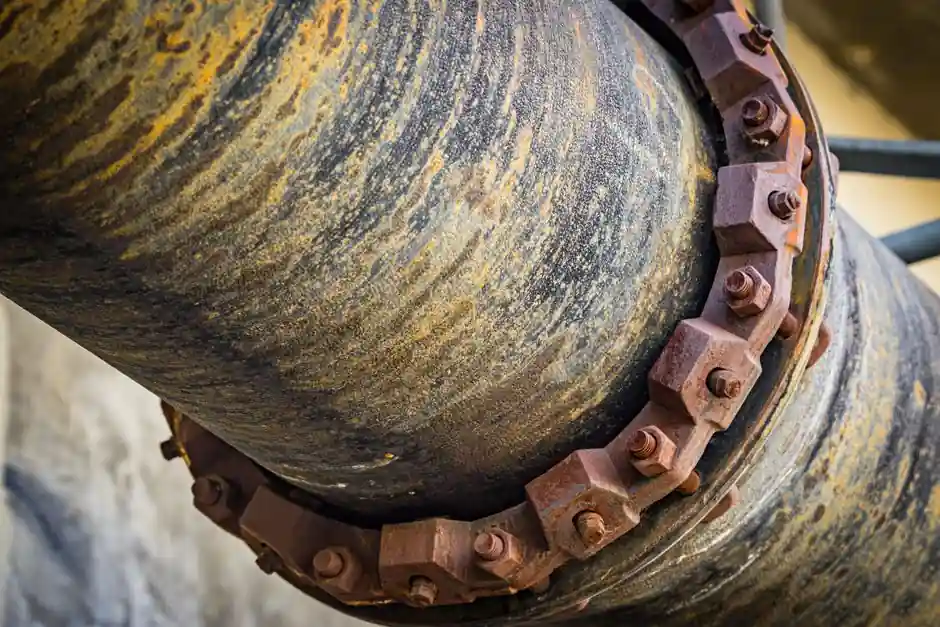
Vortex shedding flow meters dominate saturated and superheated steam, compressed air, and clean process gas lines because the bluff-body frequency is linear with velocity over a wide Reynolds range and the wetted parts are essentially a stainless shedder bar and two piezoelectric sensors [S1][S3].
Specifying one correctly comes down to four gates: the process fluid must stay above the meter’s minimum velocity (typically 3-10 m/s depending on body size), the line must run turbulence-free enough to set up a stable Karman vortex street, wet steam must be detected and compensated, and the output must match the plant’s control bus (4-20 mA + HART, FOUNDATION Fieldbus, or PROFIBUS PA) [S1][S3][S4].
How a Vortex Meter Works and Where It Fits
A bluff body in the flow stream sheds alternating vortices at a Strouhal-number-defined frequency, and that frequency is linear with velocity over a published turndown, commonly 10:1 to 30:1 for industrial vortex bodies [S3][S4]. Two piezoelectric sensors mounted in the shedder bar, 180 degrees out of phase, let the transmitter cancel common-mode pipe vibration and pull the vortex tone out of the noise floor, which is how modern digitalYEWFLO-style meters avoid the startup tuning older designs needed [S3]. Endress+Hauser positions the Prowirl family as a versatile steam, liquid, and gas meter with integrated wet-steam detection and best-in-class accuracy on its product page [S1].
For a foundational view of flow meter families, the vortex flowmeter encyclopedia entry lays out the principle; the broader flow meter overview is useful when comparing against Coriolis and electromagnetic types. Vortex sits between differential-pressure and Coriolis in price and capability, which is why it is the default for utility steam and air lines where Coriolis cost is hard to justify.
Selection Gates a Process Engineer Should Not Skip
Gate 1 is minimum velocity. Below roughly 3 m/s water or 10 m/s air the vortex signal collapses into pipe noise; below that, specify a reduced-bore body or switch to a different technology [S3][S4]. Yokogawa’s Reduced Bore Type Vortex meter integrates a concentric reducer and expander to push stable measurement into the low end of the span, which is the right call when normal flow is below the standard meter’s floor [S3].
Gate 2 is Reynolds number. Vortex meters need fully developed turbulent flow; very low Re with viscous fluids will not produce a clean shed. Gate 3 is wet steam. Superheated steam behaves as a gas, but saturated steam condensing in the body destroys accuracy unless the meter has wet-steam detection and built-in temperature compensation for direct mass flow [S1][S7]. Gate 4 is output and protocol. Loop-powered 4-20 mA with HART remains the default for utility skids; FOUNDATION Fieldbus and PROFIBUS PA appear on larger DCS-integrated projects. Match the meter’s protocol to the DCS card, not the other way around.
Comparing the Main Vortex Variants on Decision Criteria
Three realistic variants cover most spec sheets: wafer-body flanged, full-bore flanged, and reduced-bore. Wafer bodies are the lowest cost and fit between flanges in line sizes DN15 to DN100, which is the common steam and compressed-air range [S1][S5]. Full-bore flanged bodies extend the range up to DN300 and tolerate higher process temperatures and pressures on large utility headers. Reduced-bore bodies include an internal concentric reducer, trading permanent pressure drop for stable low-flow measurement where a standard body would stall [S3].
On a four-axis comparison, wafer types win on cost and lead time, full-bore flanged types win on pressure/temperature ceiling and line-size range, and reduced-bore types win on turndown at the expense of permanent loss. For a deeper cost comparison against magnetic and Coriolis, see the magnetic flow meter price 2026 cost-band write-up and the ultrasonic flow meter price and cost guide, which bracket vortex on either side of the price ladder.
Process Fluids and Applications Where Vortex Is the Right Call
Saturated steam on plant headers, superheated steam in turbine bypass lines, compressed air and nitrogen, and clean low-viscosity liquids are the core duty list [S1][S3][S4][S7]. Yokogawa lists steam, refining, chemical, oil and gas, district energy, reverse osmosis feed, and petrochemical as the target applications for the VY and digitalYEWFLO series [S3]. DwyerOmega’s FV-500C family targets similar process-fluid service with optional local display of rate and total [S5]. Used and surplus steam-mass vortex meters on the secondary market typically ship with 4-20 mA analog for rate, a pulse output for totalization, and built-in temperature compensation for direct mass flow on saturated and superheated steam [S7].
If the line carries raw wellstream, sludge, slurry, or anything that coats the shedder bar, vortex is the wrong technology. The bluff body and sensor must stay clean; even a thin film of process buildup changes the shed frequency and biases the reading. For conductive dirty liquids, the electromagnetic flowmeter is the better call, and for mass-flow-critical custody transfer the Coriolis flowmeter is the correct default.
Installation, Diagnostic, and Verification Constraints
Upstream straight run matters more than for magnetic meters. Plan on at least 10-15D of straight pipe upstream of the shedder body, with longer runs after a control valve or two elbows in different planes, otherwise the Karman street will not form cleanly. Plan for vibration isolation on long pipe racks: the meter's adaptive noise suppression handles normal plant vibration, but a compressor mounted on the same skid will swamp the signal regardless of DSP [S3].
On diagnostics, the FSA130 verification tool from Yokogawa supports both magnetic and vortex meters for in-service verification, which avoids the cost of pulling the body for bench cal on a saturated-steam header that cannot be shut down [S3]. A de-clogging alarm on Yokogawa's design flags obstructions before they bias the reading, and the shedder bar is replaceable without breaking the process piping [S3]. Endress+Hauser markets similar self-diagnostics and wet-steam detection on the Prowirl line [S1]. For broader instrumentation context, the linear guide and crossed roller guide encyclopedia pages sit alongside the flow-content cluster on most spec portals.
Standards, Calibration, and Sourcing Signals
For steam duty, look for meters rated for the design pressure and temperature of the header and qualified per the relevant ASME B16.34 valve and piping standard for body rating, plus IEC 61508 for SIL where the meter is in a safety loop. For hazardous-area chemical and refinery service, ATEX or IECEx certification is a must on European and global projects, and the meter’s ambient temperature range must cover outdoor winter ratings, not just process temperature [S1][S3].
On sourcing, OEM catalogs (Endress+Hauser Prowirl, Yokogawa VY/digitalYEWFLO, Rosemount, ABB, Siemens SITRANS) carry the full documentation and verification certificates. GlobalSpec aggregates 2026 vortex flow meter datasheets and selection guides from multiple manufacturers for cross-comparison [S4]. Secondary-market and surplus channels (kitairu, China.cn resellers) list steam-mass vortex meters with 4-20 mA + pulse output, but the buyer takes on documentation and traceability risk, which is acceptable for non-custody utility metering and a poor choice for fiscal or safety service [S7][S8].
Shortlist two or three OEM models that meet the four gates above, request a wet-steam / dry-steam validation certificate for any steam service above 5 bar, and verify the FOUNDATION Fieldbus or HART device revision against the host system’s library before issuing the PO.