
Quarry duty is a hostile envelope for any hydraulic crane: dust ingestion, shock-loaded cycles, grade work on broken rock, and lifts that swing between 3 t jaw blocks and 25 t face-plant components. Selecting a truck crane for a hard-rock or aggregate pit in 2026 starts with three numeric gates: lift class, boom reach, and chassis configuration, all matched to a measured duty cycle rather than a brochure headline.
The quarry market now sits inside a Chinese-dominated supply chain: Jining Jiaqing (Shandong) and Shanghai Super-Above both list boom trucks from 3.2 t through 16 t class, while XCMG's XCT25L5 (25 t) and XCT60_Y (60 t) telescopic range covers the upper quarry brackets, with FOB price bands of roughly USD 10,000-100,000 listed on Machmall [S2][S3][S4]. Buyers should anchor specifications to published load charts, not the headline rating.
Lift Class: Match the Heaviest Repeated Lift, Not the Maximum
Quarry lift profiles cluster in three bands: 3-8 t for jaw liners, screen media, and conveyor idlers; 10-25 t for crusher rotors, cone heads, and excavator track groups; and 40-60 t for face shovel moves and primary crusher rebuilds. XCMG's XCT25L5 ships as a 5-section telescopic at 25 t class, while the XCT60_Y extends to 60 t for heavier face work [S3].
Under-spec by lift class is the single most common quarry failure mode, because operators routinely lift at 70-80% of nameplate to maintain cycle time, and a unit running near its structural limit in a dusty, hot environment fails 2-3x faster than the same unit at 50% load. A 25 t class crane is therefore a sane minimum for any hard-rock quarry with primary crushing; below 16 t (the Jining Jiaqing 16 t boom-truck ceiling) the unit is restricted to aggregate-only operations [S2].
Boom Reach: 38-44 m Telescopic, 4-8 Sections
Reach governs whether the crane can service a face without repositioning. Quarry faces are typically 8-12 m high with a 6-10 m bench width, so a 38 m main boom covers most single-position lift patterns, while 42-44 m adds the headroom for sub-level work and crusher feed hoppers. Section count is the trade-off: more sections extend further but introduce sleeve-play and tip-deflection risk on shock loads. [S2]
Jining Jiaqing's truck-crane upper-parts line, and XCMG's 5-6 section telescopic booms, both target this 30-44 m envelope, with knuckle-boom options (10-16 t) reserved for tight urban quarries rather than open-pit faces [S2][S3]. A 4-section boom is the conservative quarry pick; 5-6 sections only when the OEM publishes combined-mode load charts, not just main-boom ratings.
Chassis: 6x6 or 8x4 Off-Road, Not On-Road Tractor
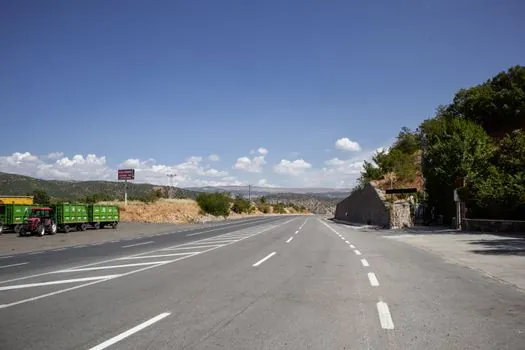
Quarry ground is the deciding factor for chassis. A standard on-road 6x4 tractor sits too high, transfers shock into the upper structure, and cannot maintain traction on broken rock. Used International MV607 (2026 model year) truck-crane chassis on Construction Equipment Guide are typically on-road rated, suitable for hybrid quarry-to-road fleets but not dedicated face work [S5].
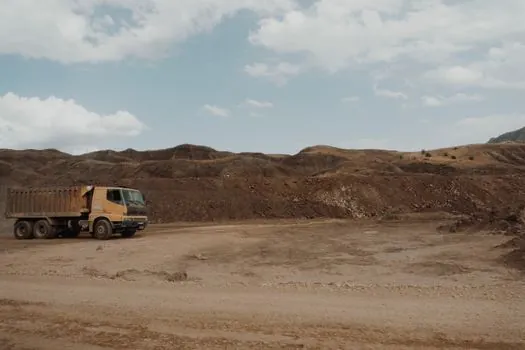
For dedicated quarry deployment, 6x6 all-wheel-drive (single front, dual rear drive) or 8x4 (dual rear) is the working envelope, with 16.00R20 or larger off-road tires, 300 mm minimum ground clearance, and a PTO-driven hydraulic pump matched to the upper-structure flow at 220-280 bar. Dongfeng and Foton truck-with-crane platforms (3-25 t for Dongfeng, 1-16 t for Foton) are widely quoted in China but most ship as 4x2 or 6x4 on-road chassis; quarry buyers must explicitly request 6x6 or uprated suspension, and verify the load chart at 4.5% chassis grade [S8][S9].
Duty Cycle, Hydraulics, and Service Intervals
Quarry duty is typically 8-12 lifts per hour across a 10-14 hour shift, with ambient dust and 35-45 deg C summer temperatures. Cooling package sizing matters more than nameplate lift: a 25-60 t telescopic needs an oil cooler rated for continuous duty at 50 deg C ambient, not the 30 deg C rating of standard road units [S2][S3].
Service intervals shorten in quarry dust: hydraulic return filter change drops from 1000 h to 250-400 h, and outrigger pad inspections move from monthly to weekly. The boom-truck class from Jining Jiaqing (3.2-16 t) uses standard subcomponents, which simplifies field repair, but the larger 25-60 t XCMG units require OEM-specific load-moment indicator (LMI) calibration; buyers should confirm local service coverage before order [S2][S3].
Certification, Standards, and Supplier Vetting
Jining Jiaqing holds ISO9001:2015, ISO45001:2018, and ISO14001, with CE and CCC product certification, and lists a 30-50% repeat-buyer rate on its Made-in-China profile [S2]. Shanghai Super-Above reports main markets across Eastern Europe, Southeast Asia, Africa, and the Middle East, with FOB Incoterms as standard [S4]. For EU-bound quarry cranes, CE marking under the Machinery Directive is the gating requirement; for African and Southeast Asian aggregate operations, CCC plus a buyer-side pre-shipment inspection is the working pattern.
Buyers should request a quarry-specific load chart, not the generic on-road chart, and should witness a 4-hour continuous duty test at the supplier yard before shipment. For aggregate-handling fleets that also need material movement, complementary equipment such as a dump truck or concrete mixer truck on the same chassis platform reduces parts inventory and operator training overhead. For stockyard logistics inside the quarry perimeter, a reach truck is often the right call for palletised spare parts, while a truck scale at the weighbridge closes the production-accounting loop.
Failure Modes and Specification Traps
Three traps account for most quarry-crane write-downs: (1) specifying on-road chassis for off-road duty, (2) accepting the headline lift figure without a published chart at full reach and partial slew, and (3) under-sizing the cooling package for sustained 40 deg C+ ambient. Each of these is correctable at the quotation stage but expensive to fix in service. [S2]
A second tier of traps includes: neglecting outrigger-pad ground-bearing pressure on broken rock (specify 600x600 mm minimum pads), specifying single-stage boom-tip lubrication where auto-grease is available, and accepting a standard 12-month warranty where 24-month or 3000-hour powertrain coverage is offered. For adjacent material-handling decisions, see this forklift selection for pipeline construction sites: 2026 spec and powertrain map for chassis-engine matching logic that translates directly to quarry truck-crane specification.
Trackable signals for the next buying window: XCMG's 2026 XCT series is already listed at 25-60 t with 5-6 section telescopic options, so the realistic watch-item is whether a heavier 70-80 t class appears in OEM catalogues for the larger aggregate pits, and whether CE-certified 6x6 quarry chassis become a stock option rather than a custom build request through the Shandong supply chain [S2][S3].
