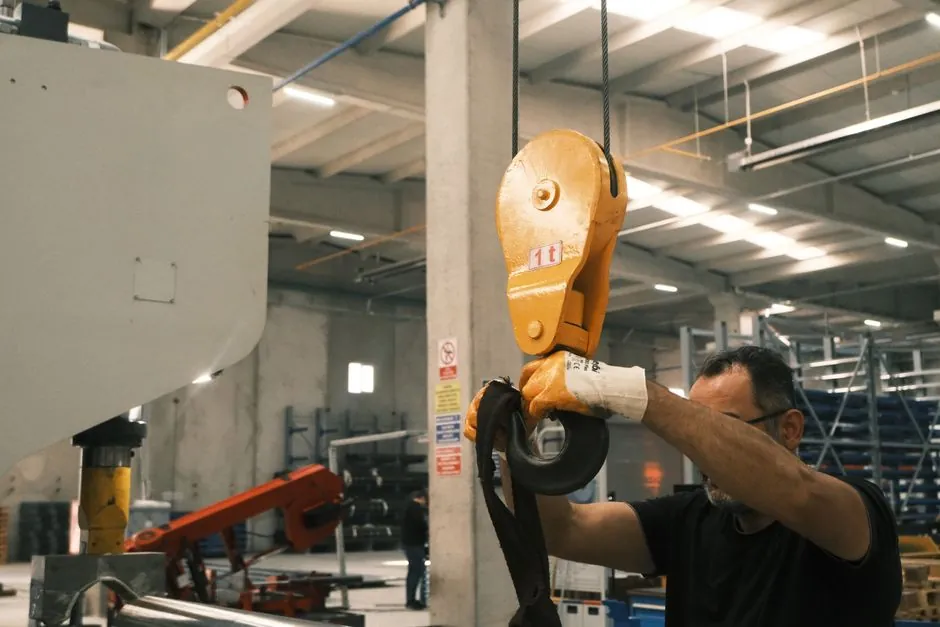
UHMWPE liners and pipes fail in service far more often from installation mistakes than from the polymer itself, and the most expensive of those mistakes is treating the material as if it were steel: tightening bolts to a snug fit, ignoring thermal growth, and skipping flexible mounting [S3].
This reference covers three installation contexts published or updated in 2026: countersunk bolt layout for chute and bin liners, thermal expansion gap sizing, and UHMWPE pipe handling, trenching, and joining (flange, butt fusion, mechanical coupling) [S1][S2][S3]. The shared theme is that UHMWPE is a polymer with a coefficient of linear thermal expansion around 1.5×10⁻⁴/°C, more than ten times steel's, so every joint, hole, and support must be designed to move [S3].
Why Thermal Expansion Drives the Layout, Not the Bolt Torque
UHMWPE's coefficient of linear thermal expansion is approximately 1.5×10⁻⁴/°C, and a 2 m sheet subjected to a 20 °C swing will grow or shrink by roughly 3 mm unless the layout absorbs that movement [S3]. The governing relationship, ΔL = L × α × ΔT, is the same form used for metals, but the multiplier is an order of magnitude larger, which is why steel-style tight fits buckle the polymer and shear the fixings [S3].
Outdoor storage bins in winter and chute work handling hot material represent the two worst-case environments; both need the same response, a flexible mounting strategy with planned clearance around every fastener rather than a stiff, fully constrained plate [S3]. Material background on the polymer itself is summarised in the UHMWPE properties reference for engineers new to specifying the grade.
Countersunk Bolt Layout: Hole Size, Recess Depth, and Spacing
The countersunk bolt hole must be 2–3 mm larger in diameter than the bolt shank, a deliberate clearance that lets the sheet shift around the fastener during thermal cycling and prevents stress accumulation at the hole wall [S3]. Drilling to a tight tolerance, the instinctive metalwork approach, is explicitly called out as a novice error that locks the liner in place and forces the expansion load into the bolt or the parent structure [S3].
The bolt head sits 1–2 mm below the liner surface, with a flat-bottomed countersink so the head loads evenly; this protects conveyor belts, scrapers, and drag-line cable from impact damage and stops the head acting as a stress concentrator that cracks the surrounding polymer [S3]. Bolt spacing has to balance two competing needs: enough fasteners to hold the sheet against impact and product load, enough open span to let the sheet flex; arrays in the field typically run a denser perimeter and a sparser field, but spacing must be tuned to sheet thickness and service temperature, not copied from a steel-plate drawing [S3].
Trenching, Handling, and Storage for UHMWPE Pipe
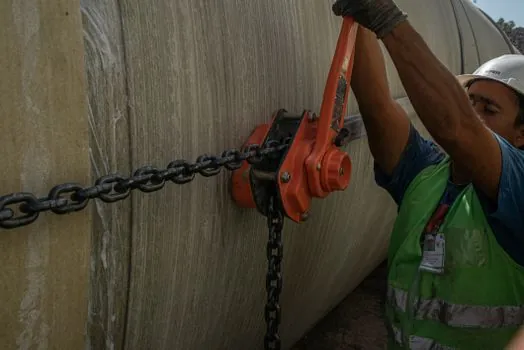
For underground UHMWPE pipe, trench width should be at least 300 mm wider than the pipe outer diameter, with depth set by the design load and local cover rather than by the pipe's own strength, and the trench floor must be free of sharp objects that can score the OD during lowering [S2]. The polymer's low density relative to metal makes handling easier, but slings and rope edges still need to be free of sharp corners, and any scratch becomes a stress riser under internal pressure or thermal cycling [S2].
Storage wants a dry, ventilated area, horizontal stacking on regular supports to prevent sag, and protection from direct sunlight because prolonged UV exposure degrades the material over time [S2]. Onsite cutting uses a circular saw with a fine-toothed blade or a dedicated pipe cutter, the cut must be perpendicular to the axis for a clean joint, and burrs are removed with a file or sandpaper before any fusion or flange work [S2].
Joining Methods Compared: Flange vs Butt Fusion vs Mechanical Coupling
Flange connections suit services where the line will be opened for maintenance: flanges are bolted on with gaskets, holes aligned, and bolts tightened evenly in a cross-pattern so the gasket seats uniformly without distortion [S2]. Butt fusion welding is the strongest joint and the one used for permanent runs: a heating plate brings both pipe ends to a controlled molten state, then the ends are pressed together under the manufacturer's specified temperature, pressure, and hold time to form a seamless, monolithic bond [S2].
Mechanical couplings are the fastest field option, useful for repairs and tie-ins where welding gear cannot be deployed, but they introduce a different gasket and housing material into the line and should be checked for chemical compatibility on chemical-service duty [S2]. As a decision shortcut: butt fusion for new permanent lines, flanges at equipment connections and where future disassembly is planned, mechanical couplings for emergency repair or low-criticality service branches.
Fastener Choice for Sheet Lining on Truck Beds, Chutes, and Buckets
For truck bed and body lining, fastening options include stud welds, fanged bolts, and weld washers, and the choice is driven by parent material thickness and accessibility rather than by the UHMWPE itself [S1]. Newer trucks with factory decals often need aluminium cover strips to shield the graphics from the heat of the stud-welding process, while older trucks with thin aluminium skin usually need a continuous weld along the sheet length to spread the load into the parent metal [S1].
Excavator buckets, hoppers, and conveyors follow the same countersunk pattern as static bin liners, but with closer bolt pitch because the parent surface is curved and subject to vibration rather than a flat plane under product load alone [S1]. The lab benchmark widely cited for the lining itself is that UHMWPE outwears steel by a factor of 2 and aluminium by more than 5 times, which sets the expectation that the polymer, not the fastener, should be the wear surface in any impact or sliding zone [S1].
When to Stop Repairing and Replace the Liner
Replace, don't re-tighten, when countersunk bolt heads have worn proud of the surrounding UHMWPE surface, because a proud head is now an impact hazard for any belt or scraper passing over it and the local polymer has already yielded [S3]. Replace when bolt-mount weld pads on the bin wall have cracked at the fillet: re-welding on a cracked pad is a short-term patch because the parent metal has work-hardened around the crack and the next thermal cycle will reopen it [S3].
Escalate rather than reuse when sheets show through-thickness cracks radiating from bolt holes, the signature failure of an installation that was clamped tight without expansion clearance; the same sheet pattern will reappear on the replacement unless the layout is reworked [S3]. On the pipe side, replace any fusion joint that fails the pressure hold or any flange gasket that shows extrusion past the flange faces, and do not re-fuse a joint from a misaligned heating plate because the polymer memory of the bad alignment weakens the next attempt [S2].
For buyers weighing UHMWPE against alternative wear linings, the relevant trade-off discussion sits in the industrial rubber TCO reference, where the cost-per-service-hour math for polymer and rubber linings is laid out against the same abrasion duty that UHMWPE typically takes.
Spec-level background on the components involved: linear guide, and crossed roller guide.