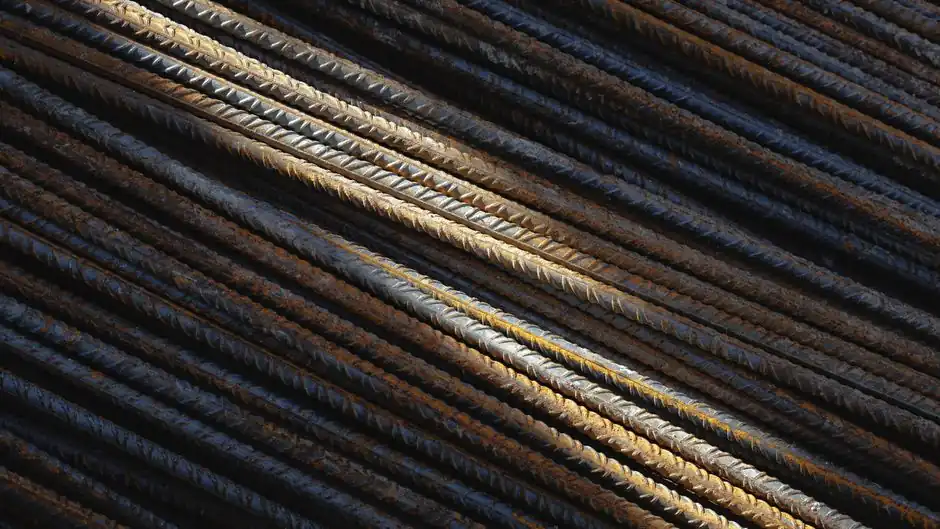
Alloy steel covers any steel deliberately alloyed with elements beyond carbon, with total alloy content falling between 1.0% and 50% by weight per the standard metallurgical definition [S2].
The class splits into two practical buckets, low-alloy (roughly under 4% to 8% total alloy content depending on the reference) and high-alloy (above that threshold, the bulk of which is stainless family), and the common engineering grades 4140, 4340, 8620, 8630, 52100, plus 304/316 stainless dominate procurement lists [S2][S3].
Definition, Alloying Window, and Low vs High Split
Alloy steel is steel to which deliberate alloying elements have been added in the 1.0% to 50% by weight range, usually to lift strength, hardness, toughness, wear resistance, corrosion resistance, hardenability, or hot hardness beyond what plain carbon steel can deliver [S2].
The boundary between low-alloy and high-alloy is not a single number, with William Smith and Javad Hashemi placing the line at 4.0% total alloy content while Paul Degarmo et al. draw it at 8.0%, and most production tonnage sits on the low-alloy side [S2]. As a working guideline, additions below about 5% are used primarily to increase strength or hardenability, while additions above 5% are aimed at corrosion resistance or temperature stability [S2].
Carbon content still matters inside alloy steel: low-carbon ranges sit near 0.04% to 0.30%, medium-carbon at 0.31% to 0.60% with manganese up to roughly 1.65%, and high-carbon at 0.61% to 1.50%, with the AISI/SAE 10xx, 41xx, 43xx, and 86xx families mapping cleanly across these bands [S5][S2]. For more on how alloying choices ripple into non-metallic material performance, see the broader alloy steel reference.
What Each Alloying Element Actually Does
Manganese is the most common alloyant, generally present around 1.75% in the SAE 13xx series, and is the workhorse for hardenability and sulfur control [S2].
Chromium and molybdenum (the 41xx Cr-Mo family, including 4140 at roughly 0.80-0.95% Cr and 0.15-0.25% Mo) raise hardenability, wear resistance, and high-temperature strength, which is why 4140 dominates shafts, gears, and machinery components [S2][S3]. Nickel-chromium-molybdenum grades like 4340 (about 1.82% Ni, 0.50-0.80% Cr, 0.25% Mo) and 8630 (about 0.55% Ni, 0.50% Cr, 0.20% Mo) add impact toughness and through-section hardening, making them standard for aerospace forgings, crankshafts, and high-stress couplings [S2][S3].
Silicon (0.20-2.00% in the SAE 92xx spring steels) and boron (added in the 50Bxx, 51Bxx, and 94Bxx series as a hardenability multiplier at very low cost) round out the common additions, while aluminum deoxidizes and restricts grain growth during solidification [S1][S2]. Nitrogen, vanadium, and niobium are the secondary tools: nitrogen stabilizes austenite and lifts strength, and vanadium/niobium form fine carbides that pin grain boundaries during heat treatment [S1][S2].
SAE/AISI Grade Map and the Common Alloy Steel Grades
The SAE/AISI four-digit system is the procurement shorthand, with the first two digits naming the alloy family and the last two or three indicating carbon content in hundredths of a percent [S2].
Typical composition targets from the published principal low-alloy steel table: 41xx with Cr 0.50-0.95% and Mo 0.12-0.30%, 43xx with Ni 1.82%, Cr 0.50-0.80%, Mo 0.25%, 46xx with Ni 0.85-1.82% and Mo 0.20-0.25%, 48xx with Ni 3.50% and Mo 0.25% (the deep-hardening nickel series), 51xx with Cr 0.80-1.05%, 61xx with Cr 0.60-0.95% and V 0.10-0.15% minimum, and 86xx-88xx with Ni 0.55%, Cr 0.50%, Mo 0.20-0.35% [S2]. The high-carbon 52xxx (Cr 1.45%, C 1.00% min) and 50xxx (Cr 0.50%, C 1.00% min) families are the basis of bearing and cold-work tool grades such as 52100 [S2].
For bar-stock procurement, the most frequently specified grades are 4140 (Cr-Mo, general machinery), 4340 (Ni-Cr-Mo, heavy-section and aerospace), 6150 (Cr-V, springs and fatigue-loaded parts), 8620 and 8630 (Ni-Cr-Mo, case-hardening via carburizing), 1018 and 1144 (low- to medium-carbon resulfurized), and 304/316 for the stainless side [S1][S3]. A 1018 vs 4140 vs 4340 vs 304 comparison on three decision criteria looks like this:
- Cost: 1018 is cheapest (low alloy, no heat treatment required), 4140 is mid-tier, 4340 carries a nickel premium, 304 is highest among these four [S3].
- Weldability: 1018 welds readily, 4140 needs preheat/postheat to avoid HAZ cracking, 4340 is more restricted and often joined by bolts or welds with strict PWHT, 304 is the most weldable of the high-alloy group [S5].
- Typical use envelope: 1018 for brackets and pins, 4140 for shafts, gears, and couplings up to medium section, 4340 for crankshafts, landing gear, and heavy forging, 304 for corrosion-resistant general service [S3][S5].
Heat Treatment and the Real Reason Grades Differ
Alloy content only matters once the heat-treatment protocol extracts its potential: low-alloy grades typically need austenitizing, oil or polymer quench, and temper to hit specified hardness bands, and 4140 in the quenched-and-tempered condition is rated for through-hardening to roughly 28-32 HRC at the surface depending on section size [S2][S3].
Case-hardening grades (8620, 8630, 4320) take a different route: carburize at 850-930 °C to push surface carbon to about 0.8-1.0%, then quench and temper, producing a hard wear skin (typically 58-62 HRC) over a tough low-carbon core [S2]. Spring grades (5160, 6150, 9260) rely on silicon or chromium-vanadium to resist temper softening, and the silicon in the 92xx series lets springs hold properties at sustained elevated service temperatures [S2].
For wear parts that must survive abrasive service, the Cr-Mo and Ni-Cr-Mo families dominate, while for cold-work tooling the high-carbon, high-chromium grades (D2, A2) and the high-speed family (M2, M4 with Mo and W) are the standard picks, with H13 as the hot-work benchmark [S5]. Stainless 304 and 316 derive corrosion resistance from a passive Cr-oxide layer that requires a minimum of about 11% chromium to form, and 316 adds roughly 2-3% Mo for chloride resistance [S5].
Standards, Specifications, and Procurement Anchors
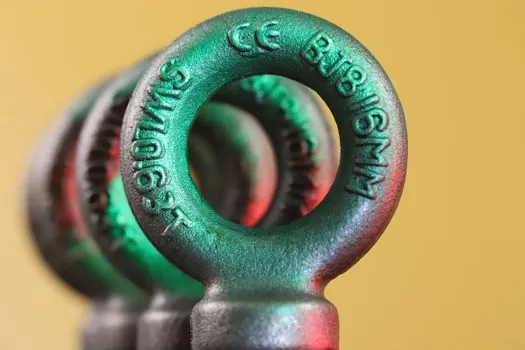
ASTM and SAE/AISI designations, not trade names, are how alloy steel is specified on drawings and purchase orders, with ASTM A29/A29M covering general requirements for steel bar, A36 covering structural carbon, and AISI/SAE 4140/4340/8620 doing the heavy lifting on bar and forging [S5][S6].
For pressure-boundary or sour-service applications, the right specification is the deciding call: NACE MR0175 limits hardness and chemistry for sour (H2S) environments, while ASME standards govern pressure-vessel and piping material selection [S6]. Buyers should also confirm whether 4140 bar is supplied as hot-rolled, cold-drawn, normalized, or quenched-and-tempered, because the same chemistry carries very different mechanical property envelopes in each condition [S3][S5].
A useful sanity check on any alloy steel data sheet: confirm the exact Cr, Ni, Mo, V, and C target ranges against the SAE four-digit table, check the heat-treatment condition and resulting hardness band, and verify which ASTM/ASME specification the lot is certified to [S2][S5]. This is the same spec-first discipline applied in adjacent equipment classes, and readers comparing material decisions against mechanical assets will recognize the pattern from the cold milling machine spares and consumables reference, where a parts-family map sits on top of a grade map.
Selection Logic: Which Alloy Steel for Which Job
Start with required hardness and section thickness: through-hardenable Ni-Cr-Mo grades (4340, 8640) are the only practical path for sections above about 75 mm that need uniform 28-32 HRC, while 4140 covers most shafts and gears under 100 mm in the Q&T condition [S2][S3].
Next, match weldability: if the part is welded in fabrication or field-repaired, prefer low-carbon variants (8620, 8630) or standard 304/316 stainless; if welding 4140 or 4340 is unavoidable, preheat to 150-300 °C and apply PWHT to avoid hydrogen cracking in the heat-affected zone [S2][S5].
Then layer on corrosion, temperature, and fatigue: choose 304 for general corrosion service, 316 for chloride-bearing media, 52100 for rolling-element bearings, 5160/6150/9260 for springs, and tool-steel grades (A2, D2, M2, H13) for cutting, forming, and die applications where hardness above 58 HRC is the gate [S5]. For cost-driven brackets, pins, and non-critical shafts, 1018 and 1020 remain the default because they machine easily and need no heat treatment to deliver serviceable strength [S5]. The same alloy-versus-composite cost-vs-performance reasoning shows up in non-metallic material choices, for instance in the E-Glass vs S-2 Glass for Aerospace selection guide, and the decision framework is directly transferable.
Common Failure Modes and How Grade Choice Prevents Them
Three failure modes drive most alloy steel rejects: hydrogen-induced cracking in welded 4140/4340, decarburization during high-temperature processing, and fatigue in under-spec spring and shaft grades [S2].
Mitigations are mechanical and procedural: preheat and PWHT for welded Cr-Mo components, controlled-atmosphere or vacuum heat treatment to limit decarburization, and the use of vacuum-degassed (VAC-ARC or ESR) remelted stock for fatigue-critical rotating components [S2]. Avoid the trap of specifying 4140 for a 200 mm cross-section expecting full through-hardness, the hardenability limit will leave a soft core regardless of heat treatment, and the right call in that envelope is a deeper-hardening 4340 or 8640, or a nickel-enriched 48xx family member [S2].
Trackable signals for the next revision of this reference: any update to the ASTM A29/A29M general-requirements bar standard, any new revision to NACE MR0175 hardness limits, and mill announcements on vacuum-degassed 4340 and 52100 capacity expansions, all of which move the procurement decision rather than the underlying metallurgical definition.
For component-level specifications, see construction machinery and equipment, and lamps and light fittings.