
Portable ultrasonic flaw detectors listed on the North American resale market on 2026-07-25 ranged from C$24.81 entry-level handheld units to C$2,711.44 for new advanced portable sets, with 1,244 active listings dominated by Olympus-branded stock (95 listings) and unbranded Chinese units (51 listings) [S3].
Manufacturer-tier pricing in 2026 separates into three bands: conventional portable flaw detectors (EPOCH 6LT/650 class), mid-range TOFD-capable instruments (KARL DEUTSCH ECHOGRAPH 1095), and phased-array/TFM platforms (Evident OmniScan X3/X4) where list price typically climbs well above the C$2,700 retail ceiling once options, scanners, and software modules are added [S1][S2][S3].
What an ultrasonic flaw detector actually does, and why that drives price
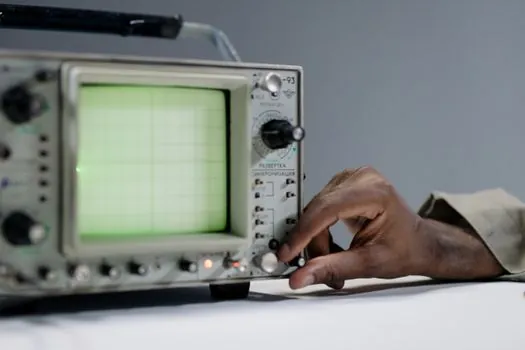
An ultrasonic flaw detector (UT) is a pulse-echo instrument that injects a high-frequency acoustic pulse into a part, times the return echo, and characterises amplitude to size cracks, voids, and disbonds in welds, forgings, turbines, and pipelines [S2]. Entry-level units cover straight-beam contact inspection with a single pulser/receiver; the moment you add TOFD (time-of-flight diffraction), phased array (PA), or TFM (total focusing method), the bill of materials jumps: more channels, an encoder interface, scan planning software, and a faster DAC/TCG section [S1].
Three functional blocks dominate the cost stack: the pulser/receiver analog front end (0.5-20 MHz bandwidth, 100-400 V excitation, 25-1000 dB gain in 0.1 dB steps), the A-scan/D-scan presentation and storage electronics (typically a 21 cm-class colour LCD on portable units), and the data pipeline for thickness logging, B-scan, or full matrix capture [S1][S2]. The KARL DEUTSCH ECHOGRAPH 1095, for instance, ships with strip-chart encoder integration, depth compensation, back-wall echo drop, and TOFD option upgrades, features that would not fit inside a sub-C$300 retail housing [S1].
Price bands observed in 2026, by class
Resale-market snapshots taken 2026-07-25 show four clear price clusters: a low-end band around C$24.81-C$295.53 covering used, unbranded, or basic handheld digital UT units (the C$24.81-C$44.40 cluster represents 75 units sold in a single listing, indicating volume commodity supply) [S3]. A mid band sits at roughly C$835.47 for a "Buy It Now" single-listing lot, consistent with used mid-range Olympus/GE/KARL DEUTSCH portable units [S3]. The new mid-high band begins at approximately C$2,711.44 for new full-feature portable sets [S3].
Manufacturer direct quotes for advanced instruments trend significantly higher: the Evident OmniScan X4 is positioned as a multitechnology flaw detector with PA, faster TFM, PCI, and twin TFM/PCI modes aimed at weld and component inspection; the OmniScan X3 series adds innovative TFM and advanced PA capability; the OmniScan SX offers a cost-effective 16:64PR SX PA or SX UT configuration with an 8.4-inch (21.3 cm) touch screen [S2]. The EPOCH 650 remains a conventional UT alternative for users who do not need phased array, while the EPOCH 6LT is the rope-access optimised single-hand variant [S2]. DirectIndustry listings explicitly note that prices "are indicative only and may vary by country, with changes to the cost of raw materials and exchange rates," and exclude delivery, customs duties, and installation or activation options [S1].
Cost drivers that move the price more than the headline spec
Five cost drivers consistently raise the quotation: (1) channel count, since a 16:64 phased-array unit carries proportional analog front-end and FPGA cost versus a single-channel conventional instrument; (2) TOFD and TFM firmware licences, which on the Evident platform are option-coded per instrument; (3) encoder and scanner integration, including the linear encoder for strip-chart recording described on the ECHOGRAPH 1095 [S1]; (4) the display and storage stack, where the OmniScan SX's 8.4-inch touch panel and onboard SSD are a measurable cost line [S2]; (5) ingress protection and ruggedisation, which the ECHOGRAPH 1095 markets as "virtually indestructible even in rough operating conditions and outdoors" [S1].
Transducer and calibration-block cost is a separate line item that buyers frequently underestimate. Reference standard blocks made to Boeing and Airbus specifications, such as those supplied by Standard NDT Inc. (Miami, FL) using in-house EDM notching verified by a video measuring system, are specified alongside the instrument and can add 5-15% to a turnkey inspection kit [S4]. OEM-supplied probes for TOFD and PA applications (typically 2-10 MHz with delay-line, immersion, or contact footprints) are usually priced separately from the mainframe; resellers on the Canadian market show probe lots bundled into the C$295.53-C$835.47 listings [S3].
Who should buy which tier, and who should not
Conventional portable units (EPOCH 650, EPOCH 6LT, ECHOGRAPH 1095 in conventional mode) suit weld fabrication shops, pressure-equipment shops, and in-service inspectors running manual longitudinal or shear-wave inspection on carbon-steel welds and forgings [S1][S2]. These operators gain little from paying for TFM if their codes (ASME V, EN 1714, ISO 17640) accept amplitude-based sizing with DAC/TCG. Mid-range TOFD units such as the ECHOGRAPH 1095 with the TOFD option suit pipeline girth-weld inspectors and rotor/casting shops that need diffraction-based height sizing and the wizard-guided setup the manufacturer describes for less experienced operators [S1].
Phased-array and TFM platforms (OmniScan X3, OmniScan X4) are for aerospace NDT labs, new-build nuclear and petrochemical inspection contractors, and any operator mandated by procedure to demonstrate full volumetric coverage with an electronic scan, where the productivity gain over manual rastering justifies the capital outlay [S2]. Buyers who only need a go/no-go thickness reading, a quick lamination check on composites, or a single-side corrosion survey on storage tanks should not be paying for phased array at all; a basic thickness gauge or a C$200-C$300 used portable UT is the right tool. For an adjacent flow-measurement comparison that often comes up in the same procurement review, see the ultrasonic level meter price guide which uses a similar cost-stack framework.
Total cost of ownership beyond the purchase order
Three TCO line items routinely surprise first-time buyers: annual calibration against IIW V1/V2 or ASTM E164 reference blocks, transducer replacement (a PZT contact probe rated for 2-5 MHz typically wears out within 12-24 months of field use, more if dropped on grit), and operator certification renewal against ISO 9712 or employer's written practice [S4].
Warranty and support tier is the second-order lever. KARL DEUTSCH sells the ECHOGRAPH 1095 via the DirectIndustry channel and advertises an under-12-hour response time from the manufacturer [S1]; Evident distributes through authorised NDT channels with regional service centres [S2]. Resale market listings, while cheap (C$24.81-C$835.47 used), typically carry no warranty, no current calibration, and no support contract, which is why fleet owners lean toward authorised OEM or authorised distributor channels [S3]. A useful cross-reference for flow-instrument TCO framing sits in the thermal mass flowmeter price guide and the electromagnetic flowmeter cost guide, which use the same install + calibrate + maintain decomposition.
Comparison of the main 2026 options against decision criteria
Comparing the three tiers directly: a sub-C$300 used conventional UT scores high on price and lead time, medium on availability of spares (unbranded units are documented in the 51-listing unbranded cluster on the Canadian resale market), and low on TOFD/PA capability and OEM support [S3]. The KARL DEUTSCH ECHOGRAPH 1095 mid-tier scores medium on price (indicative only, varies by country per the DirectIndustry disclaimer), high on TOFD/encoder integration, high on outdoor ruggedness, and high on guided-setup software for less experienced operators [S1]. The Evident OmniScan X4 platform scores low on price, high on PA/TFM/PCI capability, high on phased-array software ecosystem, and high on manufacturer-direct support, but the headline platform cost is well above the C$2,711.44 retail ceiling once a 16:64PR licence, scanners, and analysis software are added [S2].
The decision rule of thumb that emerges from this comparison: spend under C$500 only for short-cycle, low-criticality work where a used conventional UT is acceptable; spend in the C$1,500-C$5,000 indicative band for a factory-new conventional or TOFD-capable portable with calibration and warranty; and only cross into phased-array capital territory when a customer procedure or code (for example, certain ASME Section V mandatory appendices) actually requires it. For buyers cross-shopping adjacent technologies, the ultrasonic flowmeter cost discussion and the RF admittance level switch guide lay out the same tier-comparison logic for process instrumentation. Readers who need a primer on the underlying ultrasonic flaw detector measurement principle can pull the spec reference, and the related ultrasonic sensor page covers the front-end transducer physics in more depth.
Sourcing channels, lead time, and what to verify before paying
Three sourcing channels dominate 2026 procurement: OEM direct or authorised distributor (longest lead time, typically 4-8 weeks for the OmniScan-class, full warranty, current calibration certificate) [S2]; industrial B2B marketplaces such as DirectIndustry, where KARL DEUTSCH publishes the ECHOGRAPH 1095 with a "Get a quote" workflow and a 12-hour or better response SLA, noting all prices are pre-tax and exclude delivery, customs duties, and installation [S1]; and resale marketplaces, where the 1,294 active Canadian listings on 2026-07-25 skewed heavily toward used and unbranded units priced C$24.81-C$835.47, with only 366 new-condition listings across the entire category [S3]. NDT.org remains a useful aggregator for vendor catalogues and reference standard suppliers such as Standard NDT Inc. [S4].
Before paying, three checks reduce risk: (1) confirm the firmware option list matches the quoted price, since phased-array and TFM features on Evident instruments are commonly quoted as line items rather than bundled; (2) verify the calibration block and probe footprint, because mismatch between an ASTM E164 / IIW V2 block and the supplied transducer is a common field failure point, and the ECHOGRAPH 1095 specifically markets a wizard to walk operators through probe selection and instrument adjustment for that reason [S1]; (3) confirm the IP rating, drop-test certification, and operating temperature range for outdoor or rope-access use, where the EPOCH 6LT is specifically engineered for one-handed and leg-strap operation [S2]. For specifiers mapping these criteria against measurement hardware, the ultrasonic flowmeter reference page is the closest sibling in the flow-and-level family.
Trackable signals for the next procurement review: monitor Evident's OmniScan X4 phased-array and TFM firmware option pricing, watch the ECHOGRAPH 1095 indicative price in EUR on DirectIndustry for currency-driven movement, and track the Canadian resale market's median new-unit price, which sat at C$2,711.44 on 2026-07-25 with 366 new-condition listings against 312 used [S1][S2][S3].