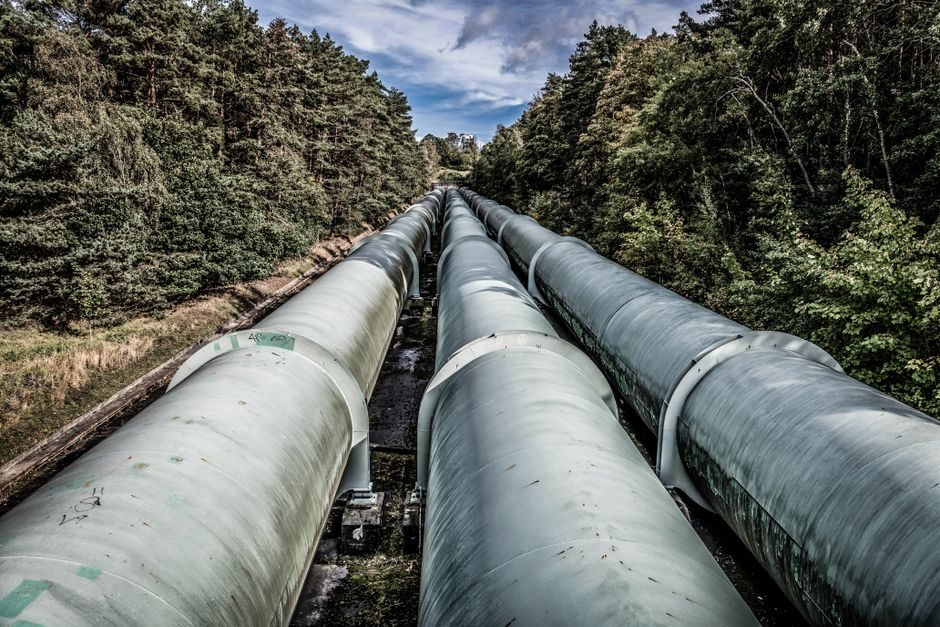
An ultrasonic flowmeter derives flow velocity from acoustic transit-time or Doppler shift, offering a non-intrusive measurement that suits corrosive, abrasive, or large-pipe service where wetted parts would degrade quickly [S6]. The general term "flow meter" covers any instrument quantifying volumetric or mass flow — including Coriolis, electromagnetic, vortex, turbine, and differential-pressure designs — and is defined simply as "an instrument that measures the rate of flow of a liquid or gas within a pipe or tube". Selection between ultrasonic and competing technologies is governed by fluid phase, temperature envelope, accuracy class, and whether the pipeline can be opened for installation.
Ultrasonic devices are most commonly built in two architectures: clamp-on (external transducers strapped to the outside of an existing pipe, with no contact with the fluid) and in-line wetted (transducers integrated into a spool piece, with the fluid flowing across them) [S1][S2]. A third variant, insertion probes, threads into a pipe tap and is common in retrofit district-heating and power-station work. The same acoustic principle underpins both liquid, gas, and steam service, with manufacturers like KROHNE Messtechnik GmbH listing in-line liquid units to 250 °C and gas/steam units to 620 °C with 100–200 bar ratings on the OPTISONIC 8300 [S2][S3].
Operating envelope: temperature, pressure, and fluid phase
Liquid ultrasonic in-line units span -200 °C to 250 °C process temperature, allowing cryogenic LNG duty through to hot oil service from a single product family [S2]. Gas and steam ultrasonic units are pushed to 620 °C and 200 bar, with bidirectional capability and precision-class metrology for custody-transfer-grade steam mass flow [S3]. By contrast, a general-purpose ultrasonic dosing flowmeter from CAMERON caps at 50 °C / 15,000 psi and targets chemical-injection service, with flows of 80–11,000 l/h — a much narrower envelope tuned to skid-mount dosing accuracy rather than plant-wide line sizing [S4].
Where installation conditions rule out opening the line, clamp-on ultrasonic meters from suppliers such as Shanghai cixi instrument CO.,LTD are described as "non-contact" instruments suited to "media flow measurement with large diameter" and to fluids that are "not easy to contact and observe" [S6]. This makes clamp-on ultrasonic the default for lined or internally coated pipes, for asbestos-cement and HDPE lines, and for temporary survey work where a hot-tap is not authorised. For an overview of the broader flow meter category, the term covers every device that outputs a flow rate signal, and the technology sub-type — not the brand — drives the operating envelope.
Comparison of primary flow-meter types
Engineers weighing ultrasonic against the rest of the field typically score four criteria: installation invasiveness, fluid compatibility, accuracy, and cost-per-meter. The table below lines up the four most common industrial types against those criteria, using only what the supplied product sheets and reference material confirm. [S1]
Ultrasonic (clamp-on or in-line): no moving parts, no pressure drop, suited to clean liquids, gases, and steam; accuracy class depends on calibration and is typically lower than Coriolis; pricing scales with pipe size rather than sensor mass [S6]. Electromagnetic: wetted, requires conductive liquid (typically >5 µS/cm, vendor-specific), no moving parts, high accuracy on water and slurries. Oval gear: wetted positive-displacement, high accuracy on viscous and lubricating fluids, but moving parts and pressure drop [S1]. Coriolis: wetted, highest accuracy and direct mass-flow output, highest unit cost, larger footprint — see a parallel cost breakdown in the Coriolis flowmeter pricing 2026 article. The cross-vendor OEM data also shows ultrasonic co-existing with electromagnetic and oval-gear technologies in the same supplier linecard, confirming that vendors view these as complementary, not competing, for liquids [S1].
Who ultrasonic is for — and who it is not for
Ultrasonic clamp-on is the right call when the pipe cannot be cut (live retrofit, lined pipe, survey), when the fluid is too corrosive or too hot for wetted sensors, or when a portable survey across many lines is needed in a single outage [S6]. In-line ultrasonic spool pieces make sense on new builds where the meter is specified at the design stage, on district-heating networks where bidirectional accuracy matters, and on high-pressure steam lines where the alternative is a costly differential-pressure manifold [S2][S3]. The CAMERON ultrasonic dosing meter is a clear fit for closed-loop chemical injection on wellheads, with 80–11,000 l/h and 10,000–15,000 psi capability [S4].
Ultrasonic is not the right call for steam or wet gas with heavy condensate carry-over (the acoustic path is disturbed by two-phase flow), for very low-flow laboratory-grade work where Coriolis accuracy dominates, or for sanitary food-and-beverage CIP where a wetted, cleanable electrode is mandated. Two-phase, aerated liquids, and high-solids slurries will defeat transit-time correlation — the standard caveat, and one reason ultrasonic and electromagnetic flowmeters sit side by side in many OEM catalogues rather than cannibalising each other [S1][S6].
Communication, output, and skid-level integration
Ultrasonic meters integrate with the same industrial stacks as any other modern flow meter. The SGM LEKTRA ultrasonic/Venturi threaded meter lists 4-20 mA, Modbus, Modbus RTU, analog output, and Bluetooth in a single IP67/IP68 housing rated to 60 °C and 1.6 MPa [S5]. The CAMERON ultrasonic dosing unit supports closed-loop control, with repeatability and precision characteristics called out for chemical skid integration [S4]. KROHNE's high-temperature OPTISONIC 8300 ships with bi-directional volume output for steam and gas [S3]. This uniformity of output options means ultrasonic fits the same SCADA, DCS, and edge-logger wiring patterns as conductivity meters on the same skid.
Bluetooth and on-board LCD programmability on the SGM LEKTRA unit point to a wider 2025–2026 trend in which ultrasonic meters carry their own data logger, removing the need for a separate recorder on small hydraulic skids [S1][S5]. Compact programmable units, including those listed on made-in-china directories, are increasingly delivered as fixed-mount, low-cost assemblies aimed at OEM skid builders. That same product category — compact ultrasonic with on-board data logging — also appears in the electromagnetic and oval-gear listings, confirming that data-logger integration has become a category-level expectation rather than a premium-tier feature [S1].
Failure modes and verification habits
Ultrasonic drift is rarely sudden; it is usually a slow loss of signal-to-noise ratio as the transducer couplant dries, the pipe wall corrodes under the clamp, or aeration increases. A disciplined verification routine — comparing the ultrasonic reading against a known reference (a calibrated clamp meter trace on the pump motor, or a conductivity meter sanity check on a side stream) — surfaces the failure before a custody or dosing threshold is breached. The CAMERON dosing unit's explicit repeatability and precision spec exists for this reason: the buyer must know what the meter will hold under closed-loop control [S4].
Clamp-on units are particularly sensitive to installation geometry: an inadequate straight-run length upstream of the transducer pair will bias the integrated path velocity and inflate the uncertainty band. Field practice is to follow the OEM's straight-pipe guidance and to log the pipe wall thickness, material, and lining type at install — all factors that feed into the sound-speed model inside the meter. For related mechanical-side calibration discipline, the Decade Resistance Box vs Loop Calibrator piece covers the same verification-rigour mindset on the electrical side.
Standards, sourcing, and what to look for in the datasheet
For liquid ultrasonic custody work, ISO 4064 and OIML R49-style accuracy classes are the usual reference points on water meters; for steam and gas custody, AGA-9 and ISO 17089-2 (Coriolis) and the gas-ultrasonic equivalent drive the approval matrix. On the hazardous-area side, ATEX 2014/34/EU and IECEx certification apply to ultrasonic meters installed in Zone 1 / Zone 2 just as they do to any other field instrument, and datasheets should list the category, gas group, and temperature class explicitly [S4][S5]. On steam lines above 100 bar, ASME B16.34 valve and piping classes typically govern the flanged connections on the in-line ultrasonic spool, and NACE MR0175 limits apply once the service is classified as sour [S3].
Specifications to demand from any 2026 ultrasonic datasheet: stated accuracy as % of reading (not just % of full scale), repeatability, flow turndown ratio, process temperature and pressure, fluid conductivity or phase requirements, transducer cable length and maximum, output protocols, hazardous-area certification, and IP rating. The OPTISONIC 8300 datasheet illustrates the format: 620 °C, 100–200 bar, bi-directional, precision, gas/steam-capable [S3]. The SGM LEKTRA datasheet shows the same discipline on a smaller form factor: 4-20 mA + Modbus + Bluetooth, IP67/IP68, -20 °C to 60 °C [S5]. Cross-checking at least two vendor datasheets against the same line condition is the fastest way to spot oversold claims.
Trackable signals worth watching into the second half of 2026: (1) more OEM datasheets quoting % of reading rather than % of full scale on ultrasonic dosing, narrowing the gap with Coriolis accuracy claims; (2) Bluetooth and Modbus-on-board as a baseline rather than a premium option in compact ultrasonic units, mirroring the pattern already visible in the SGM LEKTRA and CAMERON product sheets [S4][S5]; (3) tighter integration of ultrasonic with ultrasonic level meters on the same Modbus trunk for combined open-channel and closed-pipe metering on water-treatment skids.