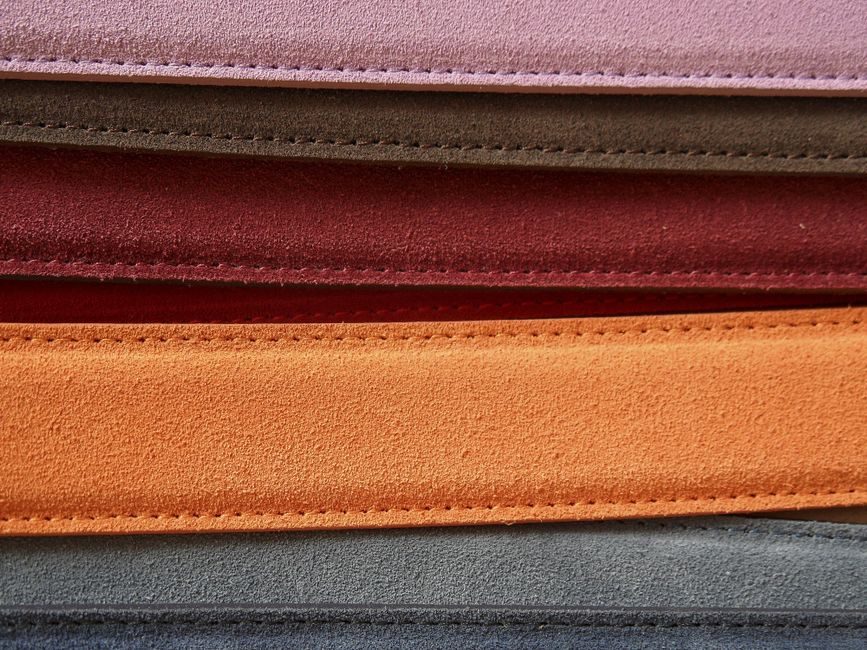
A V-ribbed belt is defined by three coordinated numbers: the length in millimetres, the rib count (typically 3 to 9 on automotive and light-industrial accessory drives) and the rib profile family (most commonly PK for serpentine automotive, PJ for higher-torque industrial, PL for very long industrial spans) [S1][S6].
Lengths in OE listings cluster in the 1300-2400 mm band for passenger vehicles, with concrete examples including a 1360 mm / 7-rib belt (BOSCH 1 987 946 204) and a 1358 mm / 9-rib belt (BOSCH 1 987 947 378) on Ford and VW applications [S1]. On long-span industrial drives the same belt family stretches well past 3000 mm, which is why profile geometry — not raw length — is the dominant selection gate [S6].
Decoding the three-part belt code: length, rib count, profile
The label on a quality V-ribbed belt is a compressed spec sheet. Reading the BOSCH 1 987 946 204 example, the critical fields are Length [mm]: 1360 and Number of Ribs: 7; a near-identical Ford/VW fitment (1 987 947 378) reads 1358 mm and 9 ribs, showing how a 2 mm length delta combined with a different rib count changes the load envelope [S1].
Profile family is usually a letter-prefix — PK, PJ, PM, PL or K — that sets the rib height and the pitch-to-height ratio. Chinese manufacturers publishing OE-grade V-ribbed belts explicitly market them as combining flat-belt flexibility with V-belt wedging action, and that hybrid geometry is what lets a 7-rib PK belt transmit the same power as a much wider classical v-belt on the same pulley diameter [S6]. A specifier who treats length as the only variable and ignores profile will typically end up with a belt that fits the pulleys but slips under accessory load.
When a classical V-belt, a ribbed belt or a flat belt is the right call
Classical V-belts (AV/B/C/D profiles) are still the cheapest option for low-speed, shock-loaded industrial drives and remain common on older pumps, fans and small machine tools [S6].
V-ribbed belts take over from roughly 5 kW upward where the drive must run backwards over a tensioner, where space is constrained (each rib is typically 3-4 mm pitch), or where a serpentine layout is needed to drive multiple accessories off one crank pulley [S1][S6]. Flat belts dominate long-centre, low-torque applications and the special material grades used in oil-and-gas service are covered in a separate flat-belt selection guide. For a dedicated spec walk-through on engine and accessory drives, see the related How to Choose a V-Ribbed Belt article.
Deflection / guide pulleys: the second spec sheet most people miss

Every V-ribbed drive on a modern engine has at least one idler, often two, and the idler is itself a spec'd component. The TREVI AUTOMOTIVE TA1403 deflection/guide pulley for Nissan Axxess lists a 17 mm bolt-hole circle, 23 mm height and 85 mm outer diameter [S5]. The DT 4.67536 unit for Mercedes-Benz (272 202 0119) clocks in at just 37 g and the same 85 mm OD class [S8]. Aftermarket replacements in plastic pulley bodies — FEBI 119239050R for Renault/Nissan, SWAG 636257 for Vauxhall/Opel GTC, FEBI 5751.20 for Peugeot/Fiat ZX — show that the same 80-90 mm OD envelope is reused across at least four European vehicle families [S2][S3][S4].
For the specifier, the consequences are concrete: pulley OD, bolt-circle pattern and belt width must all match the OE deflection pulley or the ribbed belt will track off-centre, edge-load, and fail in 10-20% of normal service life.
Numeric comparison: four realistic belt picks against four decision gates
The table below lines up four realistic V-ribbed belt choices against four buyer-facing criteria. Numbers are taken from the OE and aftermarket listings above; the qualitative fields are derived from those part numbers and the manufacturer's own geometry claims. [S1]
Belt A — BOSCH 1 987 946 204: 1360 mm, 7 ribs, PK automotive profile. Fitment: Ford/VW OE. Power class: light-to-mid accessory drive. Cost band: OE premium. Best fit when the OE part number is confirmed; weakest when the same engine has a 9-rib derivative (1 987 947 378) and a 1-rib-count error is made [S1].
Belt B — Guangzheng Rubber PK/PJ production belt: profile-flexible, length custom to order. Fitment: industrial / aftermarket engine programme. Power class: medium industrial (5-15 kW typical). Cost band: low-to-mid. Best fit for OEM programmes needing 100,000-unit annual volume, as another Chinese supplier lists that exact order-book band [S6][S7].
Belt C — Generic PK 6-rib, 1200-1500 mm aftermarket: Fitment: budget replacement. Power class: low. Cost band: lowest. Best fit for non-critical short-life service; weakest under high-ambient-temperature engine bays where EPDM compounds and OE rib geometry matter.
Belt D — High-modulus industrial EPDM ribbed belt with aramid tension cord: Fitment: heavy-duty industrial / long-centre. Power class: high (>15 kW). Cost band: high. Best fit for drives running 24/7 or above 80°C ambient; weakest on short-centre accessory drives where the stiffness causes bearing load issues.
Who a V-ribbed belt is — and is not — for

Pick a V-ribbed belt when the drive runs at high speed (>3000 rpm), wraps a small-diameter pulley (under 60 mm), uses a tensioner or idler, or needs a serpentine layout with one belt running multiple accessories [S1][S6].
Do not pick a V-ribbed belt when the drive is short-centre, shock-loaded, requires a clutching function, or lives in a heavily abrasive environment where oil and grease attack the rubber ribs. In those cases a classical v-belt or a chain remains the better answer [S6]. The same logic — pick the geometry that matches the duty, not the part that is on the shelf — applies to other components in a process line, including the linear guides that move tooling around an engine assembly cell.
Failure modes, inspection points and replacement triggers
The three most common V-ribbed belt failures are rib cracking, belt glazing and tension loss. Rib cracking usually points to a back-side idler that has run hot (over 90°C) or to a misaligned deflection pulley like the 85 mm OD TA1403 or DT 4.67536 running out of true [S5][S8]. Glazing shows up as a shiny, hardened rib face and almost always traces back to a slipping accessory or a weak tensioner, not to the belt itself. Tension loss above 8-10% of nominal typically means the automatic tensioner has bled off and the belt should be replaced together with the tensioner, not on its own.
Visual inspection should cover the full rib length — turn the belt so the rib side is fully visible — and look for chunked rib corners, exposed cord and any contamination by oil or coolant. A squeal on cold start that disappears after 30 seconds is normal; a squeal that persists above 1500 rpm is a tension or alignment problem and will eat the belt in under 5000 km.
Selection workflow: five gates to clear before clicking buy
Gate 1 — OE part number. Pull the vehicle or machine OEM reference first; cross-check it against the actual belt's Length [mm] and Number of Ribs fields exactly as published [S1][S2]. Gate 2 — Profile family. Confirm PK, PJ, PL or K on the OE label and match it; a PK belt on a PJ pulley will not seat correctly [S6]. Gate 3 — Deflection / guide pulleys. If the OE service kit includes an idler, replace it at the same time and match bolt-circle, OD and width to the OE numbers [S3][S4][S5]. Gate 4 — Material compound. EPDM with aramid or polyester tension cord is the modern default for automotive and high-ambient industrial service. Gate 5 — Quantity and lead time. OE-grade Chinese suppliers are publishing 100,000-piece order books on common V-ribbed lines, which puts aftermarket lead times at 2-4 weeks for custom profiles [S7].
Tracking signal 1 — monitor the OE part-number catalogues (BOSCH 1 987 946 204 / 1 987 947 378 and equivalents) for any new length or rib-count extensions announced for the 2027 model-year engines. Tracking signal 2 — watch the deflection-pulley SKUs (TA1403, DT 4.67536, FEBI 119239050R) for revisions to OD, bolt-circle or material, since a pulley change is the most common upstream cause of a healthy belt failing early.