A decade resistance box provides adjustable resistance values and is used in resistivity-meter and conductivity-meter calibration, while a 4-electrode soil box and a sodium chloride solution are documented as an alternative for resistance-meter calibration checking.
Resistance boxes are used for conductivity-meter and resistivity-meter calibration, and a commercial decade box or a 4-electrode soil box with a sodium chloride solution of known resistivity can be used to check resistance meters.
What the decade box verifies
A decade resistance box is a selectable resistor assembly whose rotary switches combine values in decimal steps to produce a known resistance. It is used as a reference source for checking resistance-measuring instruments, including conductivity and resistivity meters [S1][S2].
The instrument under test does not receive a simulated conductivity value directly. It receives a known resistance, and the meter reading is compared with the resistance expected from the cell or test geometry. This distinction matters: conductivity depends on both the measured resistance and the cell constant, while resistivity is derived from resistance and the cell's geometry [S3][S5].
For a meter with a resistance input, the decade box is the reference resistance. For a conventional conductivity cell, the resistance box can support a resistance-input configuration, but the actual cell constant and process-fluid handling still define the conductivity result [S3]. A proper verification record should therefore identify the meter range, cell constant, applied resistance, observed value, error, and acceptance criterion.
Two verification routes compared
The documented resistance-meter checking options are a commercial decade box for periodic calibration checks or a 4-electrode soil box filled with a sodium chloride solution of known resistivity.
Procedure for resistance-input verification
A documented conductivity-transmitter procedure calls for identifying the transmitter and its range, isolating the installation, and following the manufacturer's instructions before applying the reference resistor [S3].
Connect the decade box to the transmitter's resistance input with suitable leads and probes, select the target resistance, and allow the display to stabilize before recording the value.
After recording the result, compare the displayed resistance or calculated conductivity with the expected value. Correct any sign or configuration error before adjusting the instrument.
Use the box as a check rather than assuming it can replace a dedicated calibrator. Resistance boxes are used for resistivity-meter calibration, multimeter or ohmmeter verification, and other resistance-related calibration tasks. The distinction is important because the box itself has finite accuracy and stability [S1][S4].
Soil-box verification with known solution
ASTM G 57 identifies sodium chloride solution resistivity values of 1,000 Ω·cm, 5,000 Ω·cm, and 10,000 Ω·cm for periodic resistance-meter checking [S5]. The corresponding conductivities are 1,000 μS/cm, 200 μS/cm, and 100 μS/cm.
The conductivity standard is therefore not just a label: its temperature, resistivity, and the soil-box geometry determine the expected resistance.
Fill the soil box with the standard solution, use a calibrated 4-terminal resistance meter, and compare the measured resistance with the calculated target.
Accuracy, traceability, and test limits
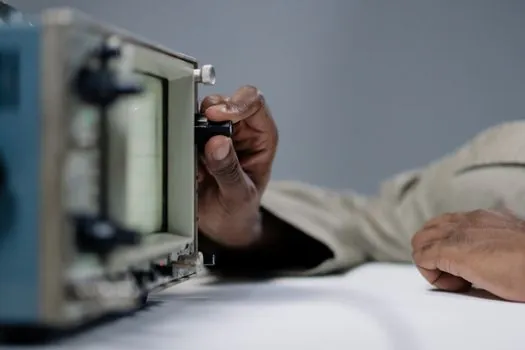
Select the decade box by range, resolution, accuracy rating, power rating, and voltage rating rather than by decade-step convenience alone [S1]. The documented decade resistance-box kit can dial in a resistance value between 0 and 999,990 Ω in 10 Ω increments.
Check the calibration certificate and the box's zero offset before a verification campaign. The resistance output is non-polar, so reversing the box leads is generally not a problem, but lead resistance and contact resistance can still affect low-value measurements [S1]. For high-accuracy work, a 4-wire connection reduces the influence of lead and contact resistance when the instrument and test arrangement support it [S1].
ASTM G 57 recommends a commercial resistance decade box for periodic checking of resistance meters other than self-calibrating models. Manufacturer recalibration is also recommended on an annual basis for resistance meters that do not self-calibrate [S5].
For traceability, record the decade-box identity, calibration status, environmental conditions, meter identity, cell constant, test resistance, observed result, and pass or fail decision. The Omega DB specification identifies stability, temperature coefficient, and power coefficient as important characteristics of a precision resistance source [S4].
Application limits and failure modes
The decade-box check is strongest for instruments with a direct resistance input or a documented resistance-input calibration mode. It does not independently verify every part of a process measurement: cable insulation, electrode condition, cell fouling, temperature compensation, and sample flow can remain outside the check [S3].
Common errors include using the wrong range, failing to check zero offset, ignoring the calibration certificate, applying a resistance above the meter or box rating, and comparing a conductivity result without correcting for cell constant [S1]. A stable display does not guarantee a correct result if the transmitter is configured for a different cell constant or temperature compensation.
Resistance meters with self-calibration features are treated separately in the cited guidance, which recommends manufacturer calibration checking for non-self-calibrating instruments [S5]. For field work, isolate the transmitter and apply lockout/tagout controls before disconnecting any energized loop [S3].
Use a decade resistance box as a controlled verification source, not as a substitute for traceable process standards. A practical lab checklist is to verify the reference certificate, select a resistance inside the instrument range, record the actual box value, compare error against the stated limit, and preserve the result with temperature and configuration details.