
Chemically reactive water-based form release agents are the default 2026 specification for warehouse slab pours on steel, aluminum, HDO, PSF and high-density melamine forms, with typical application rates of 2,000-3,000 sq ft/gal on those dense, non-absorptive substrates [S3][S6].
ACI 302 calls for 3,500 PSI as the minimum compressive strength for warehouse floor slabs, with thickness ranging from 5 inches for light pallet-rack duty to 8-10 inches for heavy bulk storage or rolling-equipment operations [S4]. A reactive release agent that produces minimal surface voids and bugholes is therefore not cosmetic; it directly supports flat-floor tolerance and the joint-filler performance the slab classification depends on.
Form-Material Matching for Warehouse Column Pours, Pile Caps and Slab Edge Forms
On dense, non-absorptive form surfaces such as steel, aluminum, plastic, fiberglass, HDO, PSF and high-density melamine plywood, chemically active water-based release agents react with alkalies in the concrete to form a soapy release film, while on steel forms the same chemistry reacts with surface iron to inhibit rust between pours [S3]. For MDO plywood, the same reactive water-based chemistry is also qualified, although coverage rates sit toward the higher end of the 2,000-3,000 sq ft/gal window because the substrate is more absorptive [S3].
Foam forms, including expanded polystyrene, require a dedicated non-aggressive formulation such as Nox-Crete Foam Release rather than a standard chemically active agent, since the latter can attack EPS, urethane, and similar substrates [S3][S6]. Closed-cell foam and rubber form liners (Urethane, STS, ABS) that cannot tolerate conventional solvent or petroleum-based release agents are still compatible with the reactive water-based chemistry, which is why most architectural concrete specifications list the same product for steel, plastic, and elastomeric form liners [S3].
Chemistry Comparison: Reactive Water-Based vs Barrier Oil vs Powder Dry-Shake
Three release-agent families compete for warehouse work, and they behave very differently at the form-face. Reactive water-based products are chemically active, low-viscosity, essentially odorless, fast-drying, non-slip on horizontal formwork, and inherently biodegradable; once dry, the film resists dew and light rain showers and will not re-emulsify [S3]. Barrier oils (petroleum or solvent-based) simply coat the form, do not react with the cement paste, tend to produce more surface voids, and increasingly fail VOC compliance for enclosed warehouse pours.
Powder dry-shake release agents are an entirely different category used for stamped and imprinted concrete, not for structural slab forming; a 30 lb pail of Concretech Powder Release covers roughly 800 sq ft of imprinting surface, applied as a broadcast before the imprint tool is set, and is broadcast at 30 lb per 800 sq ft with a calcimine or hand brush [S2]. For a flat warehouse slab, the powder product is the wrong tool; the comparison set collapses to reactive water-based versus barrier oil.
Specifying for Indoor Air, Reuse, and DOTD-Style Documentation

State DOT approval procedures, such as the Louisiana DOTD Approved Materials Procedure for form release agents on portland cement concrete, require the manufacturer to submit an Approved Materials Evaluation Form, a Safety Data Sheet, an independent-laboratory Certificate of Analysis with FTIR curve, a one-quart sample, plus a field test on steel side forms using a minimum of 5 gallons of release agent and 1 gallon of Class 3 Special Surface Finish before listing on the AML [S1]. That documentation pattern, SDS, COA, FTIR, plus an in-plant field demonstration of form build-up across at least two pours, is a useful template even on private warehouse work where no DOTD listing is required, because the same artifacts catch batch drift and substrate incompatibility early [S1].
Indoor-warehouse specifications should additionally require a current product data sheet, a published shelf life and "use by" date, declared agitation requirements, a recommended spray-tip size, and explicit coverage rates per substrate, since the same product can swing from 2,000 to 3,000 sq ft/gal between steel and MDO plywood [S3]. Manufacturers also recommend a production-scale test application on the actual form, mix design, and ambient conditions before full field deployment, because mix design, ambient temperature, and substrate condition dominate final appearance and release performance [S3].
Application, Re-Coat Intervals, and Form Cleaning
Spray application with a tip matched to the form orientation is standard, and on horizontal formwork a properly applied reactive water-based film dries fast enough to be non-slip for foot traffic, which simplifies re-coat during multi-pour column or grade-beam sequences [S3]. Once the film is dry, it tolerates dew and brief rain showers without re-emulsifying, so uncovered formwork sitting overnight on a yard pad is not automatically a re-spray event.
One operational metric the data sheets call out: with continued use, properly applied reactive release agents make forms "self-cleaning" between pours, which reduces form-cleaning labor in a precast or tilt-up yard producing warehouse columns or wall panels on a daily cycle [S3]. For built-in-place slab edge forms, that benefit is smaller because edge forms are stripped less frequently, but on the column/pile-cap form fleet it is the single biggest labor saving relative to barrier oil.
Adjacent Specifications: Admixtures, Curing Compound, and Vibrator Selection
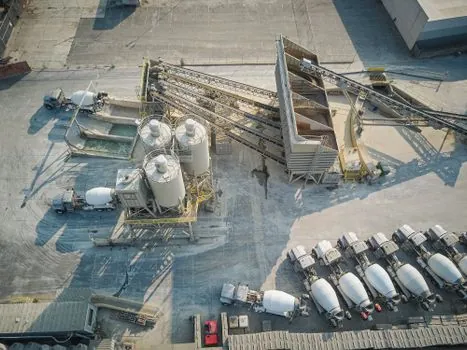
Release-agent choice is only one of four interacting picks on a warehouse slab; the others are the concrete admixture package (water reducer, set retarder for hot-weather slab pours), the concrete curing compound (resin or wax based, applied after final trowel), and the concrete vibrator strategy (stick vibrator for pile caps, surface vibrator for slab consolidation). Reactive water-based release agents are explicitly designed to let trapped air and bleed water escape during vibration, so a paired vibrator plan is part of the spec, not an afterthought [S3].
For larger sites with on-site mixing, the concrete batching plant calibration and the concrete fiber dosage (macro-synthetic for crack control in 6-8 inch slabs) round out the package. None of these choices is independent: changing the admixture supplier, switching the curing compound from resin to wax, or stepping up vibrator frequency all shift the form-face conditions the release agent sees.
Related Selection Maps and Where They Differ from Warehouse
For data-center and cleanroom slabs, the spec tightens further around reactive water-based, silicone-free, and low-residue products to protect downstream coatings and ESD floor finishes, as laid out in the data-center release-agent selection map and the cleanroom reactive water-based spec. For schools and hospitals, the priority shifts to VOC, IAQ, and biocompatibility rather than racking-load slab thickness, covered in the school release-agent VOC and IAQ spec and the hospital formwork and IAQ spec. [S2]
Warehouse work sits between the two: heavier structural loads than a cleanroom or classroom, lighter indoor-air stakes than a hospital OR, and a much higher share of precast and tilt-up element work than most commercial slabs. The reactive water-based family is the only chemistry that handles all three of those conditions without a product change between column pours and slab edge forms.
Watch List: DOTD AML Updates, SDS Revisions, and Re-Coat Field Data