
Warehouse first aid procurement in 2026 hinges on three knobs: the ANSI/ISEA Z308.1 hazard class (A or B), the headcount each kit covers (commonly 25, 50, or 100 people), and the OSHA 1910.151(b) "readily available" rule, which the industry now interprets as one station per roughly 25 employees or per 300 feet of walking distance across a floorplate [S9].
Distribution centers typically mix a wall-mount 4-shelf Class A or Class B cabinet at supervisor desks and pack stations, mid-sized 50-person kits at aisle ends, and portable 25-person hardshell pouches on forklifts and pick-cart fleets. Selecting between these formats is the difference between a 2-minute and a 6-minute response time for a picker injured at the far racking [S9][S2].
ANSI/ISEA Z308.1 Class A vs Class B for Warehouse Hazards
ANSI/ISEA Z308.1-2021 splits US workplace kits into Class A (common injuries, low-to-moderate-hazard environments such as offices and light assembly) and Class B (diverse, severe injuries, moderate-to-higher-hazard environments such as manufacturing, construction, warehousing, and any site with elevated injury risk) [S6].
For distribution centers with powered conveyor, forklift traffic, rack falls, and repetitive-motion strains, Class B is the defensible spec because it adds a tourniquet, a 4 x 4 in. cold pack, a trauma dressing, and a higher minimum of burn dressings and eye-wash, which a Class A fill does not require [S6]. Class A remains valid only for low-traffic warehouse offices, contractor rooms, or HR suites separated from the operational floor [S1][S4].
Headcount Coverage and the OSHA 1910.151(b) Readily-Available Test
OSHA 1910.151(b) requires "adequate first aid supplies... readily available" but does not set a numeric headcount per kit; in practice, vendors and safety managers anchor on 1 kit per 25 employees per shift, which is the rule of thumb echoed in the 2026 warehouse buying guide [S9][S5].
Common shelf SKUs map cleanly to that rule: a Small Industrial Class A 2-shelf cabinet covers up to 25 people, a Medium Industrial kit typically covers 50, and a 4-shelf Large Industrial Class A cabinet covers up to 100 employees in one location [S1][S4]. For OSHA's "readily available" duty on a 500-foot floorplate, three or more mid-size kits will usually beat one large cabinet at the office [S9].
Cabinet Format: Wall-Mount Steel vs Portable Hardshell vs Vehicle Pouch
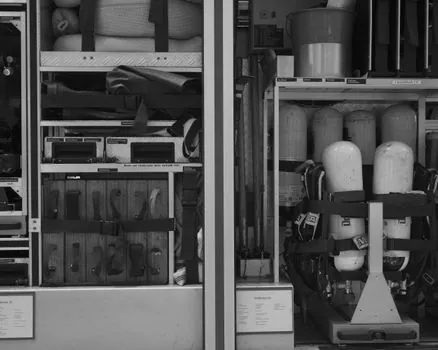
Wall-mount steel cabinets (typical 16 x 23.5 x 6.5 in. Large Industrial, 15.5 x 10.5 x 5.875 in. Small Industrial) hold 200-800 individual pieces and survive forklift-bay abuse, with baked-enamel steel, full-length hinges, and a center latch for tamper resistance [S1][S4].
Portable hardshell zipper cases (roughly 25-person capacity, OSHA 1910.151(b) compliant) weigh a few pounds, fit in a forklift seatbox, and support grab-and-go response to picking-cart or mezzanine incidents [S5]. A third format, soft-sided 25-person pouches, is standard for fleet vehicles and supervisor trucks, which matters when OSHA's "readily available" duty extends into parking lots and delivery bays [S2][S5].
Class B vs Class A Contents Compared
On four decision criteria, Class B outperforms Class A for warehouse duty: (1) severe bleeding control, where Class B mandates a tourniquet and Class A does not; (2) burn care, with Class B requiring more hydrogel dressings and a larger burn dressing; (3) eye contamination, requiring a larger eye-wash volume per kit; and (4) fracture and splinting support, with Class B adding a splint and a 4 x 4 in. cold pack [S6]. A Class A Large Industrial 4-shelf still carries 786 pieces including 100 strip bandages, 75 sterile gauze pads, 2 sterile 4 oz. eye-wash bottles, 25 burn-gel packets, 6 pairs of nitrile gloves, and 50 packets of OTC analgesics, but it does not include the tourniquet and trauma dressing that a powered-conveyor warehouse should carry [S1][S6].
Specialized Hazard Overlays: OTC Meds, AED, and Body Fluid Spill
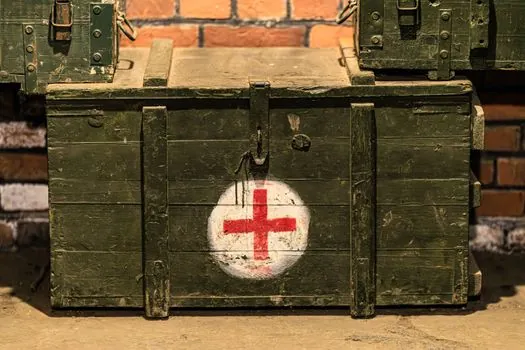
OTC medication inclusion is a site-policy decision: a Class A fill with OTC adds 50 packets each of acetaminophen, antacid, and decongestant tablets, useful for heat-stress complaints in non-climate-controlled loading docks, while a "no medications" fill removes all tablet packets for sites that ban internal medicines [S1][S4].
AEDs are not part of ANSI/ISEA Z308.1, but warehouse service vendors now bundle them with first-aid programs because OSHA General Duty Clause citations have been issued on sites where a worker collapsed and no defibrillator was within 3 minutes [S2]. Pair the kit with a body-fluid spill kit, a first aid kit refill subscription, and a posted inspection log to keep consumables in date; ANSI Z308.1 mandates that kits be checked regularly and that expired or used items be replaced promptly, which most sites fail at audit [S1][S6].
Where the Standard Falls Short
ANSI/ISEA Z308.1 is a contents-and-quantities floor, not a station-planning standard: it does not specify how many kits a 200,000 sq ft DC needs, where they should be mounted, or how fast responders must reach them, which is why safety managers still apply the 1-per-25-employees or 300 ft walking-distance rule from 1910.151(b) interpretation [S9][S5].
For non-US sites the equivalent is DIN 13157 (small workplace kit, German) or BS 8599-1, which use a low-, medium-, or high-hazard multiplier against headcount; a German DC buying 100-person coverage will therefore need a different fill list than an ANSI Class B kit, even at the same headcount. Specifiers should also confirm that the first aid kit cabinet is food-grade or paint-line-isolated when the warehouse stores consumables, paints, or lithium batteries, since ANSI Z308.1 says nothing about chemical compatibility of the cabinet [S7][S8].
Procurement Specs and 2026 Watch-List

A defensible 2026 purchase order for a mid-size DC should list: kit class (ANSI/ISEA Z308.1 Class B, not Class A), coverage (50-person or 100-person), cabinet (steel, wall-mount, with center latch and door liner), contents (must include tourniquet, 2 x 4 in. burn dressing, 4 oz. eye-wash, 4 x 4 in. cold pack, and nitrile gloves), and inspection cadence (monthly visual, annual full refill) [S6][S9].
Two signals to track into the next two quarters: whether the next Z308.1 revision tightens opioid-overdose response (naloxone) and eye-irrigation volumes for high-rack warehouses, and whether OSHA updates 1910.151(b) guidance to codify a numeric station-spacing rule, since the current 1-per-25-employees rule is guidance, not regulation [S9]. For related cold-storage cabinet selection, see this cold storage aluminum window and door spec path and for lab vs warehouse kit contrast, see ANSI Z308.1, DIN 13157, and hazard class.
For component-level specifications, see dye penetrant kit, and pressure transmitter.