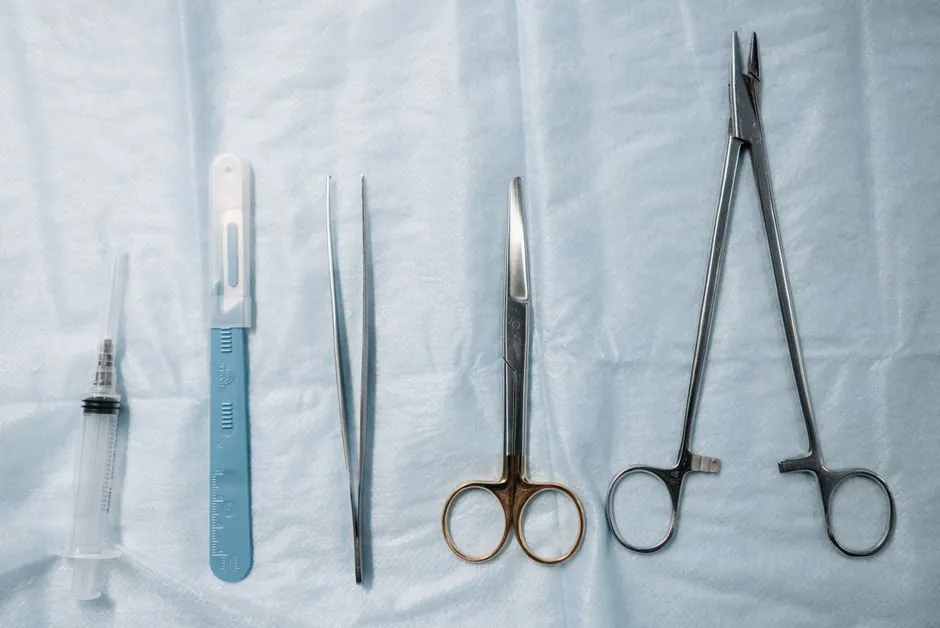
A welder-specific first aid kit is a unitized specialty kit, not a general office kit, because welding hazards concentrate around arc-eye, particulate, and thermal burn injuries. Current North American product lines converge on a 16-unit, 113-114 piece format in either a gasketed metal or gasketed plastic case, with two to three eyewash bottles, six to twelve sterile eye pads, and five to six burn gel packets [S2][S3][S4].
The most common format on the U.S. market is the First Aid Only 253-U/FAO at 9-1/16 in x 6-5/16 in x 2-3/8 in, carrying 25 plastic bandages, 18 BZK antiseptic wipes, 10 antibiotic packs, six 3.5 g burn gel packets, and combined 1 oz of eyewash plus 0.5 oz industrial eye drops [S2][S3][S6][S8]. Canadian workplaces use the parallel CSA Type 2 Welder's Kit priced C$134.50-C$164.95, sized for up to five employees per shift per Ontario WSIB requirements [S5].
Hazard profile drives the contents list
Flash burns, UV arc-eye, spatter, and minor lacerations are the four injury categories every published welder-kit product page lists in the same order [S2][S3][S4][S6]. Vendors therefore weight the contents toward eye and burn care: the F40-383 ships 4 sterile eye pads, three 0.5 oz eyewash bottles, five 0.125 oz burn gel packets, one 4 in x 4 in burn dressing, and one 0.5 oz tube of Foille burn ointment as the burn-active component [S4].
The 16-unit 253-U/FAO ships six 3.5 g burn gel packs, two sterile eye pads, 0.5 oz eyewash, and 0.5 oz industrial eye drops, with the eyewash and drops bundled because welder's flash requires both flushing and lubricating the cornea [S2][S3]. Compared with a general-purpose unitized kit, a welder's kit typically carries 2-3x the burn gel and double the sterile eye pads per unit of weight [S3][S4].
Unit count, headcount, and the ANSI/CSA regulatory anchor
The "16-unit" label is not a marketing figure, it ties to the ANSI/ISEA Z308.1 minimum fill for a Type II 16-unit industrial kit, where each "unit" is a single-use module so the kit can be restocked unit-by-unit after an incident [S2][S3][S4][S8]. The F40-383 product page explicitly states the contents "exceed OSHA minimum recommendations" for indoor welding sites and welding vehicles at remote locations, with a 10 in x 7 in x 3 in 16P plastic gasketed cabinet [S4].
On the Canadian side, the CSA Type 2 Welder's Kit is built to CSA Z1220 Type 2 work-occupied medium-risk environments and is described as meeting and exceeding the Ontario Workplace Safety and Insurance Board (WSIB) requirement for workplaces with up to five employees per shift [S5]. For shop-floor sizing, a common rule is one 16-unit welder's kit per 5-25 welders per shift depending on travel distance to medical aid, with a second kit mandatory on each mobile welding truck or remote job box [S4][S7].
Container selection: metal vs plastic vs soft pouch

Three container classes are commercially available for welder's kits, and the choice is driven by the worksite, not the contents. The 255-U ships a gasketed metal case, the 253-U/FAO ships a gasketed plastic case, and the French Mondial Extincteur 2/4-person kit ships a fluorescent blue EVA soft pouch with retro-reflective cross, weighing 355 g at 215 x 135 x 60 mm [S1][S2][S3][S6][S8].
Steel-cabinet welder's kits (255-U) are specified for fixed fabrication bays where sparks and spatter would melt or puncture a plastic case; plastic-cased kits (253-U/FAO, F40-383) win on weight (about 0.75 lb / 0.34 kg for the 16-unit plastic unit) and corrosion resistance for shipyard or offshore deck use; the EVA soft pouch is built for one or two mobile welders and clips to a belt [S1][S2][S3][S4]. Norsemen Safety's UK welding-safety guidance also flags burn and electric-shock incidents as the recurring non-eye injury types, which is why any field kit still needs scissors, forceps, and a foil survival blanket even when the container is a soft pouch [S1][S7].
Options compared: 253-U/FAO vs F40-383 vs CSA Type 2
Three of the most-stocked SKUs line up cleanly on four decision criteria, which is the table an inventory buyer actually needs:
253-U/FAO (plastic, U.S.): 16 units, 114 pieces, 9.06 x 6.31 x 2.38 in, ANSI Z308.1 Type II fill, $59-$69 [S3][S6][S8].
255-U (metal, U.S.): 16 units, 113 pieces, same footprint, ANSI Z308.1 Type II fill, intended for fixed-cell heavy fabrication [S2].
F40-383 (plastic, U.S.): heavier on eye/burn content (4 eye pads, 3 x 0.5 oz eyewash, 5 burn gel + 4 in x 4 in burn dressing + Foille ointment), 10 x 7 x 3 in 16P cabinet, $37.78 [S4].
CSA Type 2 Welder's Kit (plastic, Canada): CSA Z1220 Type 2 rated, sized for up to 5 employees per shift per Ontario WSIB, C$134.50-C$164.95, flash-burn and spark focus [S5].
For U.S. mobile welding, the F40-383 gives the most burn and eye care per dollar; for U.S. fixed fabrication with high spatter, the metal 255-U is the safer container pick; for Canadian Ontario sites, only the CSA Type 2 SKU satisfies the WSIB auditor's checklist [S2][S4][S5].
What a welder's kit is NOT, and common over-spec mistakes
A welder's kit is not a substitute for an arc-flash PPE set, a respirator program, or a fire watch, and it should not be confused with the welder's PPE kit that the Strong Arm Welding 2026-04-17 guidance reminds buyers is the protective-gear kit, not the post-injury treatment kit [S9]. A welder's first aid kit treats what happens after the PPE failed or the spatter got past the gauntlet.
Two over-spec traps recur in 2026 procurement. First, buying a generic 50-person office kit and assuming it covers welding: the typical office kit carries almost no burn gel and rarely any sterile eye pads, which is the opposite ratio welding injuries demand [S4][S5]. Second, ignoring the container rating: a paper-cardboard or soft pouch kit will be destroyed by spatter inside a week in a fabrication bay, so specifying only the contents without the case class is a common audit finding [S1][S2][S4]. Buyers handling multi-trade sites should also confirm that the kit's burn and eye content is not duplicated in a site's standalone burn or eye-wash stations, otherwise the first aid kit becomes a redundant refill shelf [S5].
Standards, sourcing, and what to verify on the datasheet
The applicable documents are ANSI/ISEA Z308.1 for U.S. unitized kits and the CSA Z1220 series for Canadian Type 2 kits; both are referenced by the OEM datasheets cited above [S2][S3][S4][S5][S8]. OSHA 1910.151 governing workplace first aid is the U.S. federal anchor that the F40-383 product copy explicitly cites as the standard its fill "exceeds" [S4]. Buyers should also check the eyewash bottle integrity date, the burn gel expiry (typically 2-3 years from manufacture), and the cabinet gasket condition at every monthly inspection [S3][S4][S8].
Trackable signals for the next purchasing cycle: the 253-U/FAO is currently in restricted supply at multiple U.S. For sites standardizing across both U.S. and Canadian operations, the construction site first aid kit spec map lays out the same ANSI class/container logic for the non-welding trades that share the same shop floor.
The underlying component specifications are covered under welding cutting tool, and dye penetrant kit.