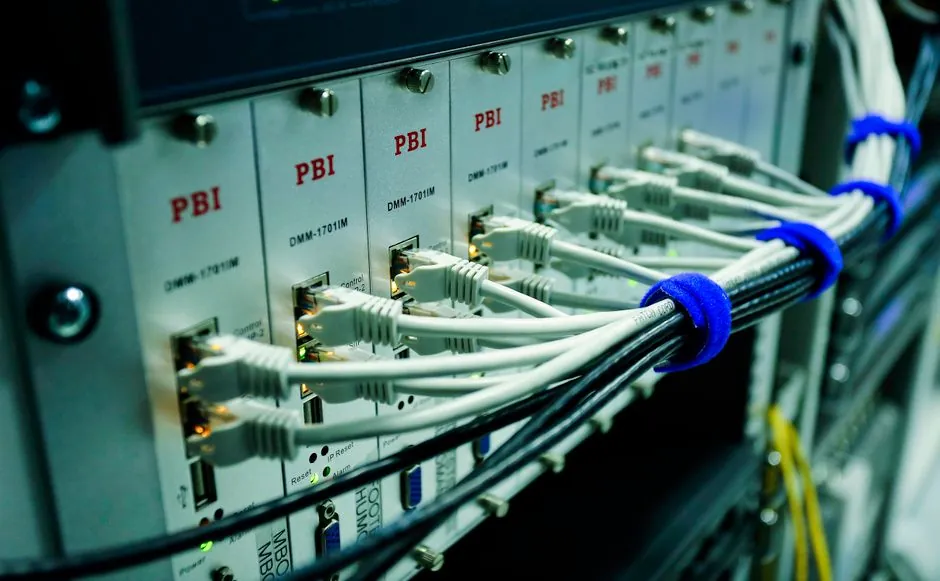
A preaction system may be used where accidental water discharge would be costly, with either a single-interlock or double-interlock arrangement selected according to the design.
A wet-pipe system remains the lower-cost option when the room is heated, accidental discharge is acceptable and minimizing the number of components in the release path is the priority.
How wet pipe and preaction release paths differ
A wet-pipe system holds pressurized water in the sprinkler piping at all times, so an operating sprinkler discharges immediately without a detection-controlled valve sequence [S1]. That makes it the simpler arrangement for heated occupancies with low freeze risk [S1][S5].
A preaction system keeps water out of the network until a defined release condition occurs. In a single-interlock arrangement, detection opens the valve and fills the pipe, while individual sprinkler heads remain closed until heat actuates them [S2][S5]. A double-interlock arrangement requires both a detection event and loss of pipe pressure caused by an operating sprinkler before the valve admits water [S2][S5].
The decisive difference is therefore not simply wet versus dry piping. Preaction is a family of arrangements, and the interlock selection determines whether a false detection puts water above equipment or leaves the network dry [S2][S5].
Decision criteria for a server room
Start with five project criteria: heat exposure, consequences of unintended water, equipment value and criticality, installation conditions and maintenance capacity [S1]. A server room is heated, so freezing does not by itself justify dry pipe. The stronger issue is whether a pipe leak, valve event or erroneous actuation could interrupt valuable information technology equipment.
Single interlock provides early warning and valve actuation, but a false detection can fill the pipe while closed sprinklers prevent discharge [S2]. Under a double-interlock arrangement, both a detection event and a loss of pipe pressure caused by a sprinkler operating are required before the valve admits water. The cost is additional supervision, testing and restoration work because every added component must remain functional [S5].
For high-value servers, archives, museums and telecommunications rooms, preaction is commonly identified as the better fit when accidental discharge would be costly [S1][S2]. For an ordinary server room without unusually sensitive equipment, that benefit may not justify the control complexity.
Comparison across reliability, water exposure and cost
Wet pipe wins on release-path simplicity because water is already in the pipe and sprinkler operation directly initiates discharge [S1]. It also carries a lower installation cost and lower maintenance burden than a preaction system for comparable electrical-room applications [S4]. Its disadvantages are constant water exposure in the piping and limited tolerance for a space where accidental discharge would damage critical assets [S1][S4].
Double-interlock preaction wins on minimizing unintended water entry because detection and an open sprinkler are both required [S2][S5]. It is less attractive on component count, test complexity and lifecycle maintenance because the detection, supervisory and releasing functions become part of the operational chain [S5].
Single interlock occupies the middle ground. It admits water after detection, so a false alarm can leave pressurized water above equipment even if no sprinkler opens [S2]. It offers less false-discharge protection than double interlock but usually requires fewer release conditions [S2].
Where wet pipe remains defensible
Wet pipe is appropriate when the room is conditioned, freeze exposure is absent and the hazard analysis does not identify inadvertent discharge as a dominant risk [S5]. The choice between preaction and wet pipe for an electrical room is a design preference, with preaction adding complexity and maintenance costs and wet pipe generally being less expensive to install.
Wet pipe should not be rejected merely because the room contains servers. The design team must establish the actual equipment exposure and water sensitivity rather than treating every server room as equivalent [S4]. If protection can be omitted because of the room construction and occupancy arrangement, that question should be resolved before selecting either system, with NFPA 13 (2025) section 9.2.6 cited for the omission discussion [S4].
Wet pipe is a poorer fit where concealed piping leakage could reach energized equipment, where uptime consequences are severe or where the owner requires a controlled release path [S1][S4]. The choice should be documented against equipment sensitivity, drainage, room construction and service impacts rather than installation cost alone [S4].
Maintenance, testing and impairment risks

Every step beyond wet pipe adds components that must be supervised, tested, maintained and restored correctly after work [S5]. A closed valve, isolated detection zone or unavailable air compressor can leave the installation operating differently from its drawings [S5]. Preaction therefore requires an impairment procedure that covers more than the sprinkler piping itself.
Double interlock also creates a dependency between detection and sprinkler operation. If detection is part of the release path and fails to act, an operated sprinkler has no water behind it [S5]. Test procedures should therefore verify the complete sequence: detection signal, supervisory condition, valve response, sprinkler operation, water admission and restoration after reset.
The preaction valve and riser arrangement also need attention during design. Drainage for the preaction riser is an issue that can be overlooked [S4].
Alignment with code, insurer and authority
The final system selection must satisfy NFPA requirements, listing and approval criteria, insurance expectations and direction from the authority having jurisdiction [S1]. For server rooms, preaction and wet pipe can both be code-compliant when designed and installed correctly, so compliance alone does not determine the preferred arrangement [S4].
Insurers and facility owners may impose requirements beyond the minimum code path, particularly for high-value equipment or business-continuity-critical sites [S1]. The engineering record should compare the selected arrangement against the equipment loss scenario, inspection scope, testing frequency, available service capacity and consequence of a false detection.
Clean-agent systems should be evaluated as a separate layer rather than assumed to replace sprinklers. A clean agent targets early suppression in an enclosed space without leaving water or residue, while sprinklers address the life-safety and structural consequences of a developed fire; the interaction between both layers must be designed deliberately [S5].
Practical selection method

Use a server-room decision test. If the space is heated, freeze risk is low, equipment tolerates water exposure and rapid direct discharge has priority, specify wet pipe. If an unintended release could disable critical equipment, specify preaction, with double interlock where the added certainty justifies the extra supervision and maintenance [S1][S2][S5].
Document the selected release sequence, including how many events are required before water enters the pipe. Single interlock uses detection plus an operating sprinkler for discharge; double interlock requires detection and pressure loss before water admission, which makes the trade explicit as speed versus certainty [S2][S5].
Track 2 signals before approval: the equipment water-sensitivity assessment and the owner's impairment, testing and maintenance capacity. If either is unresolved, do not finalize the system, because one controls the probability of unwanted discharge while the other controls whether the protection remains dependable.