
AAC blocks leave the factory cut to millimetre accuracy, so every course above the first is set on a 2–3 mm thin-bed adhesive joint, but the first course alone is bedded on a 10–30 mm conventional cement-sand mortar layer over the damp-proof course, because that thicker bed is the only joint with enough body to swallow slab or beam level errors before they travel upward [S1][S2].
An AAC wall is never truer than its first course, and a thin 2–3 mm bed has no thickness in which to hide a placement mistake; the entire plumb and level of the finished wall is set in those first 10–30 mm, after which a notched scoop trowel (4–6 mm notch) takes over for every course above [S2].
Slab Tolerances vs Thin-Bed Reality
Concrete slabs and beams are typically cast to a tolerance of roughly ±10 mm over a room bay, and AAC blocks arrive with factory dimensional accuracy in the ±1–2 mm range; a thin-bed joint cannot absorb that delta, so the thick leveling bed exists specifically to convert an out-of-level substrate into a level line for everything stacked on top of it [S2].
Field practice is to set the two end blocks of the first course with a spirit level in both axes, stretch a string line between them, fill the course to that line, then allow the bed to set for at least 12 hours before any subsequent course is loaded; laying onto a soft bed shifts the alignment just paid for and propagates the error through every course [S2]. The first course is also the only place a conventional sand-cement mortar is allowed; thin-bed AAC adhesive above the leveling bed replaces roughly 80% of the cement-sand volume of a comparable brick wall, dropping mortar consumption to about one-fifth of conventional practice for the same square metre of wall [S2].
Why Thin-Bed Mortar Cannot Do the Same Job
Thin-bed AAC adhesive is a factory-produced, pre-mixed cementitious jointing mortar containing fine aggregates and chemical additives that is designed to perform in joints of around 2–3 mm rather than the 10–20 mm typical of conventional mortar, with its formulation tuned to deliver adequate adhesion, workability, water retention and strength at that reduced thickness [S3][S4].
Thin joints also preserve the thermal performance of the AAC leaf because conventional cement-sand mortar is a conductive bridge slicing the block's insulation roughly every 20 cm, and replacing a 10–20 mm conventional bed with a 2–3 mm thin bed cuts both the size of that bridge and mortar consumption to around one fifth of that of a conventional bed [S2][S3]. For the same reason, the bed joint below the first course cannot be thin, because the damp-proof course below the wall already interrupts that thermal plane, and the 10–30 mm cement-sand bed is acknowledged in the thermal calculation as a single, defined, sacrificial thermal bridge at floor level rather than a repeating one every course [S2].
What Goes Wrong If the First Course Is Skipped or Done Wrong

An unlevelled first course is the single most common defect in AAC blockwork, and the failure mode is cumulative: a 3 mm error at course one becomes a 9 mm deviation at course three and a visible step joint by the time plastering starts, at which point the wall is already locked in [S1][S2]. Common first-course mistakes documented across field guides include building on the first course before its bed has set (the hour of leveling just done shifts under the next course's weight), wedging the wall head tight to the soffit with no 15–20 mm compressible gap (beams deflect under creep and bear on the wall), and substituting standard sand-cement mortar for thin-bed adhesive above the leveling course (defeats the thermal and accuracy gains that justify AAC) [S1][S2].
The first-course bed is also the integration point for ancillary details that have nowhere else to live: flexible metal ties to concrete columns every two to three courses (about 60 cm), bed-joint reinforcement (two bars or ladder mesh) extending at least 50 cm past each side of any window opening, and proprietary or cast lintels bearing 20–25 cm at each end; sill corners are statistically the first place AAC walls crack if the first-course bed and the courses above it are not leveled together [S2].
Comparison: Thick-Bed First Course vs Thin-Bed Courses Above
The two joint types are not interchangeable, and the table below lines up the decision criteria a spec writer or site engineer actually weighs when sequencing an AAC wall. [S1]
Joint thickness: thick-bed first course is 10–30 mm conventional cement-sand mortar; thin-bed above is 2–3 mm AAC adhesive applied with a 4–6 mm notched scoop trowel [S1][S2]. Tolerance absorption: thick-bed absorbs roughly ±10 mm of slab or beam level error in a single course; thin-bed assumes substrate is already within ±1–2 mm and has no capacity to level [S2]. Thermal contribution: thick-bed is a single defined thermal bridge at floor level, accepted in the wall U-value calc; thin-bed cuts repeating thermal bridges by 70–85% versus a 10–15 mm conventional joint, and is a primary reason AAC walls hit their designed R-value [S2][S4]. Mortar consumption: thick-bed uses one full conventional mortar volume across a small area (one course only); thin-bed reduces total wall mortar volume to roughly one-fifth of an equivalent brick wall, with the corresponding drop in site-batched cement, sand, water and handling [S2][S3]. Set time before next course: thick-bed first course needs about 12 hours to firm up before any second-course loading; thin-bed courses are typically laid course-on-course in the same shift once the line is established [S2].
Standards, Density and Material Context
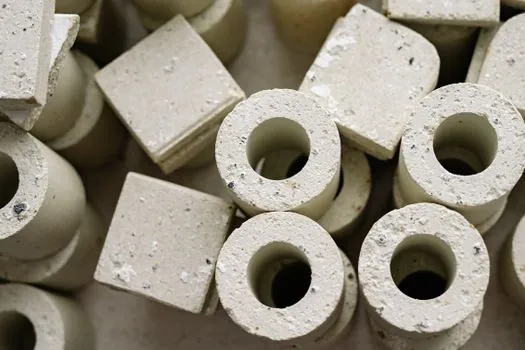
AAC is roughly one-fifth the density of normal concrete but retains about half its bearing strength, and loadbearing AAC blockwork is documented up to three storeys in Australian reference data; the Australian Standard AS 3700-2018 (Masonry structures) and AS 5146.2:2018 (Reinforced autoclaved aerated concrete design) cover RAAC block and panel design where reinforcement is added for structural purposes [S5].
AAC was first produced in Australia in 1990 and in Europe since the 1920s; the market remains dominated by one Australian manufacturer, and AAC blocks are typically supplied as one of several density grades that trade off thermal insulation against compressive strength, with the block density grade and fire-resistance rating required to be confirmed at design stage rather than resolved on-site [S1][S5]. For WUI (Wildland-Urban Interface) construction in California, AAC products classified as noncombustible under ASTM E136 can support compliance with fire-resistive wall assemblies, but project-specific acceptance depends on the full wall assembly, the jurisdiction and the Authority Having Jurisdiction [S1].
Site Practice and What to Verify Before Laying Course Two
Before any second-course block is placed, the first-course bed should be checked for level along its full length (not just at the ends), the corner blocks verified in all three planes, the bed confirmed set for at least 12 hours, and the surface brushed free of cutting dust because sawing dust is the same bonding enemy on the first course as on every course above [S1][S2].
For related background on how bed joint geometry affects material performance in other building systems, see the spec-driven comparison of strapping materials by joint and strength criteria, and for the broader masonry-joining context the dry-mortar reference entry covers the factory-premixed mortar category that thin-bed AAC adhesive belongs to. The reference page on AAC blocks summarises the material properties this jointing sequence is designed to exploit.
Spec-level background on the components involved: first aid kit.