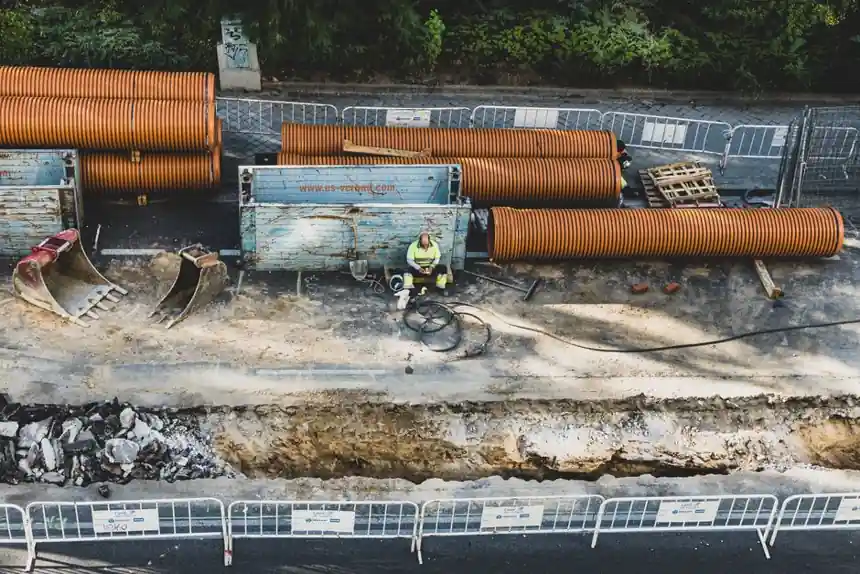
California's Department of Transportation has directed that corrugated plastic duct be used in all post-tensioning systems for internal tendons except where steel pipe is explicitly required, a 2025 policy that formalises a decade-long drift away from galvanized metal sheathing [S1].
The driver is not strength; steel still beats HDPE on radial stiffness, fire endurance, and measured bond capacity in pull-out tests. The driver is whole-life durability, friction, and constructability on curved tendon profiles, three factors that have quietly tilted bridge and segmental-viaduct specifications toward plastic since roughly 2018.
What Each Duct Type Actually Does Inside a Bonded Tendon
A corrugated sheathing duct forms the void through which prestressing strands are pushed, tensioned, and then pressure-grouted to create a bonded tendon inside structural concrete [S3]. The duct has to survive handling, concrete placement, strand insertion at pressures that can exceed several hundred bar at the jack, and a final grout injection that must fully encapsulate every strand without leaving voids.
Galvanized steel strip, rolled into a corrugated profile, has been the default sheathing since the 1960s because the corrugations give axial flexibility for curved profiles while the steel ring section resists concrete-placement collapse [S2]. HDPE takes the same corrugated geometry but trades the metal for a thermoplastic that is chemically inert to grout, chloride, and the alkaline pore water of concrete.
The Trade-off Matrix: Steel vs HDPE on Six Decision Criteria
Comparing the two options against a fixed set of criteria makes the specifier's call clearer than reading either material's marketing sheet. On radial stiffness and impact resistance during concrete pours, galvanized steel wins; corrugated metal ducts "possess superior resistance to compression, impact, and deformation" and are preferred for long-span bridges, heavy industrial slabs, and high-rise foundation beams [S2].
On corrosion resistance, HDPE wins decisively. The metal sheathing relies on a zinc galvanic coating that can be breached during handling, after which marine exposure, de-icing salts, chemical-plant atmosphere, or stray currents initiate tendon corrosion [S2][S3]. On friction losses, HDPE wins because its inner wall is smoother than a corrugated steel strip, which directly reduces the wobble-friction coefficient used in tendon elongation calculations [S2]. On fire endurance, steel wins, since HDPE softens and melts well below fire-exposure temperatures while a metal duct "will not melt or lose its load-bearing capacity" and preserves the strand channel during a fire event [S2].
On bond to grout, the data is more nuanced. ASCE pull-out testing found that corrugated galvanized steel ducts delivered better anchorage than corrugated HDPE ducts, and that rigid steel pipe performed worst of all in the same test series [S5]. That result is the single strongest published case for keeping metal on bond-critical tendons. On constructability, HDPE wins for curved segmental layouts because it ships in long coils, can be bent to small radii without special fittings, and weighs roughly an order of magnitude less per metre than galvanized steel strip ducting.
Why Caltrans and Similar Owners Are Pushing the Switch
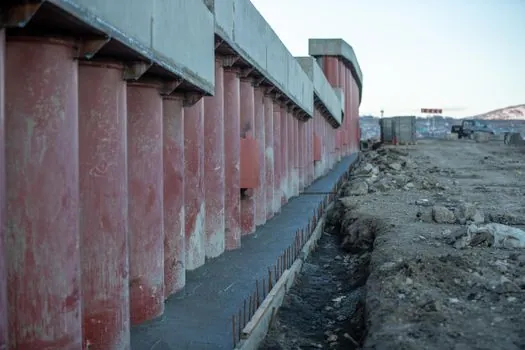
Caltrans Preliminary Investigation PI-0355, released December 29, 2025, catalogues a national-and-international survey of practice and concludes with the directive to default to corrugated plastic duct for internal tendons unless steel pipe is specifically required [S1]. The investigation frames plastic as the safer baseline because tendon corrosion, not duct crushing, has been the dominant failure mode in serviceability problems on segmental box girders and cable-stay anchorages over the last twenty years.
HDPE also supports better grouting. A smooth, sealed plastic duct reduces the chance of grout leakage at splice sleeves, and its chemical inertness means no galvanic cell forms between the duct wall and the grout or the strand, a failure mechanism that has shown up in forensic examinations of corroded internal tendons in marine bridge environments [S2]. On the install side, the lower mass cuts crane time, and the long coil lengths reduce the number of coupler splices per run, which is exactly where the leak paths live.
For pre-tensioning, the comparison is different and metal still dominates because the strand is pulled against the duct before concrete is placed, so any HDPE softening under heat of hydration becomes a concern. The shift to HDPE is concentrated in post-tensioned, bonded, internal tendons, especially curved segmental layouts, which is why [S1] narrows the policy to "all post-tensioning systems used for all internal tendons" rather than the entire prestressing market.
Where Steel Duct Still Has to Stay
Fire-rated structures, aggressive impact zones, and any tendon where the designer is relying on mechanical interlock between the duct wall and the surrounding concrete are the three situations where steel sheathing is still specified [S2][S5]. Long-span bridge piers, anchorage blisters, and any tendon passing through a structural element with a fire-resistance rating above two hours typically retain galvanized steel or, in extreme cases, rigid steel pipe.
Engineers specifying HDPE for those cases should also note the bond penalty flagged in the ASCE study and account for it in development length and anchorage-zone reinforcement [S5]. For the majority of curved, internal, post-tensioned tendons in bridges, tanks, and slabs, however, the corrosion and friction wins outweigh the bond and fire penalties, which is the calculation Caltrans has now made explicit in writing [S1].
For specifiers comparing duct material to other reinforcement decisions, the same whole-life logic shows up in stainless band selection for pole mounts, where grade 316 is the equivalent of HDPE, picked for chloride resistance rather than raw strength. Tendon stressing geometry is the other lever: where long tendons must be stressed from both ends to control friction losses, HDPE's lower wobble coefficient directly reduces the force imbalance the jacks have to compensate for, a topic covered in the post-tensioning stressing guide for long tendons. And on the rebar side, the bar bender vs steel fixer trade split parallels the duct debate: a single crew trained on plastic duct couplers can usually install HDPE faster than a steel-duct crew, but the steel crew is still required at anchorages and fire-rated zones.
Limits, Open Questions, and Trackable Signals

Two open questions will determine how far the HDPE transition goes. First, long-term bond durability under cyclic loading: the ASCE bond study is the most cited reference and dates to a 2008 publication, predating many of the current HDPE resin grades and coupler systems [S5]. A modern round of pull-out and fatigue tests on current-generation HDPE would either confirm or qualify the bond penalty. Second, fire-endurance qualification: there is no widely cited UL or ASTM fire-endurance rating for bonded HDPE-duct tendons, so engineers specifying HDPE in fire-rated members still have to fall back on prescriptive detail or a project-specific fire test.
Trackable signals over the next 12-24 months: any update to the AASHTO LRFD Bridge Design Specification post-tensioning provisions; the final Caltrans specification language that follows from PI-0355; and any published forensic report on HDPE-duct tendons that have been in service for 15-20 years, which is the cohort now entering the window where early corrosion failures on galvanized steel sheathing historically first appeared.
Detailed specification references: alloy steel, carbon steel, and silicon steel.